
Ensuring Reliable Digital Payments Through AI-Driven Monitoring in BFSI
In this blog, we will learn about ensuring reliable digital payments through AI-Driven Monitoring in BFSI.
Introduction
The financial services industry is experiencing a major shift as digital payment channels become the preferred choice for consumers and businesses alike. From UPI transactions and mobile banking to digital wallets and instant fund transfers, customers now expect payment services to be available anytime, anywhere, with minimal delays. In this environment, maintaining the performance and reliability of payment systems is critical for banks and financial institutions.
A single transaction failure or service disruption can negatively impact customer confidence, affect business revenue, and create operational challenges. As digital transaction volumes continue to grow, organizations require intelligent monitoring solutions that can identify issues before they affect end users and business operations.
Challenges in Modern Payment Ecosystems
Today’s payment infrastructure consists of multiple interconnected technologies working together in real time. A transaction often passes through mobile applications, APIs, payment processors, databases, cloud platforms, and core banking systems before completion. This interconnected architecture introduces several monitoring challenges.
Common issues faced by BFSI organizations include:
- Increased response times during periods of heavy transaction activity
- Payment failures caused by external service providers or third-party integrations
- Limited visibility into the complete transaction lifecycle
- Difficulty identifying the source of performance bottlenecks
- Longer troubleshooting and recovery times
- Managing performance across hybrid and cloud-native environments
Traditional monitoring approaches typically focus on individual infrastructure components, making it difficult to understand how issues in one service affect the overall transaction experience.
How AI-Powered Monitoring Makes a Difference
AI-powered observability platforms provide a smarter way to monitor complex payment environments. Instead of relying solely on predefined alerts and manual investigations, these solutions continuously analyze application behavior, infrastructure performance, and transaction flows to identify unusual patterns automatically.
Advanced monitoring platforms can deliver:
- Complete visibility into every transaction from start to finish
- Automatic discovery of applications, services, and dependencies
- Intelligent detection of performance anomalies
- Faster identification of underlying issues
- Real-time alerts for potential service disruptions
- Insights into application and infrastructure health from a single dashboard
By leveraging artificial intelligence and automation, organizations can move from reactive troubleshooting to proactive performance management.
Practical Scenario
Imagine a situation where a payment gateway integrated with a banking application begins responding slowly during a peak transaction period. Customers may experience delays while making payments, checking balances, or transferring funds.
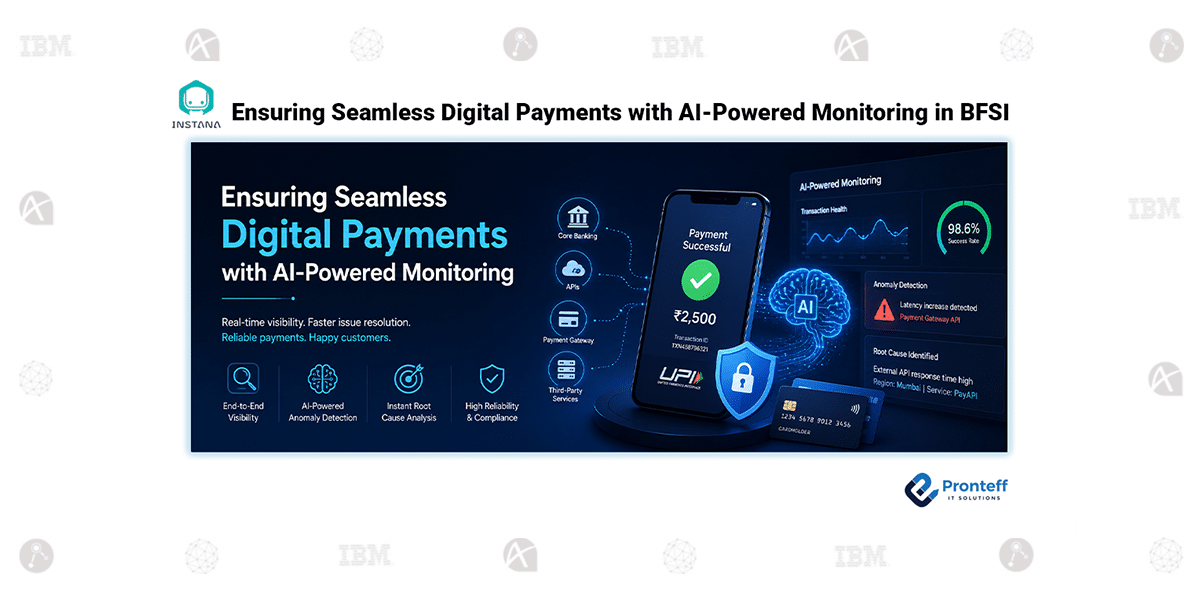
An AI-driven monitoring solution can immediately recognize abnormal response times, trace affected transactions across multiple systems, and pinpoint the exact component responsible for the slowdown. Operations teams receive detailed insights within moments, allowing them to resolve the issue before it escalates into a widespread service outage.
This level of visibility significantly reduces the time spent diagnosing problems and helps maintain uninterrupted digital payment services.
Benefits for Financial Institutions
Implementing AI-powered monitoring offers several advantages for BFSI organizations:
- Higher transaction success rates
- Improved application availability and reliability
- Better customer experiences through faster service delivery
- Reduced operational disruptions and downtime
- Quicker detection and resolution of incidents
- Enhanced compliance with service-level commitments
- Greater efficiency for IT and operations teams
These benefits contribute directly to stronger customer trust and improved business performance.
Conclusion
As digital payment ecosystems become increasingly sophisticated, financial institutions need more than conventional monitoring tools to maintain service excellence. AI-powered monitoring enables organizations to gain comprehensive visibility into their payment infrastructure, detect issues proactively, and resolve problems faster.
By adopting intelligent observability solutions, BFSI organizations can ensure consistent transaction performance, strengthen operational resilience, and deliver the seamless digital experiences that modern customers expect. In an era where every second matters, AI-driven monitoring has become an essential component of successful digital payment operations.