
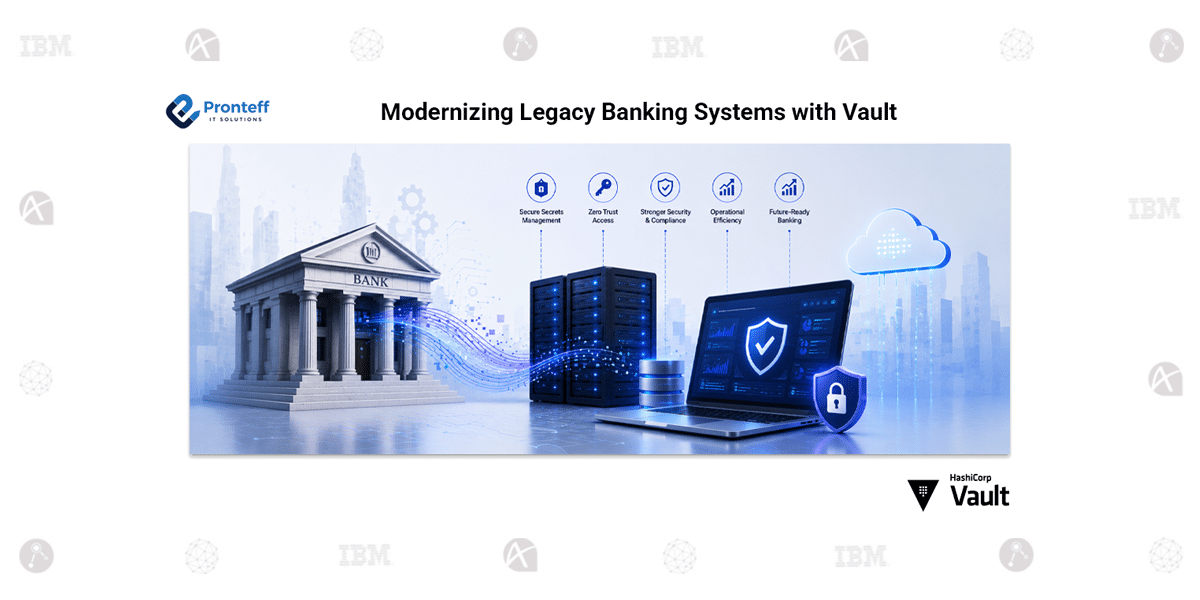
Modernizing Legacy Banking Systems with Vault
In this blog, we will learn how to modernize legacy banking systems with Vault.
Legacy banking systems continue to support mission-critical operations across Banking, Financial Services, and Insurance (BFSI) institutions. For many years, these platforms have supported essential banking operations, managing activities such as financial transactions, customer information, payment processing, and other core banking services.. However, as the financial industry rapidly embraces digital banking, open APIs, cloud adoption, and mobile-first customer experiences, legacy environments often struggle to meet modern security, scalability, and compliance requirements. Without proper security controls, these systems can expose organizations to significant risks. HashiCorp Vault provides a secure and efficient way for banks to modernize legacy infrastructure without disrupting essential business operations.
The Hidden Risks in Legacy Environments
Traditional banking applications frequently rely on outdated security practices that can create vulnerabilities across the organization. Common challenges include:
- Hardcoded credentials embedded within applications and scripts
- Limited visibility into who accesses sensitive data and when
- Infrequent or manual credential rotation processes
- Difficulty integrating securely with modern APIs, cloud platforms, and DevSecOps workflows
- Siloed security controls across on-premises and cloud environments
These security gaps increase the likelihood of unauthorized access, insider threats, data breaches, and regulatory non-compliance. For BFSI organizations operating under stringent regulations, such vulnerabilities can result in financial losses, reputational damage, and legal consequences.
Enabling Secure Transformation
Modernizing legacy infrastructure does not necessarily require a complete replacement of existing systems. Instead, organizations can adopt a phased modernization strategy. HashiCorp Vault acts as a centralized secrets management and data protection platform, enabling applications to securely retrieve credentials, certificates, encryption keys, and other sensitive information on demand.By eliminating reliance on static secrets, Vault significantly reduces the attack surface while enabling secure integration between legacy systems and modern cloud-native applications.
Strengthening Security Without Disruption
HashiCorp Vault enhances security and operational resilience through several key capabilities:
- Dynamic credentials that are generated on demand and automatically expire after use
- Encryption as a Service (EaaS) to safeguard sensitive customer and financial data
- Identity-based access controls for secure authentication and authorization
- Centralized audit logging for comprehensive monitoring, traceability, and compliance reporting
- Automated secret rotation to reduce manual effort and improve security hygiene
These capabilities help banks strengthen their security posture while ensuring uninterrupted access to critical services.
Real Business Impact
Organizations integrating Vault into legacy environments can realize substantial business benefits, including:
- Reduced risk of unauthorized access and credential compromise
- Improved adherence to regulatory and compliance requirements
- Accelerated digital transformation and cloud adoption initiatives
- Simplified security management across hybrid and multi-cloud infrastructures
- Enhanced operational efficiency through automation and centralized governance
Conclusion
Modernizing legacy banking systems does not require a disruptive, large-scale overhaul. By adopting a security-first approach, BFSI institutions can evolve their infrastructure safely and efficiently while preserving existing investments. HashiCorp Vault empowers organizations to bridge the gap between legacy systems and modern digital platforms, enabling secure innovation, stronger compliance, and long-term business agility.