
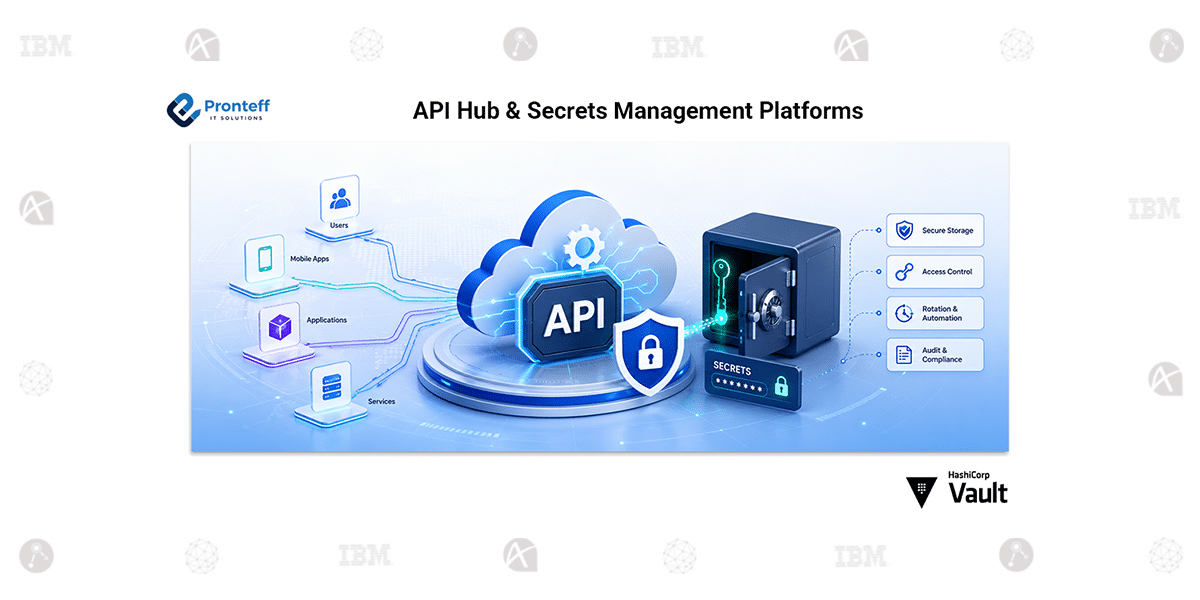
API Hub & Secrets Management PlatformsFor RBI, SEBI – Regulated Co-operative Banks Audit-Ready by Design | IBM API Connect + HashiCorp Vault |
Pronteff IT SolutionsIBM Gold Business Partner IBM API Connect | HashiCorp Vault |
|---|
Co-operative banks — Urban Co-operative Banks (UCBs), District Central Co-operative Banks (DCCBs), and State Co-operative Banks — are at an inflection point. The rapid adoption of UPI, NACH, Account Aggregator frameworks, and FinTech partnerships has dramatically expanded the API surface these institutions must govern and secure. At the same time, RBI’s evolving IT Framework, Cyber Security guidelines, and Digital Lending regulations are raising the bar on what “audit-ready” means — moving well beyond basic authentication into full API lifecycle governance, machine identity control, and cryptographic key separation.
Yet most co-operative banks today lack the specialised tooling to meet these expectations, relying instead on basic gateway configurations and manual credential management that leave critical gaps. This brochure outlines how a purpose-fit IBM API Connect (API Management) paired with IBM HashiCorp Vault (Secrets & Key Management) closes those gaps — reducing regulatory risk, eliminating secrets sprawl, and giving the CISO and IT team audit-ready evidence without rebuilding your core infrastructure.
Platform Capabilities — Quick Wins for CISO & IT Team
| IBM API Connect Full Lifecycle API Management & Governance |
IBM HashiCorp Vault Secrets, Keys & Machine Identity Security |
|---|---|
| End-to-End API Lifecycle Design → Approve → Publish → Retire with full traceability for RBI |
No Hardcoded Credentials Centralised vault — zero static API keys in application code |
| Maker-Checker Workflows No API goes live without multi-role approval; change log auto-maintained |
Dynamic Short-Lived Secrets Credentials auto-expire; breach blast radius reduced to seconds |
| Partner / FinTech Governance Scoped access, throttling & SLAs per partner; self-service onboarding portal |
Encryption-as-a-Service Apps call Vault API; encryption keys are never stored in the application layer |
| Immutable Audit Trails Who published, who accessed, which policy — ready for RBI inspectors |
Key-Data Separation RBI mandates keys not reside with data — Vault enforces this by design |
| Versioning & Deprecation Multiple live versions; consumer notification before any breaking change |
Automated Key Rotation Certificates, DB passwords, and API tokens are rotated on schedule automatically |
| Runtime Security OAuth2, JWT, mTLS, payload schema validation enforced at the gateway |
Full Secret Audit Log Every key access, every secret touch — timestamped and identity-tagged |
RBI Compliance Mapping — Circulars, Requirements & Non-Compliance Risk
| RBI Circular / Framework | Regulatory Requirement | Platform Capability | Risk of Non-Compliance |
|---|---|---|---|
| RBI IT Framework for UCBs (2011 + updates) | Maker-checker for IT changes; controlled API change management | APIM: Approval workflows, lifecycle promotion Dev→UAT→Prod | Audit finding: uncontrolled changes; regulatory penalty |
| RBI Cyber Security Framework (2016 + 2023 advisory) | Immutable audit trails; full access traceability for all systems | APIM: Tamper-proof access logs | Vault: Secret & key audit log | Cannot reconstruct access post-incident = regulatory censure |
| RBI Digital Lending Guidelines (2022) | Secure FinTech API integrations; governed third-party access | APIM: API Products with scoped access, SLAs & throttling per partner | Uncontrolled FinTech API access — data breach & RBI inquiry |
| RBI PA-PG Cyber Security Guidelines | Secure payment API credentials; no hardcoded secrets in systems | Vault: Dynamic secrets; zero static credentials in application code | Credential exposure in payment flows — regulatory action + fraud |
| RBI Outsourcing Guidelines (2023) | Governance of machine-to-machine access for outsourced services | Vault: Short-lived machine secrets | APIM: Scoped partner APIs | Third-party secret sprawl — audit gap, vendor-induced breach |
| RBI Data Localisation (2018 + DPDP Act 2023) | Control plane & audit logs must reside within India | Both platforms: on-prem or SaaS, AWS Mumbai — data stays in India | Cross-border data flow = RBI data localisation violation |
| RBI Key Management (IT Framework §7) | Encryption keys must be separated from data & application layers | Vault: Encryption-as-a-Service; keys never stored in app layer | Keys stored with data = single point of compromise; audit failure |
Flexible Deployment — Your Choice
All options aligned with RBI data localisation & outsourcing guidelines |
Get Audit-Ready in 30 DaysRequest a CISO briefing tailored for your bank — we map your RBI audit gaps to platform controls. Available for UCBs, DCCBs & State Co-operative Banks sales@pronteff.com | (+91) 7013043465 |
|---|