

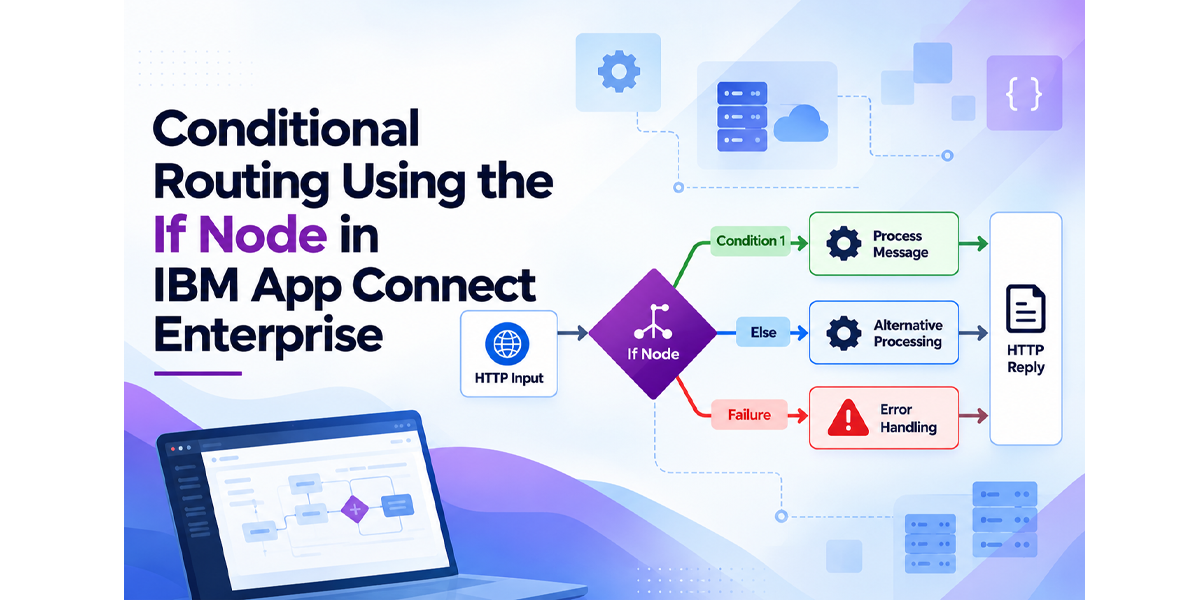
By Avinash Konda · Updated 15 October 2026.
IBM App Connect Enterprise If Node: Conditional Routing That Holds Up in Production
JSONata can make message-flow decisions readable. The harder part is designing what happens when a message matches nothing, arrives in an unexpected shape, or triggers a routing error.
A message reaches an integration flow with a valid HTTP status, a parseable body, and a familiar field. Yet it still takes the wrong path. Sometimes the cause is a condition that no longer reflects the business rule. Sometimes the field is absent, the payload has changed, or an unmatched message quietly follows a path nobody intended.
That is why conditional routing deserves more thought than simply adding a branch. In IBM App Connect Enterprise (ACE), the If node gives a flow an explicit way to route messages according to conditions expressed in JSONata. Its value is not just visual branching; it is making a business decision visible enough to review, test, and operate.
Why a small routing decision becomes an enterprise concern
Imagine an API receiving requests for several product types. A request for one product may need enrichment, another may require a different downstream service, and an unknown product must not be treated as though it were valid. The decision is small, but the consequences are not: a misrouted request can create inconsistent records, unexpected downstream load, or a response that hides the real problem.
In a regulated or high-volume integration, the design needs to answer three separate questions:
- Business decision: which processing path should this message take?
- Contract decision: is the message structurally and semantically valid enough to make that decision?
- Operational decision: what happens when no condition matches or evaluating a condition fails?
The If node primarily addresses the first question. The surrounding flow must deliberately address the other two.
A plain-language mental model of the If node
Think of the If node as a staffed junction. Each named condition represents a sign directing eligible messages to a particular exit. If none of the configured conditions match, the message takes the Else exit. If an error occurs while the node processes the decision, the message can take the Failure terminal.
ACE uses JSONata expressions to define the conditions. Fields can be referenced using schema information associated with the message flow, including a schema discovered through the context tree or one specified in the node’s Map Inputs table. A schema is a useful way to make field selection clearer, but IBM’s ACE 13.0.x documentation also states that the If node can be configured without one. So, schema association is not a universal prerequisite for every If-node design.
Architecture and runtime flow
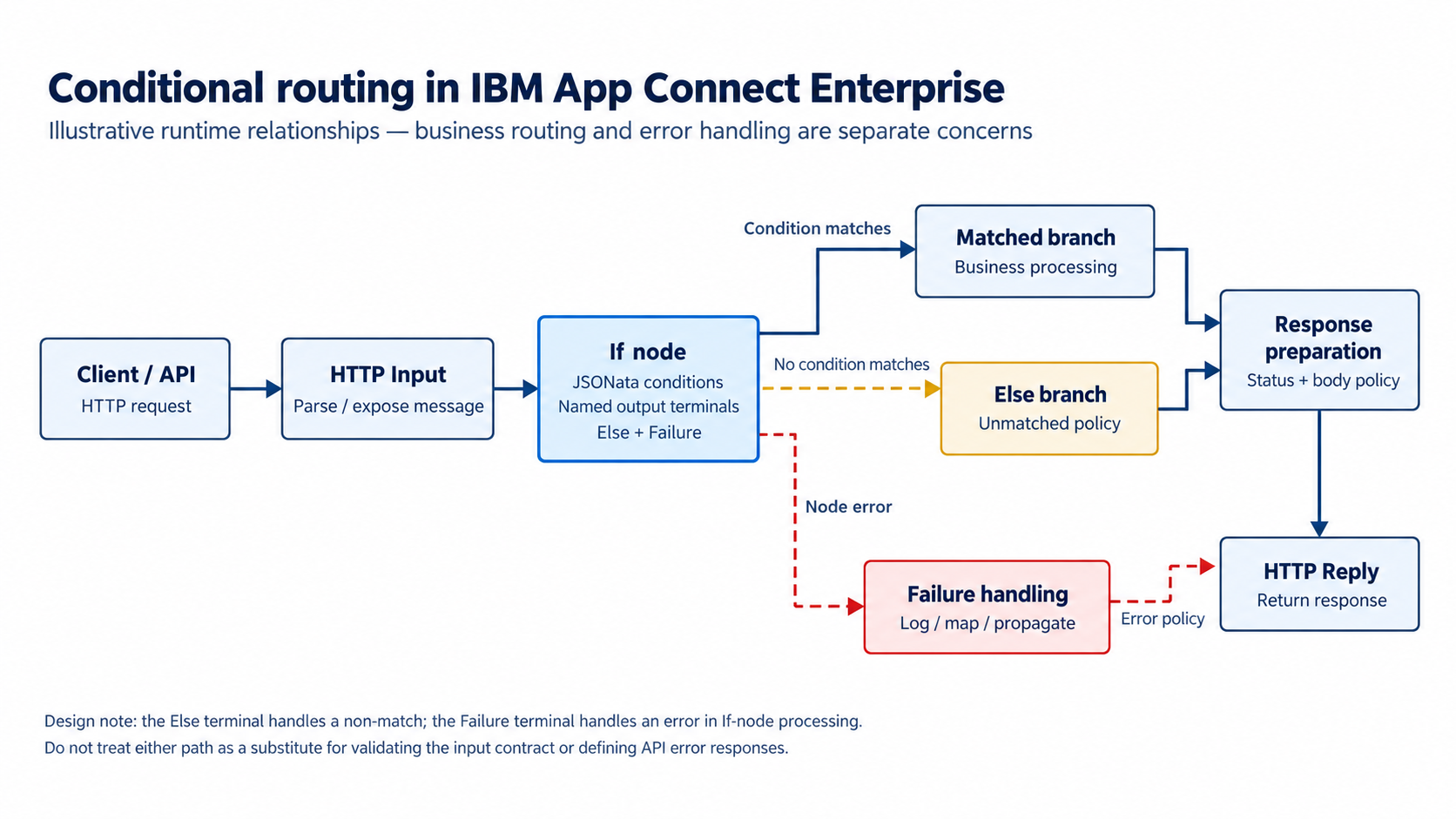
The diagram below shows the decision point in context. The branches are illustrative: an enterprise flow may use different processing nodes, response handling, and error policies depending on the interface contract.
What happens at runtime?
- Receive and parse: the input node accepts the request and exposes its message for downstream processing. The flow should have a clear contract for the expected payload.
- Evaluate the decision: the If node evaluates the configured JSONata conditions against the available message data.
- Propagate to a named terminal: a matching condition sends the message to its associated output terminal.
- Handle the non-match: if no configured condition matches, the Else terminal receives the message. The flow owner must decide whether that means a controlled rejection, a default business process, or another explicit outcome.
- Handle node errors: errors in If-node processing are propagated through Failure. This path should have an intentional exception policy rather than being mistaken for the normal Else route.
- Complete the interaction: downstream processing shapes the response or propagates an exception according to the API’s contract.
IBM’s If node documentation describes the JSONata conditions, named terminals, Else terminal, Failure terminal, and schema options. Confirm the details against the ACE version and deployment model in use before adopting a design.
Choosing the right routing mechanism
The If node is not a universal replacement for every routing construct. Choose based on the expression model, complexity and the behavior required when several rules match.
| Mechanism | Best fit | Design consideration |
|---|---|---|
| If node | Readable conditional branches using JSONata expressions. | Define the meaning of each named terminal, Else and Failure; test the conditions against realistic message variations. |
| Route node | Routing with XPath filter expressions and named output terminals. | Its distribution mode can route to the first matching expression or to every matching expression. That choice changes behavior when multiple rules match. |
| Filter node | Boolean message selection using ESQL, including scenarios where database content participates in the decision. | True, False, Unknown and Failure are distinct outcomes; unconnected terminals can result in messages being discarded. |
| Compute / JavaCompute | More involved transformation or decision logic that is difficult to express clearly as a simple route. | Greater flexibility can mean more custom logic to review, test, and maintain. Avoid using transformation code where a dedicated routing construct is clearer. |
These are not merely syntax choices. IBM’s documentation distinguishes the If node’s JSONata conditions from the Route node’s XPath filter expressions and the Filter node’s ESQL expression model. See IBM’s guidance on nodes for making decisions, the Route node, and the Filter node.
A production-minded implementation lifecycle
1. Assess the decision
Write down the business rule in domain language before translating it into an expression. Identify which fields are authoritative, which values are allowed, and whether any rules overlap.
2. Design the message contract
Clarify required fields, optional fields, data types, accepted values and version compatibility. Decide where structural validation belongs; routing logic should not silently become the only contract check.
3. Model the branches
Name each terminal for its business meaning. Define the intended behavior for a match, no match, missing data and an evaluation error. Avoid vague terminal names that make a production trace hard to interpret.
4. Associate the data model where useful
Use schema information when it improves field discovery, maintainability and shared understanding. Confirm that the schema location and root correspond to the message being evaluated; do not assume that every If-node configuration requires a schema.
5. Secure and minimise the decision inputs
Route on trusted, contract-defined business attributes. Avoid relying on client-controlled fields for authorization decisions unless those values have been authenticated and validated by the appropriate layer. Do not expose sensitive payloads in diagnostic logs.
6. Validate the decision table
Test ordinary matches, boundary values, absent and null fields, unexpected types, unknown business values, overlapping conditions, and the failure path. Confirm both the selected route and the resulting external response.
7. Operate and change safely
Monitor branch outcomes and exceptions with privacy-aware telemetry. Review route distribution after deployments, and treat schema or business-rule changes as compatibility changes that require regression testing.
What conditional routing protects—and what it does not
A well-designed If node can make routing rules explicit, reduce scattered conditional logic, and help reviewers see how a message moves through a flow. It can also give the team a deliberate place to define the non-match behavior.
It does not, by itself, validate every business invariant, authenticate a caller, authorize an operation, make a downstream service available, or guarantee that the response is semantically correct. Those responsibilities belong to the broader integration and API architecture.
Common mistakes and trade-offs
- Treating Else as an error handler. Else means no configured condition matched. The message may be perfectly parseable but contain an unrecognised business value. Define a safe, contract-aligned outcome.
- Ignoring Failure. A node-processing error is different from a non-match. Decide how errors are recorded, propagated and converted into an external response.
- Assuming schema binding is mandatory. Schema-based field selection can make configuration easier to understand, but ACE documentation permits configuration without a schema. Choose intentionally and document the expected message structure either way.
- Leaving branch behavior implicit. A branch that reaches a generic Compute node without a clear responsibility becomes hard to reason about. Keep branch names and downstream responsibilities aligned.
- Testing only the happy path. A single valid sample cannot reveal missing fields, unexpected types, unknown categories or changes in upstream payloads.
- Overloading the routing node. If conditions become difficult to explain or the logic depends on complex transformations, consider separating validation, transformation, and routing responsibilities.
Troubleshooting: symptom before solution
| Symptom | Possible cause to investigate | What to verify |
|---|---|---|
| A message consistently reaches Else. | The incoming value differs from the expected business value, the field path is wrong, or the field is absent. | Compare a representative message with the actual condition and confirm the message structure used by the expression. |
| A condition works in a test but not after a schema change. | The message contract, schema association or selected field path may have changed. | Review schema version, schema root, and representative payloads from both sides of the change. |
| Messages take an unexpected branch. | The condition may not express the business rule precisely, or the assumed data type/value may differ at runtime. | Review the expression’s intent and test boundaries, null or missing values, and unexpected types. |
| The flow reports a node error rather than a normal non-match. | Condition evaluation or another aspect of node processing may have failed. | Inspect the exception details and ensure the Failure terminal has an intentional handling path. |
| Clients receive an unclear or inconsistent response. | Branches may construct different response bodies or statuses without a shared API contract. | Compare response semantics across success, Else, and failure paths, including what information may safely be returned. |
| Routing behavior changes after deployment. | The deployed artifact, runtime version, schema or rule set may not match the tested baseline. | Confirm the deployed version and configuration, and rerun the branch regression suite against the deployed environment. |
Frequently asked questions
What is the If node in IBM App Connect Enterprise?
The If node evaluates JSONata conditions and routes messages to the corresponding output terminal. If no condition matches, the message follows the Else terminal.
Does the ACE If node require a JSON schema?
No. A schema can simplify field selection and improve clarity, but the If node can also be configured without one.
What is the difference between Else and Failure?
Else handles messages that do not match any configured condition. Failure handles errors during If-node processing.
Should I use the If node or the Route node?
Use the If node for JSONata-based conditional routing. Consider the Route node when XPath filters and its message distribution behavior better suit the requirement.
Can the If node replace input validation?
No. Conditional routing determines the appropriate processing path, while input validation checks whether incoming data meets the expected contract.
How should conditional routing be tested?
Test every configured branch, unmatched messages, missing or null fields, unexpected values and data types, overlapping business rules, and error-handling paths.
The takeaway
The If node is most useful when the decision is clear, the data contract is understood, and every outcome has an intentional destination. A clean branch diagram is only the beginning; the production design is defined by how the flow treats uncertainty, errors, contract changes, and observability.
For the next article in this series, explore how to design consistent error handling across IBM App Connect Enterprise message flows—especially where validation failures, routing non-matches, and downstream exceptions need different responses.