
Understanding Apigee Runtime Components
In this blog, we will learn about Apigee Runtime components.
Description:
Google Apigee Hybrid offers a flexible architecture that allows organizations to manage APIs securely across cloud and on-premises environments. At the core of this architecture lies the runtime plane, which is responsible for executing and managing APIs, enforcing policies, and ensuring data consistency. The Apigee Runtime services work collectively to enable high performance, scalability, and security in hybrid deployments.
Runtime Components:
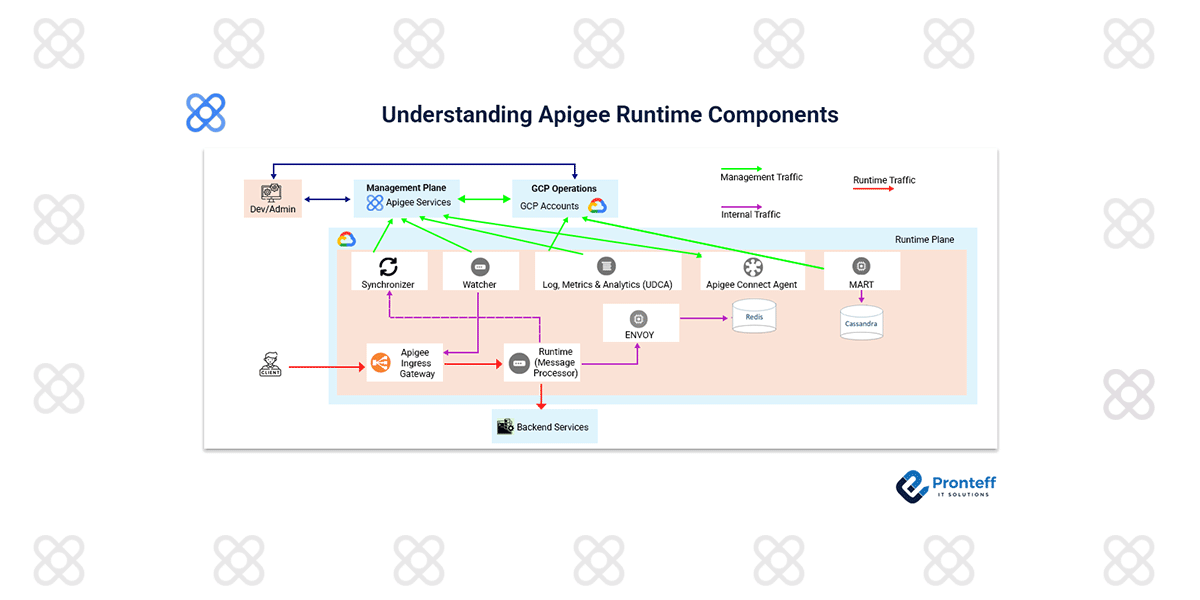
The Apigee Runtime services form the operational backbone of API traffic management. Each service in the runtime plane serves a specialized purpose, contributing to the overall system integrity.
- Apigee Connect ensures secure communication between the management plane and the plane, eliminating the need to expose sensitive MART endpoints publicly.
- Apigee Ingress Gateway routes incoming traffic to the correct message processors, managing external access through LoadBalancer endpoints.
- Apigee Operators (AO) automate the deployment and maintenance of Kubernetes and Istio components that support Apigee deployments.
- Cassandra acts as the persistent data store for key elements such as OAuth tokens, KVMs, and cache data.
- Guardrails validate the readiness of the runtime environment before deploying new services, maintaining system integrity.
- Logger and Metrics services facilitate observability by collecting logs and operational metrics for performance monitoring through Cloud Operations.
- MART (Management API for Runtime Data) provides administrative capabilities to manage data entities like quotas and API products.
- Message Processor handles actual API request processing and policy execution for specific environments.
- Redis supports distributed rate limiting across message processors for consistent request throttling.
- Synchronizer ensures environments stay in sync with configuration data from the management plane.
- UDCA (Universal Data Collection Agent) collects analytics and deployment data for visibility in the Apigee UI.
- Watcher continuously monitors runtime cluster tasks, ensuring synchronization and accurate reporting to the management plane.
Conclusion:
In essence, Google Apigee services collectively enable secure, scalable, and reliable API management in hybrid environments. Each service—from data synchronization to monitoring and request handling—plays a critical role in maintaining operational consistency. Understanding these components not only helps optimize performance but also empowers organizations to harness the full potential of Apigee Hybrid for enterprise-grade API governance.