
Securing Multi-Cloud BFSI Environments with HashiCorp Vault
In this blog, we will learn how to secure multi-cloud BFSI environments with Hashicorp Vault.
As BFSI (Banking, Financial Services, and Insurance) organizations accelerate cloud adoption, many are embracing multi-cloud and hybrid environments to improve flexibility, scalability, and operational resilience. However, this transition significantly expands the attack surface and introduces new layers of security complexity. Managing secrets, identities, encryption, and compliance across multiple platforms becomes increasingly difficult without a centralized strategy. HashiCorp Vault provides a unified, policy-driven approach to securing these distributed environments.
Challenges in Multi-Cloud BFSI
Financial institutions face several critical security hurdles in multi-cloud setups:
- Fragmented security controls across providers like Amazon Web Services, Microsoft Azure, and Google Cloud Platform
- Misconfigured or long-lived credentials are increasing breach risks and regulatory exposure
- Limited centralized visibility into access patterns, usage behavior, and audit trails
- Difficulty securing APIs, containers, and microservices-based architectures
- Compliance challenges with regulations such as PCI-DSS, GDPR, and regional financial data laws
How HashiCorp Vault Solves These Challenges
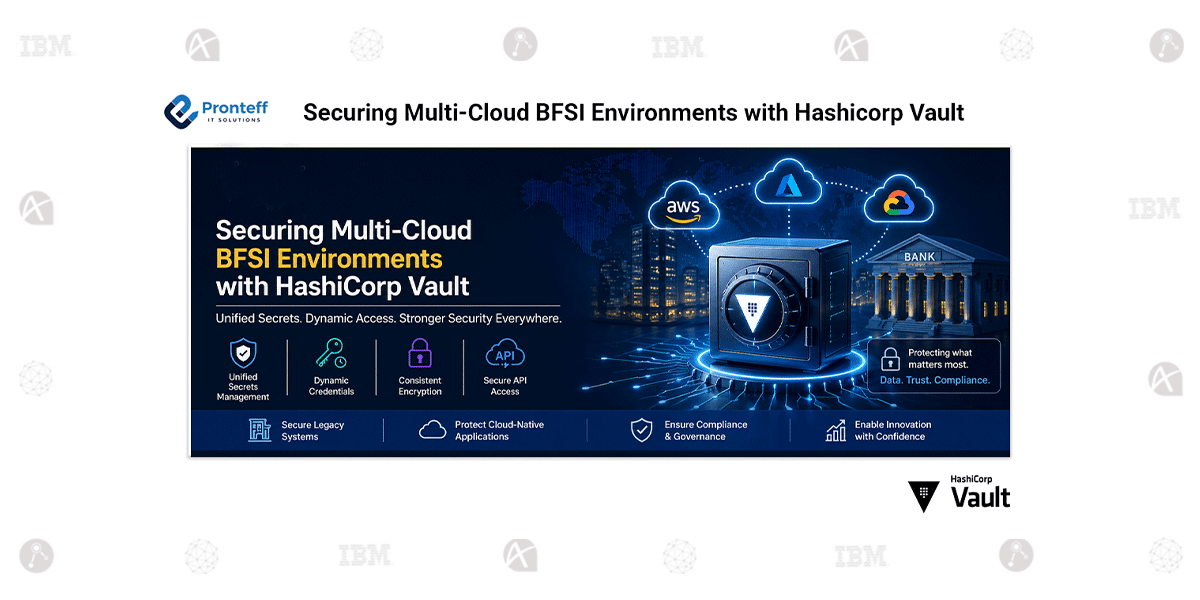
Unified Secrets Management
Vault centralizes secrets across environments, eliminating hardcoded credentials and improving governance, auditability, and policy enforcement across teams.
Dynamic Credentials
It generates short-lived, on-demand credentials, reducing exposure windows and minimizing risks from insider threats or compromised systems.
Consistent Encryption
Vault delivers encryption as a service, ensuring sensitive BFSI data—such as customer records and transaction details—is protected both in transit and at rest across on-premise and cloud systems.
Secure API Access
It integrates seamlessly with microservices architectures to enable secure, identity-based communication between services using tokens and authentication mechanisms.
Policy-Based Access Control
Vault uses fine-grained policies to enforce least-privilege access, ensuring users and applications only access what they truly need.
Use Case: Hybrid Banking Infrastructure
In a hybrid setup, Vault helps banks secure legacy core banking systems while also protecting modern cloud-native applications. It ensures consistent security policies, centralized control, and seamless integration across environments, enabling secure digital transformation without disrupting existing operations.
Business Value
- Simplified and centralized security management
- Greater scalability and operational agility
- Stronger protection against cyber threats and data breaches
- Improved compliance and audit readiness
- Faster, safer cloud adoption with reduced risk exposure
Conclusion
Multi-cloud is rapidly becoming the standard for BFSI organizations, but security must remain foundational rather than an afterthought. HashiCorp Vault empowers financial institutions to innovate confidently while maintaining robust data protection, regulatory compliance, and trust in an increasingly complex digital ecosystem.