

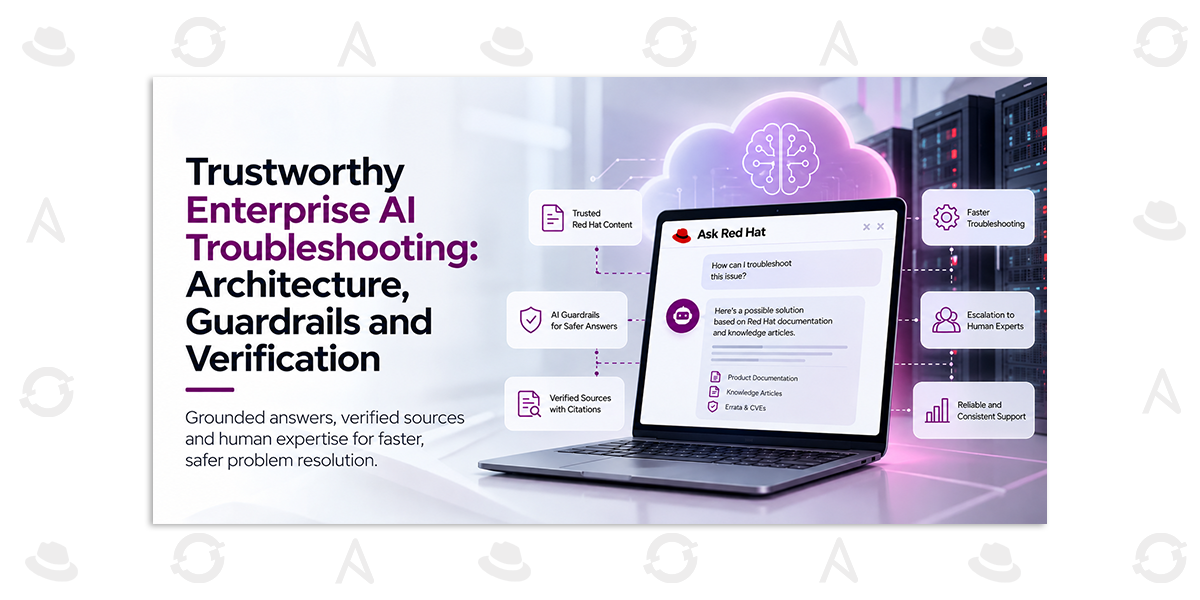
Trustworthy Enterprise AI Troubleshooting: Architecture, Guardrails and Verification
A useful troubleshooting answer is not simply plausible. It must be relevant to the product and version, traceable to evidence, safe to act on, and honest about what it cannot determine.
An AI assistant can produce a confident explanation for a production incident and still be wrong in the one detail that matters: the affected version, the supported recovery path, or the operational risk of the suggested action.
That is why enterprise troubleshooting has a different bar from general-purpose question answering. When a recommendation might influence a payment service, a customer-facing API, or a shared Kubernetes platform, fluency is not evidence. The answer must be inspectable before an engineer relies on it.
Why trust is an architecture problem
Traditional troubleshooting already involves uncertainty. Engineers compare symptoms with logs, known issues, product documentation, change records, and the experience of colleagues. An AI assistant can shorten that search, but it also introduces a new failure mode: a well-written answer can combine correct general knowledge with an unsupported detail.
Trust therefore cannot be added at the end with a disclaimer. It needs to be designed across the complete path: interpreting the question, finding relevant evidence, generating an answer, checking safety, showing sources, and escalating when self-service is not enough.
Think of an enterprise AI troubleshooting assistant as a research analyst, not an autonomous incident commander. It gathers relevant evidence and proposes an explanation; the responsible engineer still validates the evidence and decides what action is appropriate.
A realistic scenario: the version mismatch
Imagine an operations engineer investigating a failed platform upgrade. The visible symptom resembles a known networking issue, but the cluster is on a different product release from the one described in a popular community post. A generic assistant may return a familiar fix that is valid elsewhere but unsupported in this environment.
A trustworthy assistant should first narrow the context: product, release, observed symptom, and recent changes. It should retrieve relevant vendor material, distinguish confirmed facts from hypotheses, cite the source behind its recommendation, and say when the available evidence is insufficient. If the proposed action could disrupt production, it should steer the engineer toward established change control or expert support rather than imply that the answer is safe to execute immediately.
How grounded troubleshooting works
Retrieval-augmented generation (RAG) combines a language model with a retrieval step. Instead of relying only on patterns learned during training, the system searches a selected body of content and uses relevant passages as context for its response.
For product troubleshooting, that content might include customer-facing knowledge articles, product documentation, errata, security advisories, and lifecycle information. The answer can then link the engineer back to the material used to support it.
RAG is not a truth machine. Retrieval can miss the decisive document, return outdated material, or rank a broadly related page above a version-specific one. The model can also misinterpret retrieved evidence or make a claim that the cited passage does not support. Grounding makes verification more practical; it does not remove the need for verification.
Architecture and runtime flow
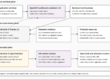
A dependable design separates responsibilities so that failures can be investigated independently. Intent routing determines which capability is appropriate. Retrieval finds relevant approved content. Answer generation synthesizes the evidence. Safety checks assess whether the response is appropriate to return. The user sees citations and clear escalation options, while operational evaluation measures whether the overall experience is improving.
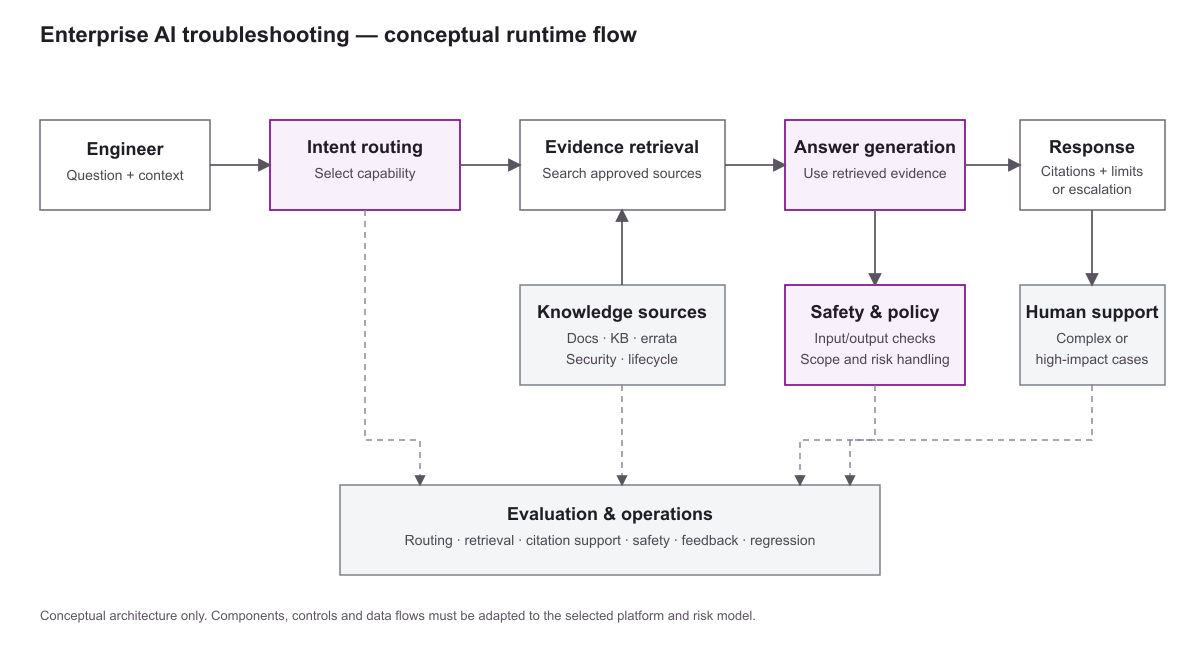
The key design decision is to avoid treating the model as the only component worth testing. If routing is wrong, the system may never retrieve the right evidence. If retrieval is weak, even a capable model has little useful context. If citations are incomplete or safety checks are poorly tuned, a technically sound response may still be hard to trust.
Trust controls and what each one contributes
| Control | What it helps with | What it does not guarantee |
|---|---|---|
| Approved, maintained knowledge sources | Reduces dependence on unsupported or irrelevant information. | That every relevant document is indexed, current, or retrieved. |
| Source citations | Lets an engineer inspect the evidence behind a claim. | That the citation truly supports every sentence in the answer. |
| Product and version context | Helps distinguish guidance for different releases and support states. | That the user supplied accurate environment details. |
| Input and output safety checks | Can detect some harmful, irrelevant, or policy-violating requests and responses. | Complete prevention of prompt injection, data leakage, or unsafe advice. |
| Evaluation and regression tests | Reveals quality changes across routing, retrieval, grounding and presentation. | Perfect performance on every novel incident. |
| Human escalation | Provides a path for ambiguous, high-impact, or unresolved cases. | That every issue can be resolved immediately. |
How it compares with alternatives
| Approach | Best fit | Main trade-off |
|---|---|---|
| Keyword search and documentation portals | Experienced engineers who know the right terms and want direct source access. | Users must connect the evidence and interpret it themselves. |
| General-purpose AI assistant | Broad explanation, brainstorming and cross-domain questions. | Product-specific authority, source coverage and version fit may be unclear. |
| Grounded product-support assistant | Natural-language discovery across approved product knowledge with citations. | Quality depends on retrieval coverage, source freshness, and evaluation. |
| Automated remediation or agentic operations | Well-bounded, repeatable actions with explicit permissions and controls. | Higher operational risk; requires stronger authorization, auditability, rollback, and approval design. |
These options are not mutually exclusive. A mature operating model can use AI to find and explain evidence, documentation for direct verification, and controlled automation for actions that have been separately approved and tested.
A staged implementation approach
1. Assess the support problem
Identify the incident categories where knowledge discovery consumes time, the users who need help, and the decisions that must remain with a qualified engineer. Define success in operational terms rather than measuring only chatbot usage.
2. Design the evidence boundary
Choose authoritative content sources and define ownership, update cadence, product-version metadata, access rules, and retention expectations. Decide which content must never be exposed to a user or model context.
3. Separate routing, retrieval and response responsibilities
Make it possible to assess whether the system understood the question, retrieved suitable evidence, and represented that evidence faithfully. Keep high-impact actions outside the response-generation path unless a separately governed automation design authorizes them.
4. Define safety and escalation policies
Establish handling for ambiguous questions, sensitive data, unsupported topics, risky recommendations, and missing evidence. Make the route to human support visible rather than treating escalation as a failure.
5. Validate with representative incidents
Evaluate realistic questions across product releases, common faults, rare faults, misleading premises, and adversarial inputs. Measure retrieval relevance, citation support, answer groundedness, refusal behavior, and whether the response correctly recognizes uncertainty.
6. Operate and improve
Monitor quality by incident category and risk, review feedback, detect broken or stale citations, and run regression evaluations before changing models, prompts, source pipelines, or routing logic. Keep an auditable record of changes and known limitations.
What this protects—and what it does not
Grounded retrieval, evaluation, and safety controls can make answers easier to verify and can reduce some classes of unsupported responses. They do not prove that a system is secure simply because it cites official documentation.
- It can help: find relevant product guidance faster, summarize evidence, surface known issues, and make uncertainty more visible.
- It cannot guarantee: that retrieved content covers the incident, that the model interprets it correctly, or that a suggested action fits the customer’s exact environment.
- It must not replace: access control, change management, incident command, tested recovery plans or expert review of high-impact changes.
Security design must also consider prompt injection in retrieved content, over-broad permissions, sensitive information in prompts and logs, data retention, dependency vulnerabilities, and the possibility that a valid answer is still unsafe in a particular environment. These require layered controls and governance beyond model-level guardrails.
Common mistakes and trade-offs
Assuming a citation proves correctness
A citation can be present but irrelevant, stale, or too broad to support the claim. Evaluate citation support, not just citation count, and make it easy for users to open the source.
Optimizing only for answer helpfulness
A confident answer may score well in a superficial review while omitting an important caveat. Test against version-specific incidents and measure unsupported claims, unsafe suggestions, and appropriate abstention.
Ignoring source freshness
Product behavior changes across releases. Source ingestion, indexing, and lifecycle metadata should be treated as operational dependencies, with monitoring for stale or missing content.
Using one quality score for every incident
A documentation lookup and a production recovery recommendation do not carry the same risk. Evaluate by task and impact, and apply stronger verification and escalation to high-consequence scenarios.
Making the assistant sound certain when evidence is weak
Uncertainty should change the response. The assistant may ask for missing context, present multiple hypotheses, explain what evidence is absent, or direct the user to support. A polished guess is not a successful resolution.
Troubleshooting the troubleshooting assistant
| Symptom | Possible cause | What to investigate |
|---|---|---|
| Answer cites a page for the wrong release | Missing version context, weak metadata, or retrieval ranking. | Inspect query interpretation, metadata filters, and the source actually retrieved. |
| Answer is plausible but unsupported | Generation added claims beyond the retrieved passages. | Review claim-to-source support and groundedness evaluation results. |
| Relevant documents are missing | Indexing delay, ingestion failure, access filtering or poor chunking. | Trace the content lifecycle from source publication to retrieval availability. |
| Safe technical language is incorrectly blocked | Guardrail thresholds or domain terminology are poorly calibrated. | Review false positives using representative security and operations language. |
| Answer quality drops after an update | Model, routing, prompt, retrieval, or source changes caused regression. | Compare evaluation by component and incident class against the last known baseline. |
| Users cannot tell when to escalate | Unclear confidence communication or missing support pathways. | Review response policy for ambiguity, high-impact actions, and unresolved cases. |
Frequently asked questions
Does retrieval-augmented generation eliminate AI hallucinations?
No. RAG supplies external context and makes source verification easier, but retrieval can fail, and a model can misrepresent the evidence. Grounding must be measured and reviewed.
Why are citations important in enterprise AI troubleshooting?
Citations let engineers inspect the underlying documentation, check product-version fit, and decide whether the recommendation applies to their environment. Citation presence alone is not proof of correctness.
Can an AI troubleshooting assistant safely resolve production incidents on its own?
It may support investigation and, in carefully governed systems, help initiate bounded automation. High-impact changes require explicit authorization, audit trails, validation, and appropriate human oversight.
How should teams evaluate an enterprise troubleshooting assistant?
Use representative, version-aware scenarios and measure retrieval relevance, citation support, answer groundedness, safety behavior, uncertainty handling, and escalation quality. Repeat the evaluation whenever important system components change.
What is the difference between a general AI chatbot and a product-support assistant?
A product-support assistant is designed around a bounded knowledge domain and approved support content. Its value depends on how reliably it retrieves and cites relevant evidence, not simply on how broadly it can converse.
What should happen when the assistant cannot find a reliable answer?
It should state the limitation, ask for essential missing context where useful, show what evidence it did find, and offer an appropriate human-support path. It should not fill the gap with invented certainty.
The takeaway: make answers inspectable
Trustworthy enterprise AI troubleshooting is not a model-selection exercise alone. It is a system-design discipline: authoritative sources, context-aware retrieval, faithful synthesis, layered safety controls, measurable evaluation, and a clear path to human expertise.
The goal is not to make engineers trust every answer. It is to make it easier for them to decide which answers deserve trust—and to recognize when they do not.