
Building Trusted, Compliant AI with Red Hat OpenShift AI
Here in this blog, we will learn how to build trusted, compliant AI with Red Hat OpenShift AI.
Artificial intelligence is transforming every sector, but in regulated industries, performance alone isn’t enough. Success depends equally on security, governance, and trust. Government bodies, healthcare organizations, and financial institutions must unlock AI’s value while adhering to strict regulatory frameworks such as FedRAMP, HIPAA, PCI DSS, and NIST 800-53.
These frameworks define how encryption, identity management, auditing, and data protection must be implemented. They also impose operational limits that affect where AI workloads can run and how data can be processed.
Red Hat OpenShift AI addresses this challenge by enabling organizations to design, train, and deploy protected AI systems directly where sensitive data resides—whether in private datacenters, public clouds, or edge locations.
Bringing AI to the Data
Highly regulated data cannot always move freely. Privacy mandates, geographic data residency laws, and corporate risk policies often restrict the movement of medical records, financial transactions, and operational telemetry. This “data gravity” becomes a major obstacle for enterprise AI adoption.
OpenShift AI flips the traditional model.
Rather than transferring sensitive data into centralized cloud AI services, the platform is deployed alongside the data itself. Because OpenShift AI operates uniformly across on-premises infrastructure, cloud platforms, and edge environments, teams can build and run AI models close to regulated datasets while maintaining compliance.
Security is embedded throughout the stack:
- Encryption for data at rest and in transit
- Role-based access control (RBAC)
- Network isolation and segmentation
- Continuous compliance scanning
This architecture allows organizations to operationalize AI without violating regulatory boundaries.
Compliance as the Backbone of Production AI
Many AI initiatives stall before production because the infrastructure supporting them cannot satisfy regulatory requirements. Deploying models that process protected health information, payment data, or classified workloads demands environments built for continuous validation, policy enforcement, and cryptographic trust.
OpenShift AI provides this enterprise-grade foundation by inheriting the hardened security posture of Red Hat Enterprise Linux and Red Hat OpenShift. Compliance controls are integrated as operational standards across hybrid environments rather than treated as isolated checklist items.
Framework alignment includes:
- FedRAMP Moderate & High – Standardized encryption, logging, and identity governance across public sector ecosystems
- HIPAA – Data isolation, encryption, and fine-grained access management for protected health information
- PCI DSS 4.0 – Segmented networks, RBAC enforcement, and real-time monitoring for payment systems
- NIST 800-53 / ISO 27001 – Comprehensive controls for system integrity, configuration, and risk management
Zero Trust as a Design Principle
AI environments are highly distributed. Pipelines span clouds, data moves across clusters, and inference requests originate from multiple endpoints. Traditional perimeter-based security is no longer sufficient.
OpenShift AI adopts a zero-trust model that assumes no implicit trust between users, services, or infrastructure.
Core zero-trust capabilities include:
Verified identities everywhere – APIs, workloads, and services operate using authenticated credentials and federated identity systems
Policy-driven authorization – RBAC, security context constraints, and microsegmentation enforce least-privilege access
Encrypted service communication– Mutual TLS secures service mesh and control plane traffic
Continuous posture validation – Configuration and runtime states are monitored against approved baselines
This approach turns compliance into a living, continuously enforced discipline rather than static documentation.
Security Across the Full Stack
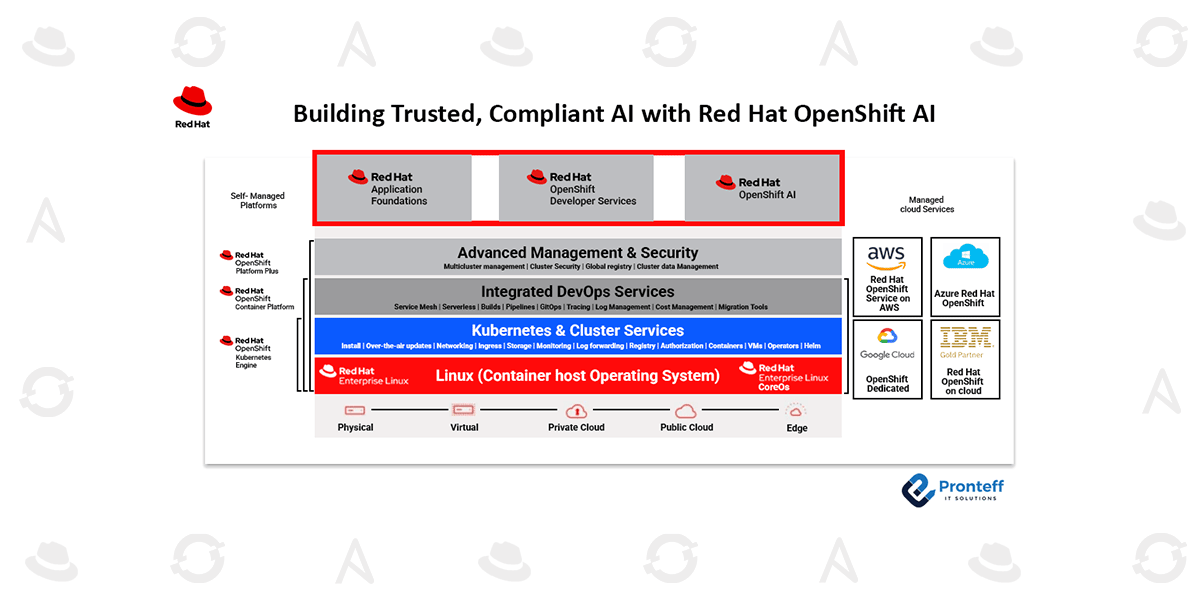
Regulatory alignment is enforced at every layer of the OpenShift AI architecture:
Operating System Layer
Red Hat Enterprise Linux CoreOS delivers immutable infrastructure, SELinux enforcement, and native encryption aligned with FedRAMP, DISA STIG, and CIS benchmarks.
Platform Layer
Red Hat OpenShift provides secure defaults, namespace isolation, encrypted etcd storage, and policy-controlled deployments mapped to NIST and PCI requirements.
Application Layer
AI pipelines and model services inherit platform protections, ensuring secure transitions from data ingestion to training and inference.
Data Layer
OpenShift Data Foundation offers encrypted storage volumes and integrates with enterprise key management systems to meet HIPAA and PCI data-at-rest mandates.
This layered model ensures compliance from the operating system up to the AI service endpoint.
Continuous Compliance and Governance
In AI ecosystems, compliance cannot rely on periodic audits. It must be continuous and automated.
OpenShift AI supports ongoing governance through:
Compliance Operator – Automated scans against FedRAMP, PCI DSS, and CIS benchmarks
Red Hat Advanced Cluster Security – Runtime threat detection and vulnerability monitoring
Red Hat Advanced Cluster Management – Centralized policy enforcement across hybrid and multicluster deployments
Together, these capabilities shift compliance from reactive auditing to proactive assurance.
Securing the AI Software Supply Chain
AI systems depend on complex ecosystems of models, containers, and open-source libraries. Securing this supply chain is critical.
OpenShift AI integrates with Red Hat’s trusted software supply chain solutions to provide transparency and artifact integrity:
Trusted Artifact Signer – Cryptographic signing and verification of models and containers
Trusted Profile Analyzer – Visibility into vulnerabilities and licensing risks
Red Hat Quay – Secure image registry with provenance tracking
Advanced Cluster Security Policy Controls – Blocks deployment of unsigned or non-compliant artifacts
These controls align with NIST Secure Software Development Framework (800-218) and Executive Order 14028, ensuring traceability across AI assets.
Consistent Compliance Across Hybrid Cloud
OpenShift AI maintains uniform security and compliance policies regardless of deployment location—private datacenters, sovereign clouds such as AWS GovCloud or Azure Government, or disconnected edge environments.
This consistency reduces redundant certification efforts and simplifies reporting. Organizations can scale AI globally while maintaining a single compliance baseline, supporting distributed training, federated learning, and regional inference strategies.
Compliance as an Innovation Enabler
Regulations are often viewed as barriers to AI adoption. In reality, they create the trust framework required to innovate responsibly. Encryption mandates, audit trails, and access governance make it possible to analyze sensitive data with confidence.
With built-in FIPS validation, FedRAMP alignment, HIPAA safeguards, and PCI DSS controls, OpenShift AI becomes more than an AI platform—it serves as a compliance-ready innovation engine.
Trust: The Foundation of Hybrid AI
Red Hat OpenShift AI brings together open-source innovation and enterprise-grade security to support regulated industries. Its zero-trust architecture, alignment with global compliance standards, and consistent hybrid deployment capabilities allow organizations to overcome data gravity and operationalize AI wherever it delivers the greatest value—securely and responsibly.