
By Sai Teja Kuntamukkala · Updated 08 October 2026 · Approx. 10-minute read
IBM DataPower TCP Proxy Service: Layer 4 Forwarding Without Touching the Payload
Not every connection through DataPower needs API routing, XML processing, transformation, or application-level policy. Sometimes the requirement is simpler: expose a controlled TCP endpoint, keep the backend hidden, and relay the byte stream to a remote service without interpreting the application protocol.
TL;DR
IBM DataPower TCP Proxy Service accepts a TCP connection on a configured local address and port, creates a separate outbound TCP connection to a remote host and port, and relays traffic between the two sides. It is useful when DataPower must provide a controlled Layer 4 entry point without application-message processing. The important design detail is that this is a real proxy: there are two TCP connections, not one end-to-end client-to-server session.
In this article
- The problem TCP Proxy Service actually solves
- Why “transparent forwarding” can be misunderstood
- Architecture and runtime flow
- When TCP Proxy Service is a good fit
- When another DataPower service is a better fit
- Implementation approach
- How to validate it properly
- Production considerations
- Frequently asked questions
The problem: sometimes the application protocol should remain somebody else’s job
DataPower is often associated with APIs, XML, SOAP, security policies, transformation, and application-aware gateway processing. But some enterprise connectivity requirements do not need any of that.
Imagine a client that speaks a proprietary or legacy TCP-based protocol. The backend service sits on an internal network and should not be exposed directly. The client needs a stable entry point, but DataPower does not need to understand the message format.
In that scenario, inserting an application-aware gateway can add unnecessary complexity. What is needed is a transport-level boundary: DataPower listens for the connection, establishes a connection to the configured remote peer, and relays the TCP stream between them.
That is the core purpose of TCP Proxy Service.
The design question is not “Can DataPower proxy this traffic?”
The better question is: Does DataPower need to understand the application protocol, or only provide a controlled TCP path? The answer determines whether TCP Proxy Service is the right object.
The word “transparent” can be misleading
A common description of TCP Proxy Service is that it transparently forwards TCP traffic. That is useful shorthand, but it can create the wrong mental model.
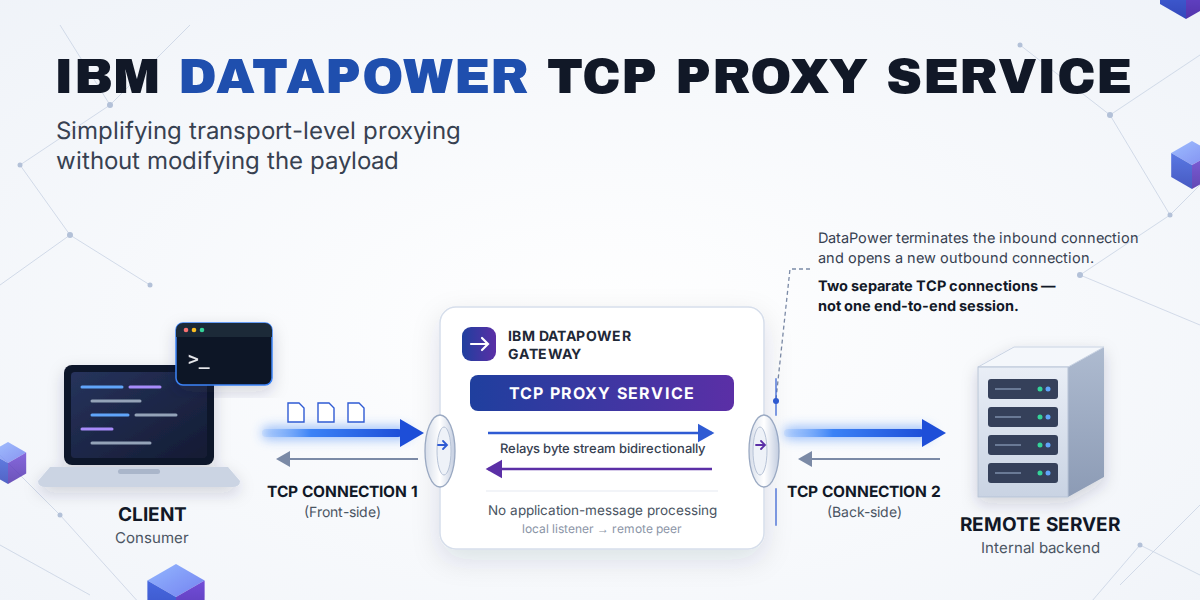
DataPower is not simply passing the original client TCP connection straight through to the backend. The inbound connection terminates at DataPower, and DataPower establishes a separate outbound TCP connection to the configured remote peer.
So “transparent” is best understood at the application-payload level: the TCP byte stream is relayed without DataPower needing to interpret or transform the application message.
At the network-session level, however, DataPower is an active proxy in the middle.
| What the client sees | What DataPower does | What the backend sees |
|---|---|---|
| DataPower local IP/host and listening port | Accepts the inbound TCP connection | A connection arriving from the DataPower side of the network |
| A TCP service endpoint | Creates a separate outbound TCP connection | The configured application traffic relayed over that connection |
| No direct knowledge of the internal backend address is required | Relays traffic in both directions | No direct TCP session with the original client |
This distinction becomes important for firewall rules, backend audit logs, source-IP expectations, troubleshooting, and security design.
Architecture: one service, two TCP connections
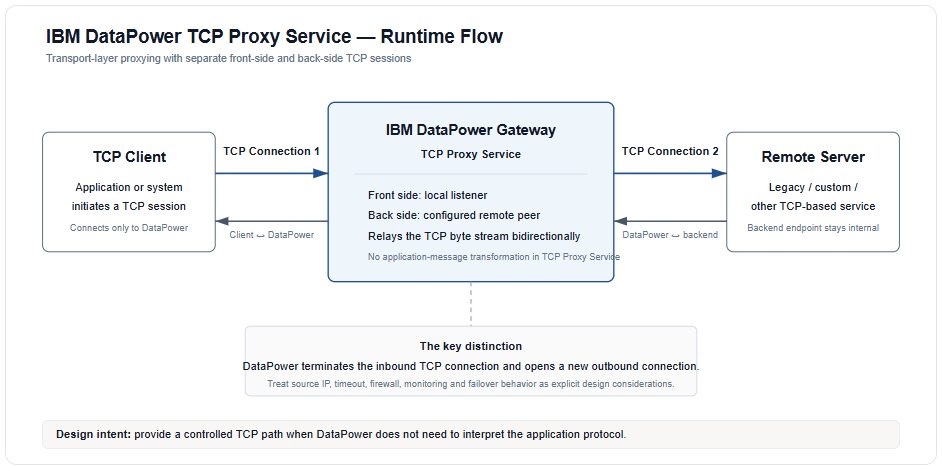
TCP Proxy Service sits between the client and backend as an active Layer 4 proxy. The application byte stream is relayed, but the front-side and back-side TCP sessions are separate.
The client is configured to connect to the DataPower listener instead of connecting directly to the backend. Once DataPower accepts the session, it establishes its own connection to the configured remote host and port. Traffic is then relayed in both directions.
The backend address is therefore decoupled from the client configuration. That can simplify endpoint exposure and network segmentation, but it also means operational teams should treat DataPower as a real connection boundary rather than an invisible wire.
When TCP Proxy Service is a good fit
Use TCP Proxy Service when…
- The application already communicates over TCP.
- DataPower does not need to parse the application message.
- You want clients to connect to a controlled DataPower endpoint.
- The backend address should remain behind the gateway/network boundary.
- The traffic should be relayed without application-level transformation.
- A simple local-listener-to-remote-peer model matches the architecture.
Reconsider it when…
- You need routing based on URL, headers, SOAP operations, or message content.
- You need request/response transformation or application-aware policy enforcement.
- DataPower must terminate or actively manage TLS rather than simply relay an existing byte stream.
- You need backend pools, advanced load balancing, or health-based target selection.
- The backend must reliably receive the original client source address as its TCP peer.
- You need protocol-specific observability beyond connection-level behavior.
A useful rule of thumb is simple: if the requirement is fundamentally connection forwarding, TCP Proxy Service deserves consideration. If the requirement is fundamentally message processing, look at a service designed for the application protocol.
TCP Proxy is not a smaller Multi-Protocol Gateway
The two solve different problems.
| Requirement | TCP Proxy Service | Application-aware DataPower service |
|---|---|---|
| Forward a raw TCP stream | Natural fit | Usually more capability than needed |
| Understand HTTP, SOAP, XML, JSON, or message semantics | Not the purpose | Use an appropriate Layer 7 service |
| Transform the request or response | No application-message processing model | Designed for policy-driven processing |
| Route based on application content | Not the design goal | Better fit |
| Provide a stable TCP endpoint in front of one remote peer | Good fit | Potentially unnecessary |
What about TLS?
A TCP proxy can relay bytes that happen to belong to an encrypted application session because it does not need to understand the payload. But that is different from asking DataPower to terminate, inspect, or establish managed TLS sessions.
If the security requirement is specifically about DataPower acting as a TLS endpoint or TLS forwarder, the TLS design should be selected deliberately rather than assuming a plain TCP proxy provides the same security function.
Implementation approach: design the connection lifecycle first
The configuration itself is straightforward. The architecture around it is where most production issues originate.
Implementation focus
Start with session behavior, network ownership, source/destination addressing, timeout expectations, observability, and failure handling. Then map those requirements to the DataPower listener and remote peer.
- Understand the application protocol behavior
Confirm that the application is TCP-based and determine whether sessions are short-lived, long-lived, persistent, bursty, or mostly idle. Find out whether the application depends on the source IP address of its peer. - Define the client-facing endpoint
Decide which DataPower interface/address and port should accept the connection. Treat this as an externally consumed service endpoint with clear firewall, routing, and ownership rules. - Define the remote peer
Identify the backend hostname or IP address and destination port, and confirm that the DataPower network path can reach it. If the design uses DNS, include DNS availability and resolution behavior in the assessment. - Design the idle-session behavior
Idle timeout is not just a configuration field. For protocols that keep a session open while sending traffic only occasionally, an aggressive idle policy can look like random application disconnects. The timeout should reflect the actual protocol and operational requirements. - Align firewall and routing rules
There are two network legs: client to DataPower and DataPower to the backend. Validate each path independently and document which team owns each firewall or route. - Define logging and monitoring expectations
Decide what connection-level evidence is required for operations: listener availability, backend connection failures, connection resets, timeouts, service state, and the ability to correlate events with client and backend logs. - Design failure and maintenance behavior
Determine what happens if the backend is unavailable, DataPower is quiesced, DNS changes, the service restarts, or an existing long-lived session is interrupted. Recovery behavior should be understood by the application owner before go-live. - Validate the complete session path
Test with the real application protocol wherever possible. A successful port check proves only network reachability; it does not prove the application’s session behavior, payload exchange, timeout behavior, or reconnection logic.
Validation: do not stop at “the port is open”
TCP services are deceptively easy to test at the network level. A socket may open successfully while the application still fails because of protocol expectations, idle behavior, connection resets, or source identity assumptions.
Layer 1 — listener availability
Confirm that the expected DataPower address and port are listening from the client network.
Layer 2 — backend reachability
Confirm that DataPower can resolve and reach the configured remote peer on the required port.
Layer 3 — TCP session establishment
Verify that an inbound client session results in a successful outbound DataPower-to-backend session.
Layer 4 — bidirectional application exchange
Send a representative application message and confirm that the backend receives it and that the response returns through the same proxy path.
Layer 5 — idle and long-lived connection behavior
Keep the session open for the application’s normal idle period. Validate whether it remains connected or closes according to the intended operational design.
Layer 6 — failure and reconnection behavior
Test a backend outage, service restart, or controlled interruption in a non-production environment and confirm that client reconnection behavior matches expectations.
Key lesson: “TCP reachable” and “application works through the TCP proxy” are not the same test. Production sign-off should prove both.
Production considerations that matter more than the basic setup
| Area | Design question |
|---|---|
| Idle timeout | How long can a legitimate session remain quiet before traffic resumes? |
| Client source identity | Does the backend depend on seeing the original client as its direct TCP peer? |
| DNS | If a hostname is used, who owns resolution, TTL changes, and recovery when DNS fails? |
| Backend availability | Is one remote peer sufficient, or is a separate HA/load-balancing design required? |
| TLS | Is DataPower merely relaying encrypted bytes, or must it actively terminate/manage TLS? |
| Monitoring | Which events indicate a client problem, a DataPower problem, or a backend problem? |
| Capacity | How many concurrent sessions, how much traffic, and what session duration are expected? |
| Maintenance | How will active TCP sessions be handled during planned changes or service quiesce? |
Do not confuse endpoint hiding with full security
Exposing DataPower instead of the backend reduces direct endpoint exposure, but it does not automatically add application authentication, content inspection, authorization, malware filtering, or encryption. Those controls must come from the application protocol, an appropriate DataPower service, or other security layers in the architecture.
Do not assume it is a load balancer
TCP Proxy Service is fundamentally a local-listener-to-remote-peer forwarding model. If the real requirement is backend pooling, health checks, balancing, active/standby selection, or complex failover, treat that as a separate architectural requirement instead of stretching a simple proxy into a role it was not selected for.
Frequently asked questions
Does TCP Proxy Service modify the application payload?
Its purpose is TCP forwarding. It relays the traffic between the local listener and configured remote peer without requiring application-message transformation or protocol-aware processing.
Is there one TCP connection from client to backend?
No. DataPower accepts the inbound client TCP connection and initiates a separate outbound TCP connection to the destination.
Does the backend remain hidden from the client?
The client connects to the DataPower endpoint, so it does not need to use the backend server’s internal address directly. Whether this fully meets a security requirement depends on the broader network and application architecture.
Can it carry different TCP-based application protocols?
The service forwards a TCP stream rather than depending on one application-message format. That makes it useful for TCP-based protocols where DataPower does not need application-level interpretation.
Can I use it for encrypted traffic?
A raw TCP proxy can relay an encrypted byte stream without understanding the payload. If DataPower must terminate, validate, or actively establish TLS as part of the security design, use the DataPower capability intended for that TLS role rather than treating simple TCP forwarding as TLS processing.
Does TCP Proxy Service preserve the original client IP for the backend?
Do not assume so. The backend connection is initiated by DataPower, not by extending the original client TCP connection. If the backend depends on original-client network identity, make that a specific design and validation requirement.
Is TCP Proxy Service a replacement for a Layer 4 load balancer?
Not automatically. A forwarding service to a configured remote peer and a load-balancing platform with backend pools, health checks, selection logic, and failover are different architectural capabilities.
The takeaway
TCP Proxy Service is valuable precisely because it is simple. When DataPower only needs to provide a controlled TCP entry point and forward traffic to an internal service, application-aware processing can be unnecessary.
But simple does not mean design-free. The most important production questions are about the two-connection model, timeout behavior, source identity, firewall paths, remote-peer availability, TLS responsibility, monitoring, and recovery.
Get those decisions right, and TCP Proxy Service becomes a clean boundary between external connectivity and an internal TCP service without forcing DataPower to understand a protocol it was never asked to process.