
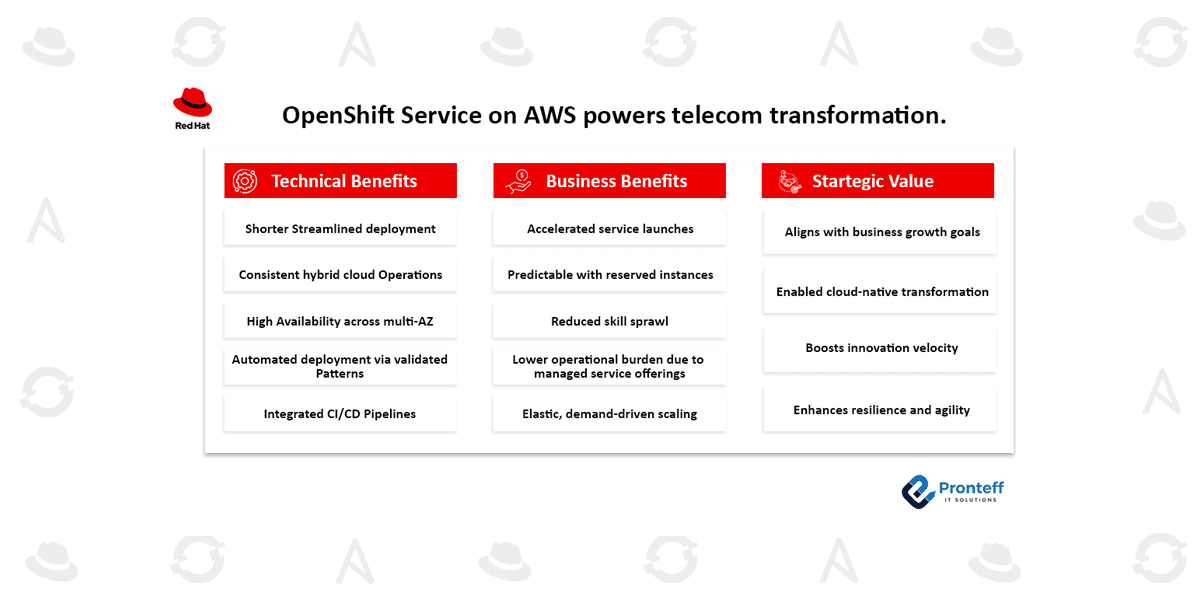
OpenShift Service on AWS powers telecom transformation.
In this blog, we will learn about how the OpenShift service on AWS powers telecom transformation.
The telecommunications sector is undergoing rapid change, and modernisation has become unavoidable. Service providers are expected to deliver digital services more quickly while boosting agility and managing costs. By adopting modern network architectures and automation technologies, telcos can stay ahead—improving revenue potential, operating more efficiently, and strengthening security and reliability.
Every provider’s cloud adoption strategy looks different. Factors such as latency sensitivity, bandwidth demands, and data-residency rules determine whether a workload should remain on-premises or be moved to the cloud. The joint efforts of Red Hat, AWS, and Nokia address these varying requirements. Together, they give service providers a practical decision-making framework to determine which workloads run best in the public cloud and which should stay local.
Red Hat OpenShift Service on AWS offers a fully managed application platform tailored to the unique challenges of telecom environments. It simplifies cloud transitions, supports ongoing innovation, and delivers the consistency needed to manage diverse hybrid-cloud infrastructures. This leads to reduced total cost of ownership (TCO) and faster delivery of new capabilities.
This article highlights why telcos are embracing the cloud, the strategic strengths of Red Hat OpenShift Service on AWS, and a real example showing how one provider accelerated modernisation while improving cost efficiency, resilience, and agility.
Public Cloud Adoption: What’s Influencing Telco Decisions?
Telecom companies are increasingly leveraging public cloud services to meet key business and operational goals, including:
- Lower costs: Moving away from capital-intensive hardware to flexible, subscription-based consumption models.
- Elastic scaling: Automatically adjusting resources during spikes in network activity.
- Faster innovation: Launching new features and services at an accelerated pace.
- Stronger resilience: Improving uptime and enhancing disaster recovery capabilities.
- Retiring legacy datacenters: Migrating workloads out of ageing, on-premise facilities.
- Enhanced security: Taking advantage of the cloud’s built-in compliance and security controls.
Despite these advantages, adopting public cloud platforms brings its own complexities. Managing Kubernetes environments, integrating cloud services, and migrating legacy workloads require skills that many organisations lack. Providers must design robust architectures, maintain cloud-native platforms, and coordinate multi-environment deployments.
To minimize disruption, many telcos are adopting the cloud in phases. Initial steps often include shifting development and test environments, then migrating OSS/BSS systems and disaster recovery workloads. Red Hat OpenShift Service on AWS supports this phased approach by reducing management overhead, improving consistency, and enabling hybrid-cloud operations across environments.
Why Red Hat OpenShift Service on AWS Is a Strategic Asset for Telcos
As networks expand and diversify, service providers are focusing on creating a unified platform model—one that simplifies operations across different infrastructures. This standardized, automated foundation—sometimes referred to as a horizontal platform strategy—reduces repetitive tasks and allows specialized teams to focus on initiatives that grow revenue and improve customer experiences.
With this approach, telcos can:
- Lower operational expenses
- Decrease integration complexity
- Deliver new digital services more rapidly
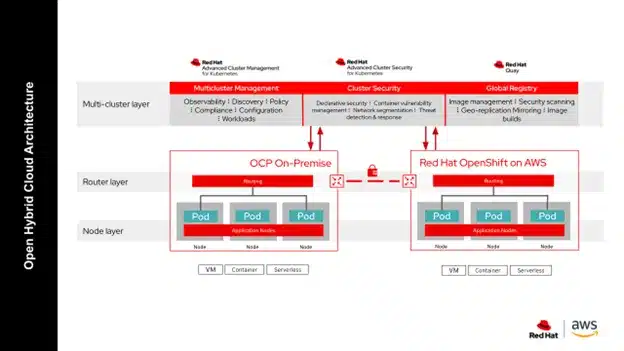
While most organisations already utilise the public cloud to some extent, telcos must determine the right balance across hybrid or multicloud environments. Deploying Red Hat OpenShift Service on AWS alongside on-premise OpenShift clusters creates a seamless hybrid architecture with consistent management, tooling, and operational practices across locations.
How Red Hat OpenShift Service on AWS Strengthens Telco Operations
Red Hat OpenShift Service on AWS is built to support the demanding performance and reliability requirements of telecom networks. Key benefits include:
1. Fully Managed Cloud Operations
Red Hat and AWS jointly manage updates, patches, monitoring, scaling, and logging. This frees internal teams to prioritise business initiatives rather than infrastructure maintenance.
2. Consistency Across Cloud and On-Premise
The platform delivers the same OpenShift experience no matter where workloads run. Tools like Red Hat Advanced Cluster Management enable unified governance and visibility across the hybrid cloud landscape.
3. VM and Container Support in One Platform
With Red Hat OpenShift Virtualisation, providers can run virtual machines and containers together. This makes it easier to modernise existing VM-based workloads while adopting Kubernetes automation and scaling.
4. Faster Deployment and Higher Agility
Clusters can be deployed quickly—often in days—accelerating the rollout of new services. Deep integration with AWS-native tools enhances flexibility and development velocity.
5. Streamlined Migration Path
Migration toolkits simplify the process of moving both virtual machine and container workloads to the cloud, reducing complexity and time-to-value.
6. Lower and More Predictable TCO
Managed operations, multi-AZ resilience, and flexible pricing result in reduced operational costs, improved uptime, and greater efficiency.
Case Study: APJ Provider Reduces TCO by 26% and Accelerates Deployment
A major telecom operator in the Asia-Pacific region struggled with scaling demands, increasing complexity, limited workforce skills, and rising operational costs. To modernise its service orchestration environment, the provider teamed up with Nokia and Red Hat.
They deployed Nokia’s Unified Inventory and Orchestration Centre on Red Hat OpenShift Service on AWS, supported by expert guidance and best practices from Red Hat.
Technical Impact
- Deployment dropped from several weeks to two days
- Multi-AZ configuration improved resilience and high availability
- Standardised deployment patterns simplified operations
- A unified CI/CD pipeline improved development consistency
Business Impact
- Faster rollout of new services
- Predictable costs using reserved AWS instances
- Reduced training requirements due to managed operations
- Elastic scaling for more efficient resource consumption
Strategic Impact
- Faster innovation cycles
- Improved resilience across infrastructure
- Stronger foundation for future cloud-native growth
A cost analysis revealed a 26% reduction in TCO compared to an on-premise setup, based on factors such as hardware reuse, shared SRE responsibilities, multi-AZ requirements, datacenter costs, and comparable service expenses.
Key Telecom Use Cases for Red Hat OpenShift Service on AWS
Red Hat OpenShift Service on AWS supports high-value telco workloads, including:
- Running VMs and containers side-by-side for modernised operations
- Accelerating cloud-native development through rapid build and release pipelines
- Scaling OSS/BSS systems with elastic resources
- Creating flexible testing and staging environments in the cloud
- Implementing robust cloud-based disaster recovery
- Improving both internal and customer-facing applications
- Leveraging AWS Marketplace solutions without relying on legacy systems
Conclusion
For telecom providers aiming to expand revenue and streamline operations, modernisation is essential. Red Hat OpenShift Service on AWS enables this by offering a unified, fully managed platform for both virtualised and cloud-native workloads.
By leveraging the resilience of AWS and the consistency of OpenShift, service providers can reduce costs, improve agility, and accelerate innovation. Tools for migration, combined with managed services and strong partnerships with AWS and Nokia, give telcos a clear and achievable modernization path.
Red Hat OpenShift Service on AWS equips service providers not only to evolve—but to excel—in an increasingly digital and competitive telecom market.