
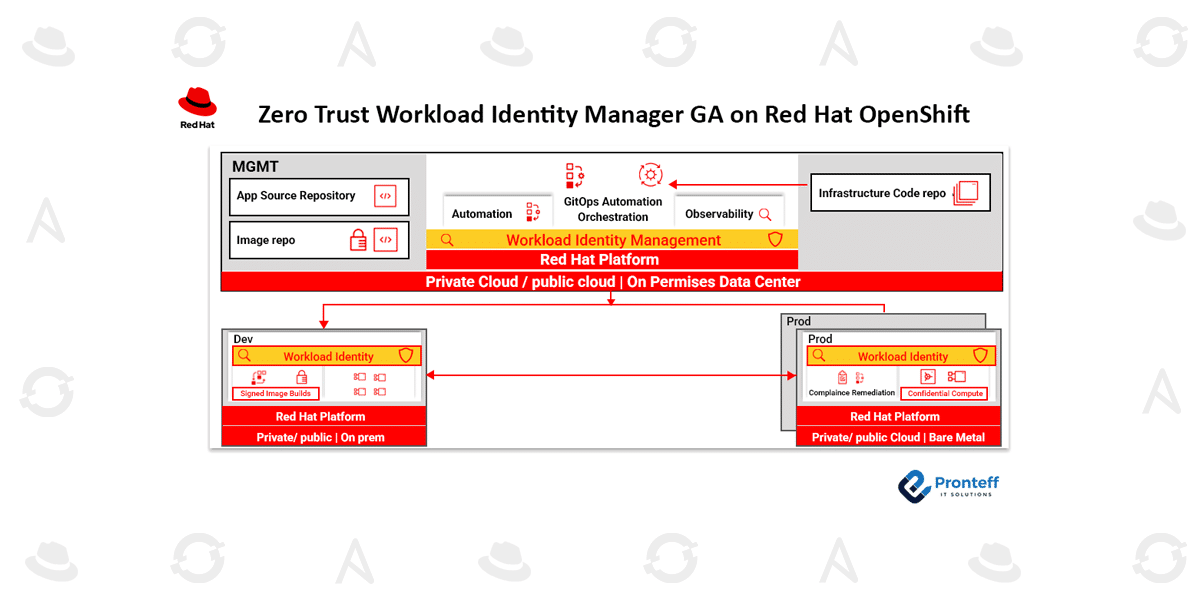
Zero Trust Workload Identity Manager GA on Red Hat OpenShift
In this blog, we will learn about Zero Trust workload identity manager GA on Red Hat OpenShift.
Modern applications today span multiple clusters, cloud environments, and geographic regions. In such distributed setups, traditional identity approaches—like long-lived credentials, static certificates, or cloud-specific IAM systems—often fall short.
A zero-trust workload identity manager addresses this challenge by issuing short-lived, cryptographically verified identities to workloads at runtime. Instead of relying on location or network boundaries, applications can prove their identity based on what they are.
This approach forms the backbone of a zero-trust architecture:
- No workload is trusted by default
- Identities are granted only after successful workload attestation
- Credentials are short-lived, automatically rotated, and securely managed
- Workloads can communicate securely across clusters, organizations, and cloud platforms
Built on SPIRE
The zero-trust workload identity manager is built on SPIRE, the reference implementation of the SPIFFE standard for workload identity. SPIRE acts as the control plane for attesting workloads, issuing identities, rotating them, and storing them securely.
It supports a wide range of environments, including virtual machines and containerized workloads, enabling consistent identity management across diverse infrastructures.
By leveraging SPIRE, Red Hat enhances open source capabilities with enterprise-grade features such as multi-cluster federation, support for external databases, and flexible configuration options.
Key capabilities
With its general availability, the zero-trust workload identity manager evolves from a technology preview into a fully enterprise-ready solution. It offers:
- Dynamic identity issuance: Every workload—VM or container—receives a short-lived identity at runtime
- Cross-environment federation: Supports both OIDC and SPIRE-to-SPIRE federation for hybrid and multi-cloud use cases
- Secretless authentication: Integrates with Vault, allowing workloads to authenticate using SPIFFE identities instead of static credentials
- Bring Your Own Database (BYODB): Enables use of existing PostgreSQL databases for better compliance and operational control
- Flexible configuration: Supports both automated setups and advanced customization
- End-to-end attestation workflows: Integrates with service meshes, CI/CD pipelines, and policy engines
- Secure APIs: Allows seamless integration of workload identity into application workflows and automation pipelines
Securing agentic AI workloads
As agentic AI systems become more common, both human users and AI-driven workloads increasingly participate in decision-making and operations. This makes accountability and traceability critical.
With SPIRE at its core, the zero-trust workload identity manager ensures that AI workloads are treated with the same level of security as human-driven processes. It enables organizations to:
- Track and verify every action performed by AI or human actors
- Maintain visibility across complex, multi-step workflows
- Apply consistent zero-trust policies across all workloads, regardless of origin
Why it matters
By consolidating workload identity into a unified model, the zero-trust workload identity manager simplifies how trust is established across modern environments. Organizations can:
- Secure workloads across Kubernetes clusters, hybrid clouds, and regions
- Eliminate reliance on static secrets and manual certificate handling
- Enable applications to trust each other based on continuously verified identities rather than network location
This solution is available as part of Red Hat OpenShift Platform Plus, helping organizations adopt a consistent and scalable identity framework for both virtual machines and containers across their infrastructure.