
What’s New in Migration Toolkit for Virtualization 2.10
In this blog, we will learn about what’s new in the migration toolkit for virtualization 2.10.
Migration Toolkit for Virtualization 2.10 Is Now Generally Available
The Migration Toolkit for Virtualization (MTV) 2.10 is now generally available, delivering new enhancements that build on recent releases to make virtual machine (VM) migrations safer, faster, and easier to manage. This release focuses on minimizing downtime, reducing operational risk, and giving organizations greater control as they modernize VM environments.
With notable improvements to storage offloading, MTV 2.10 helps teams plan and execute migrations more efficiently—especially for large-scale or mission-critical workloads.
Accelerating VM Migrations with Storage Offloading
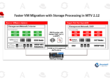
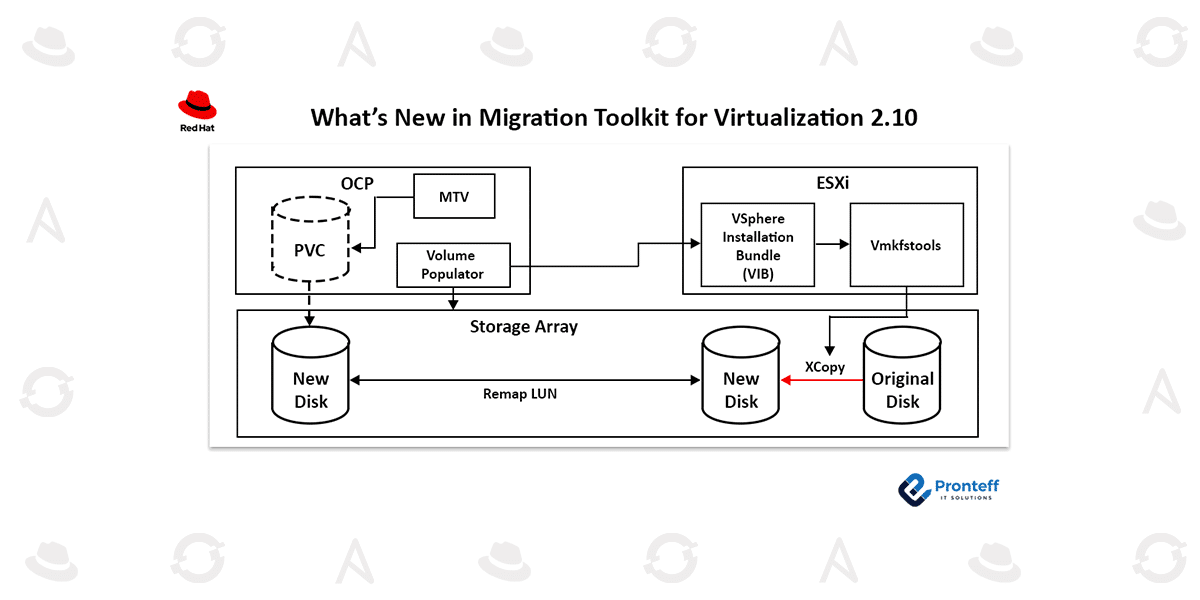
Migration speed plays a crucial role in successful VM transitions. In MTV 2.10, storage offloading is introduced as a Technology Preview, addressing one of the most common migration challenges: network bandwidth limitations.
Instead of transferring VM disk data over the network, storage offloading uses existing storage infrastructure to handle data movement directly at the storage layer. MTV’s plug-in framework works with supported storage providers to orchestrate disk transfers internally within the storage system.
This approach significantly shortens migration times, minimizes service disruption, and improves overall reliability—particularly for large or data-intensive migrations.
New Storage Offloading Enhancements in MTV 2.10
MTV 2.10 expands storage offloading capabilities with several important updates:
- Warm migration support (Developer Preview)
Storage offloading, previously limited to cold migrations, now supports warm migrations. This allows VMs to remain operational while data is transferred, with only a brief interruption during final cutover. Customers should consult their account teams to determine suitability for their migration strategies. - Broader support for certified storage providers
The certified storage ecosystem continues to grow with the addition of Pure Storage and Dell, alongside existing support for Hitachi, HPE, and NetApp. This expanded compatibility enables organizations to take advantage of their current, trusted storage platforms for offloaded migrations.
Additional Enhancements in MTV 2.10
Beyond storage offloading, MTV 2.10 introduces several improvements designed to streamline the overall migration experience:
- Live VM migration across OpenShift clusters (Technology Preview)
VMs can now be live-migrated between OpenShift clusters, enabling continuous availability during the migration process. - Migration to namespaces using user-defined networks (UDNs)
VMs can be migrated into existing UDNs, simplifying network configuration, preserving static IP addresses, and reducing migration risk. - Support for BTRFS-based VMs
MTV now supports migrating VMs that use the BTRFS file system, expanding compatibility and offering more flexibility when moving workloads to OpenShift Virtualization. - New “Tips and Tricks” learning section
A new in-product learning area provides practical guidance on VM migration best practices, selecting appropriate migration types, troubleshooting, and understanding key terminology. - Network-bound disk encryption (NBDE) support
Encrypted VM disks can now be migrated from VMware to OpenShift without requiring VM reboots to retrieve decryption keys, enabling smoother and less disruptive migrations. - AI-assisted migration insights (Developer Preview)
Looking ahead, MTV 2.10 introduces Model Context Protocol (MCP) in Developer Preview. This capability allows AI assistants to better understand migration context and plans, paving the way for intelligent guidance, automation, and decision support in modernization initiatives.