

Enhancing AI Development with the MCP Catalog on OpenShift AI
In this blog, we will learn how to enhance AI development with the MCP catalog on OpenShift AI.
The growing adoption of AI agents across enterprises is driving demand for secure and scalable integration with organizational platforms, applications, and data resources. Red Hat OpenShift AI 3.4 introduces a new capability designed to simplify this process—the MCP Catalog, currently available as a developer preview.
The MCP (Model Context Protocol) Catalog provides a centralized and curated collection of MCP servers that can be discovered, deployed, and managed directly within OpenShift AI. It includes MCP servers from Red Hat, trusted technology partners, and open-source contributors, with additional integrations being added over time. Organizations can also deploy their own custom MCP servers and manage them using the same lifecycle and connectivity framework available within the catalog.
Most MCP registries are designed to help users locate available servers, whereas the MCP Catalog in OpenShift AI supports the entire workflow from discovery to deployment and ongoing management. Users can browse available MCP servers, deploy them directly to their OpenShift clusters, manage their lifecycle, and connect them seamlessly to AI applications running within the platform.
From Discovery to Deployment
Previous versions of OpenShift AI primarily focused on AI model management through AI Hub. With OpenShift AI 3.4, MCP servers become a core component of the platform’s growing AI ecosystem.
Many existing MCP registries help developers locate MCP servers, but leave deployment, maintenance, security, and operational management entirely up to users. This often involves manually building container images, configuring networking, managing authentication, and handling updates.
The MCP Catalog removes much of this complexity by providing:
- Enterprise-ready MCP server deployments
- Streamable HTTP-based connectivity
- Secure container images built on Red Hat Universal Base Image (UBI)
- Vulnerability-scanned software packages
- Automated deployment and lifecycle management through the MCP Lifecycle Operator
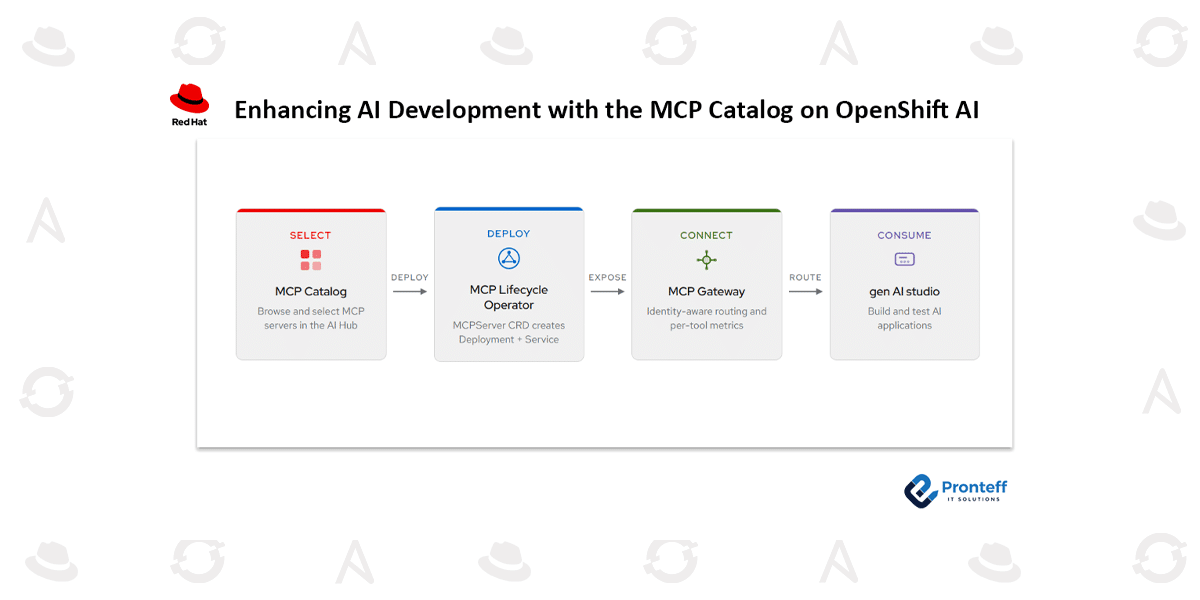
When a user deploys an MCP server from the catalog, the MCP Lifecycle Operator automatically provisions the necessary Kubernetes infrastructure and deploys the service within the OpenShift environment. Once deployed, the MCP Gateway manages runtime communication between AI agents and MCP servers. It provides secure, identity-aware routing and detailed visibility into tool usage, allowing platform teams to monitor interactions and maintain governance across agent workflows.
This creates a streamlined process:
Discover → Deploy → Connect → Consume
As of OpenShift AI 3.4, the MCP Lifecycle Operator is available as a Developer Preview, while the MCP Gateway is offered as a Technical Preview.
MCP Servers Available Today
The initial catalog includes a growing collection of MCP servers organized into three categories.
Red Hat MCP Servers
These MCP servers extend AI agent capabilities by providing direct access to Red Hat infrastructure, automation, and operational services.
OpenShift MCP Server
Enables AI agents to access cluster information, troubleshoot workloads, retrieve logs, and assist with operational tasks using natural language interactions.
Ansible Automation Platform MCP Server
Allows AI agents to trigger automation workflows, execute playbooks, monitor jobs, and automate infrastructure management processes.
Red Hat Lightspeed MCP Server
Provides access to operational recommendations and platform intelligence, enabling AI agents to deliver proactive insights and remediation guidance.
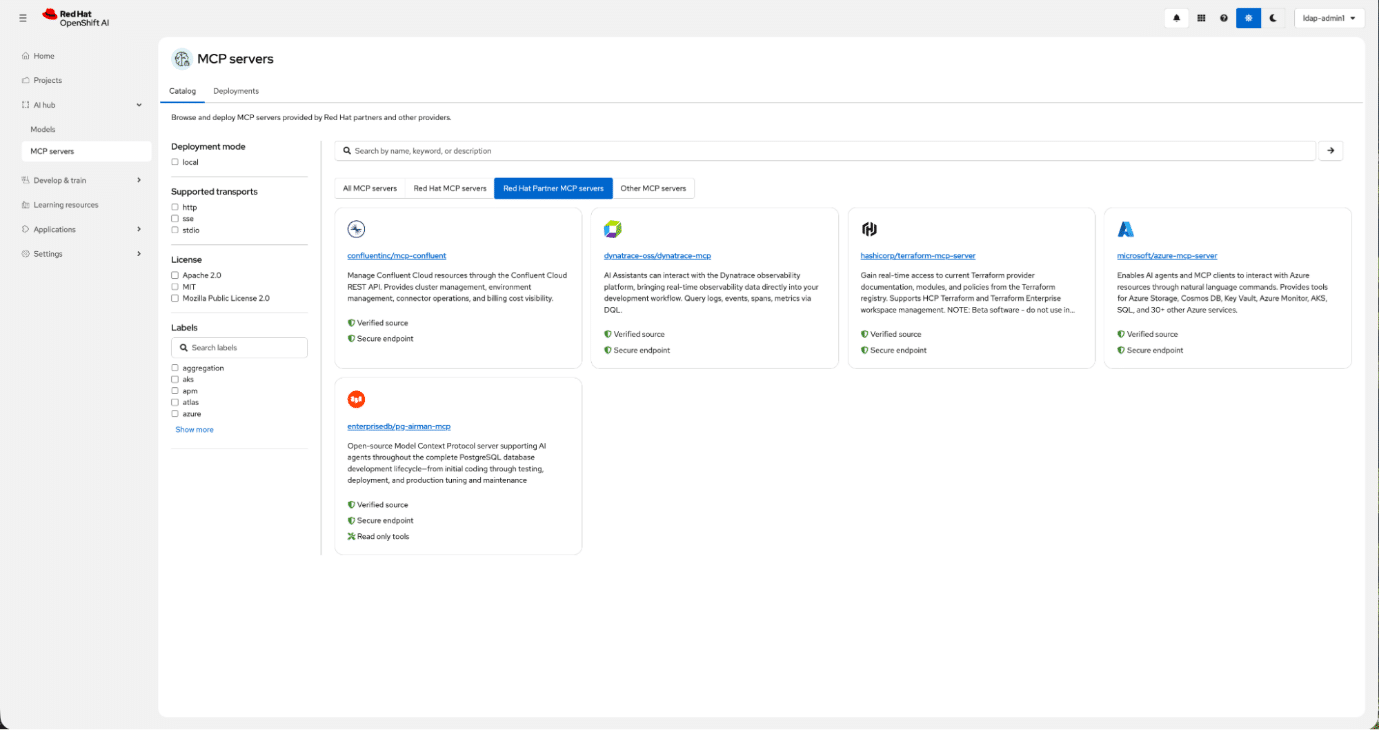
Technology Partner MCP Servers
Several strategic technology partners contribute MCP servers that extend AI capabilities across enterprise environments.
- Confluent Cloud
- EDB Postgres AI
- IBM Terraform
- Microsoft Azure
- Dynatrace
These integrations allow AI agents to manage cloud resources, automate infrastructure provisioning, monitor application performance, interact with databases, and support streaming data operations.
Community MCP Servers
Open-source MCP servers available in the catalog include:
- MongoDB
- MariaDB
These servers enable AI agents to access and manage structured and unstructured data sources commonly used in enterprise AI applications and retrieval-augmented generation (RAG) architectures.
Simplifying Enterprise AI Integration
Before the introduction of the MCP Catalog, integrating MCP servers often required several manual steps, including locating source code repositories, building containers, configuring security settings, and troubleshooting connectivity issues.
With OpenShift AI 3.4, these tasks are significantly simplified. Users can deploy supported MCP servers directly from the catalog, while OpenShift AI handles deployment automation, connectivity, and lifecycle management.
Expanding the Enterprise MCP Ecosystem
The MCP Catalog represents the first phase of a broader strategy to build a scalable enterprise AI ecosystem.
Future enhancements will focus on:
AI Quickstarts
Industry-focused, preconfigured AI solutions that help organizations rapidly move from experimentation to production.
Expanded MCP Server Catalog
Continuous onboarding of validated MCP servers from partners and the open-source community.
Enterprise Governance
Advanced controls for supply chain security, asset certification, trust management, auditability, and policy enforcement across AI agent interactions.
Getting Started
The MCP Catalog in Red Hat OpenShift AI 3.4 provides organizations with a governed and enterprise-ready framework for integrating AI agents with enterprise systems. By combining curated MCP servers, automated deployment, secure connectivity, and lifecycle management, Red Hat is helping simplify the path from AI experimentation to production deployment.
Whether you’re building intelligent operations workflows, automating infrastructure management, or connecting AI agents to enterprise applications, the MCP Catalog offers a scalable foundation for enterprise AI innovation.