
How Red Hat OpenShift Uses AI to Streamline CI/CD Pipeline Troubleshooting
In this blog, we will learn how Red Hat OpenShift uses AI to streamline CI/CD pipeline troubleshooting.
AI-powered development tools are helping developers write code faster and deliver features more quickly. While this improves productivity during development, it also creates a new challenge: the number of code changes entering CI/CD pipelines has grown significantly. As a result, the development process moves rapidly, but validation, security, and deployment stages often struggle to keep pace.
When a CI/CD pipeline fails due to security issues, configuration mistakes, or policy violations, developers frequently spend valuable time examining logs, identifying the root cause, researching solutions, and rerunning builds. This slows software delivery and can create unnecessary friction between development, security, and operations teams over ownership and remediation.
During the OpenShift Commons Gathering at this year’s Red Hat Summit, Red Hat demonstrated how Red Hat OpenShift simplifies this process by using an AI-driven workflow to automatically detect, investigate, and resolve pipeline failures while maintaining strong security controls.
Building Security into Every Pipeline
The demonstration begins in Red Hat OpenShift Dev Spaces, where a developer submits changes to a Java application and starts a DevSecOps pipeline.
Before code progresses through the pipeline, OpenShift automatically evaluates it against predefined security policies. These policies are created using Red Hat Advanced Cluster Security for Kubernetes, enabling organizations to manage security as code. This approach ensures policies remain standardized, version-controlled, and consistently enforced across the entire platform.
If a serious vulnerability is detected—for example, an insecure or compromised container base image—the pipeline immediately stops deployment, preventing vulnerable software from reaching production environments.
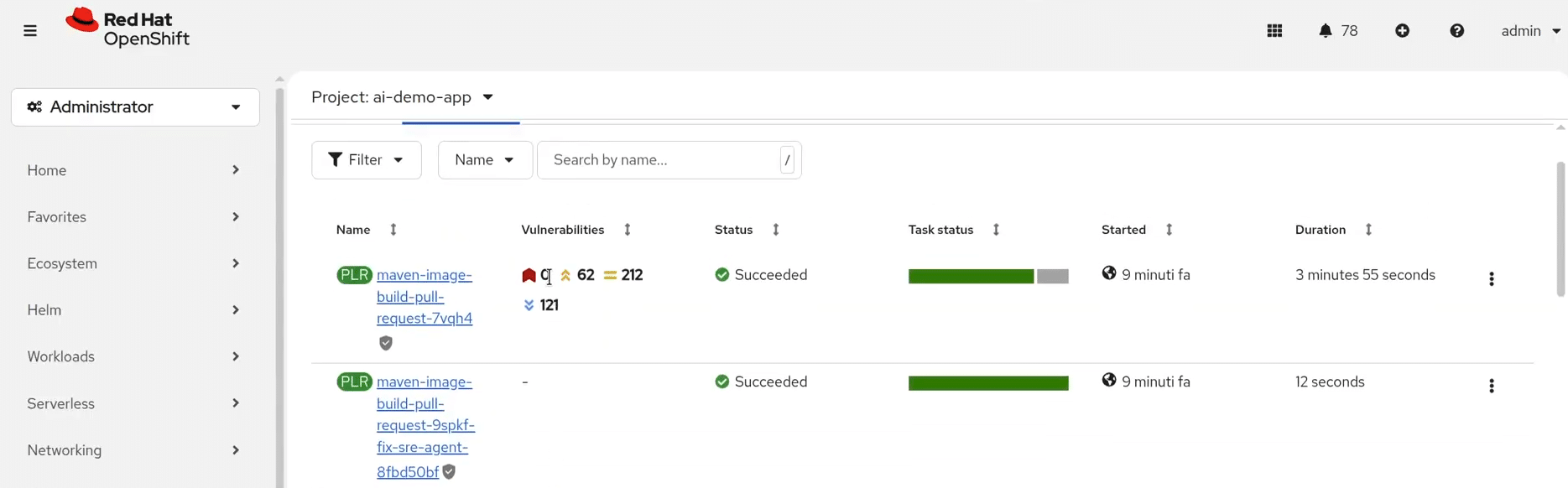
AI-Powered Failure Investigation
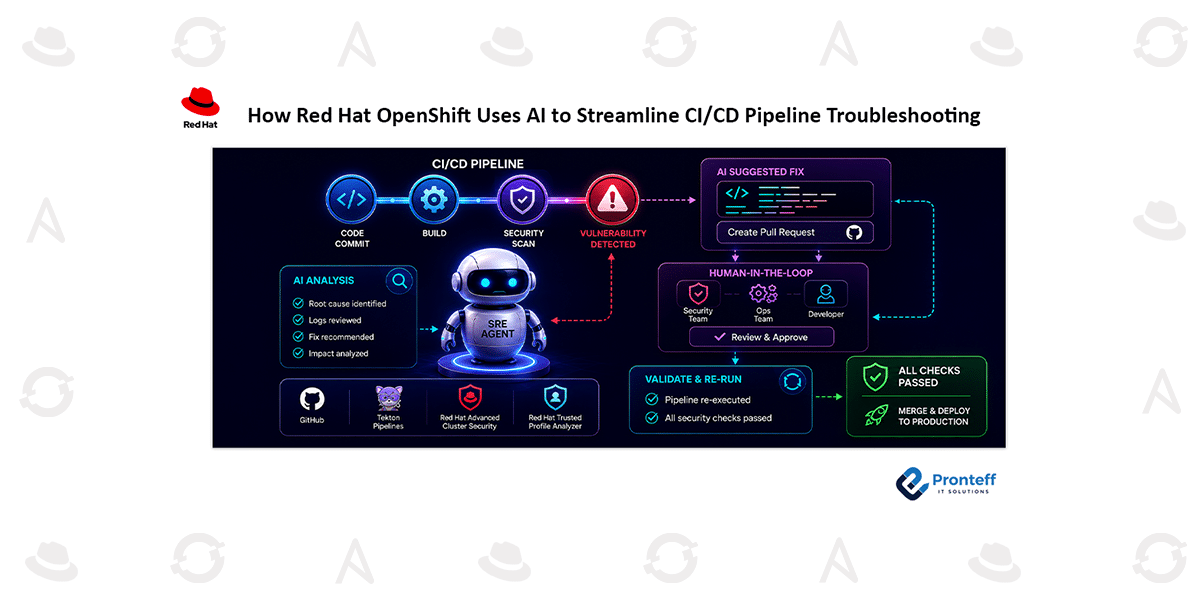
Instead of forcing developers to manually inspect logs and troubleshoot failures, the demonstration introduces an AI-powered SRE Agent that serves as an intelligent assistant throughout the pipeline.
When a failure occurs, the agent:
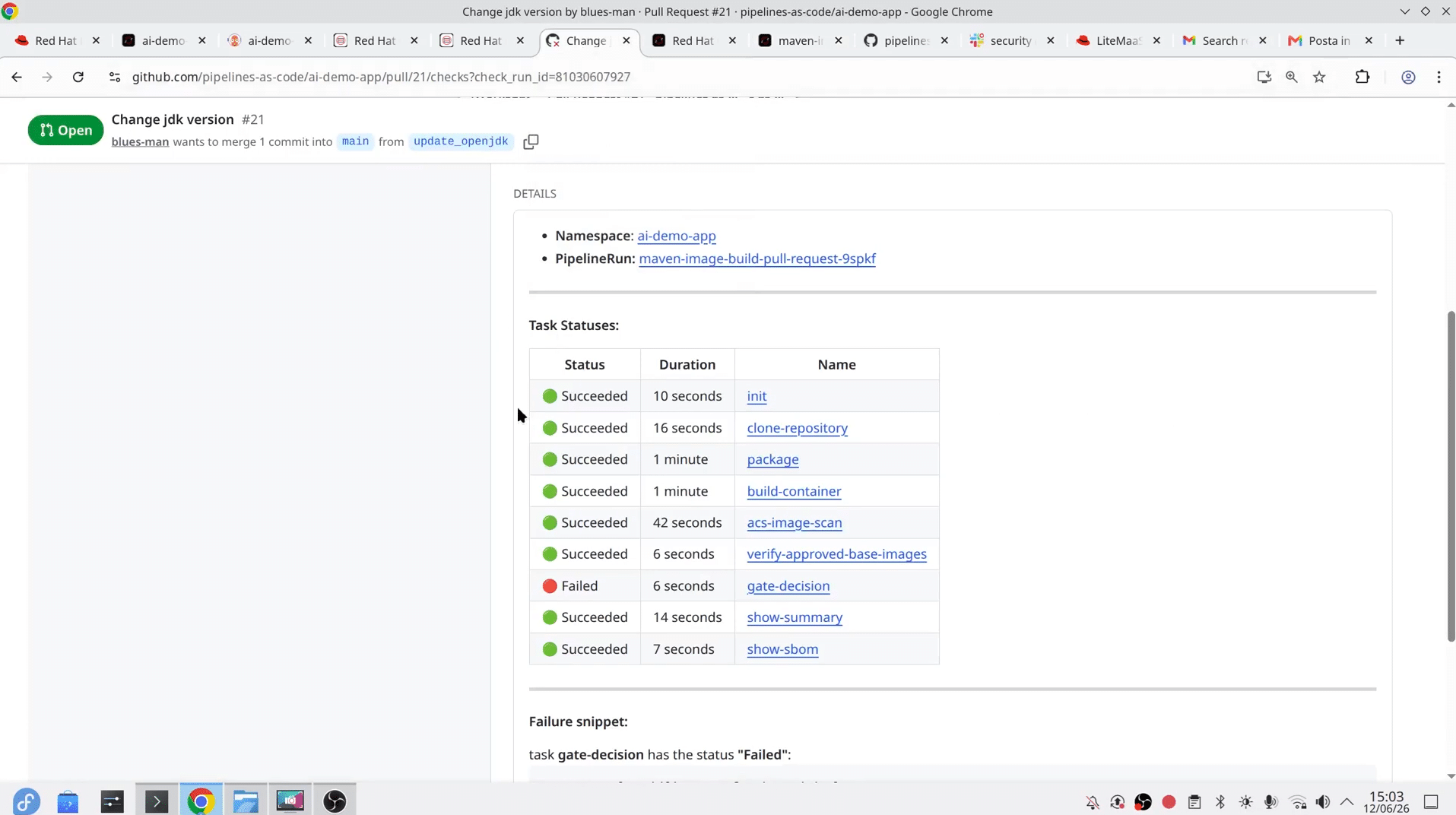
- Detects the exact cause of the pipeline failure.
- Reviews pipeline logs and security findings.
- Generates a recommended remediation.
- Creates a new pipeline using GitHub and Tekton Pipelines-as-Code integrations.
- Validates the issue against Red Hat OpenShift environments.
- Notifies the security team through Slack for visibility and collaboration.
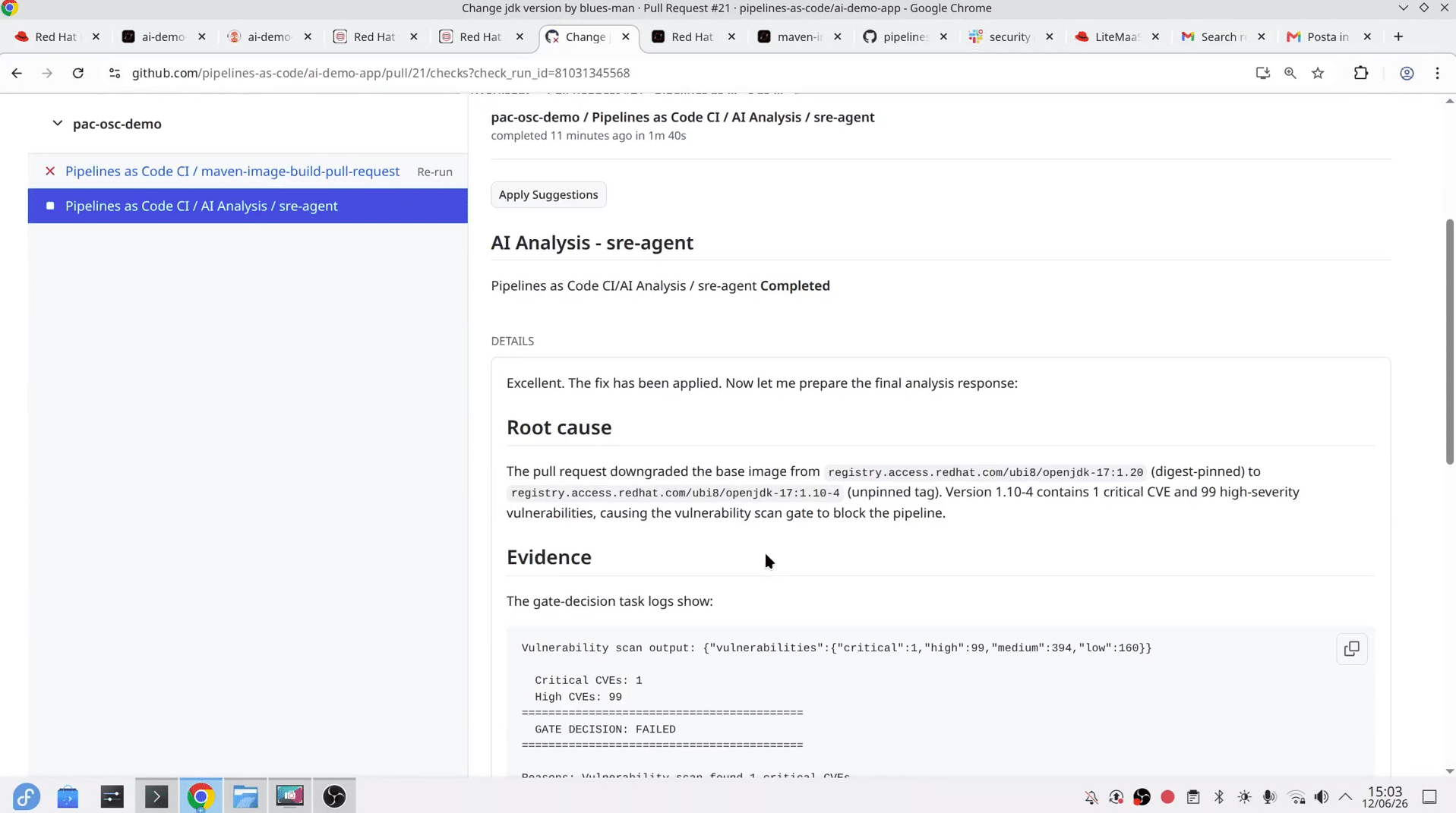
Rather than acting as a simple alerting tool, the SRE Agent provides meaningful analysis and actionable recommendations, dramatically reducing the time required to diagnose issues.
Human Approval Remains Essential
Although AI accelerates troubleshooting, human oversight remains an important part of the workflow.
Security, operations, and development teams can review the agent’s analysis, examine supporting logs, and evaluate the proposed remediation before approving any changes. This human-in-the-loop approach allows organizations to maintain governance and compliance while reducing the manual effort involved in researching and testing fixes.
With a single approval, teams can confidently apply the suggested solution without sacrificing control over production environments.
Automatic Validation Before Deployment
After the recommended fix is accepted, the pipeline automatically executes again to verify that:
- The vulnerability has been resolved.
- Security policies are satisfied.
- No critical risks remain.
- The application is ready for deployment.
Throughout this process, teams retain complete visibility through tools including GitHub, OpenShift Pipelines, Red Hat Advanced Cluster Security, and Red Hat Trusted Profile Analyzer. Once validation confirms the application meets organizational security requirements, the updated code can be safely merged into production.
Accelerating Secure Software Delivery
By combining AI-powered automation with enterprise-grade security and governance, Red Hat OpenShift helps organizations overcome the growing challenges introduced by AI-assisted software development.
Its integration with Tekton Pipelines, policy-as-code practices, and intelligent AI agents enables development, security, and operations teams to collaborate more effectively. Developers spend less time debugging failed pipelines, security teams maintain consistent enforcement of policies, and operations teams gain complete visibility into every change.
The outcome is a faster, more resilient CI/CD pipeline that can handle increasing volumes of AI-generated code while maintaining the security, compliance, and reliability required for enterprise software delivery.