
Handling Websocket Connection in IBM API Connect
In this blog, we will learn how to handle a WebSocket connection in IBM API Connect.
Introduction
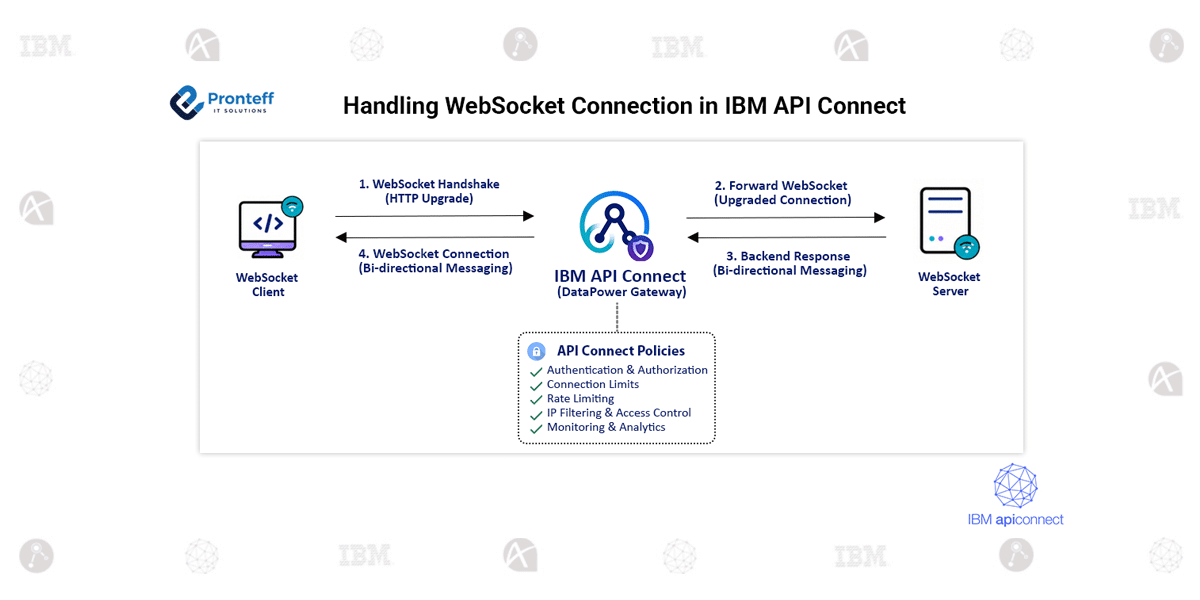
IBM API Connect improves standard WebSocket communication by adding control, security, and governance at the API gateway level for WebSocket connections.
Instead of letting the client communicate directly with the backend WebSocket server, the whole connection process is handled through policies in the API Connect Gateway.
This helps enterprises manage real-time communication in a more controlled and secure way without exposing the backend WebSocket services directly.
The main part that makes this possible is the WebSocket-Upgrade policy, which changes an incoming HTTP request into a WebSocket connection inside the API flow.
Core Capabilities:
Centralized Gateway Control: All WebSocket traffic goes through the API Gateway, so everything is managed in one place and the backend isn’t exposed directly.
Connection Management: Sets limits on how many connections a client can make to avoid overload and make sure everyone uses the service fairly.
Traffic Regulation: Limits how much traffic is allowed before and during the connection to stop excessive use.
Observability & Monitoring: Keeps track of connection events and traffic activity, which helps with finding problems and checking performance.
Configuration Steps:
- Create an API and add the WebSocket-Upgrade policy in the assembly flow.
- Provide a target service URL using HTTPS to meet validation requirements.
- Add the WSS scheme to the list of supported schemes for the API.
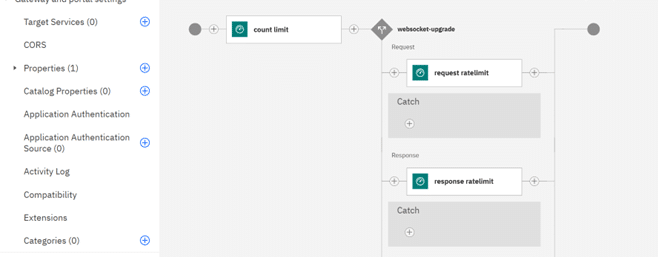
- Put a count Limit policy before the WebSocket upgrade to manage how many connection attempts are allowed.
- Set up standard rate limit policies in both the request and response flows inside the WebSocket-Upgrade policy to handle message traffic.
Conclusion
The WebSocket-Upgrade policy in IBM API Connect changes how WebSocket is used from a direct, uncontrolled channel into a secure, policy-based API feature.
Adding gateway-level control over connections, rate limiting, and security, it lets enterprises safely use real-time communication at scale.