
What Is the Red Hat OpenShift AI Model Catalog?
In this blog, we will learn about the Red Hat OpenShift AI Model Catalog.
The open-source AI ecosystem is thriving, offering an unprecedented variety of powerful models. Developers can now choose from reasoning-focused architectures like DeepSeek and Kimi K2, highly versatile solutions like the popular Qwen family, or lightweight, edge-optimized options like IBM’s Granite 4. However, this wealth of choices can easily lead to analysis paralysis.
Today, the primary challenge for organizations isn’t finding an open-source model—it is determining which one will deliver the best performance under specific operational constraints. A team designing an autonomous, agentic workflow needs maximum reasoning capabilities, whereas a team building a customer-facing chatbot must prioritize ultra-low latency.
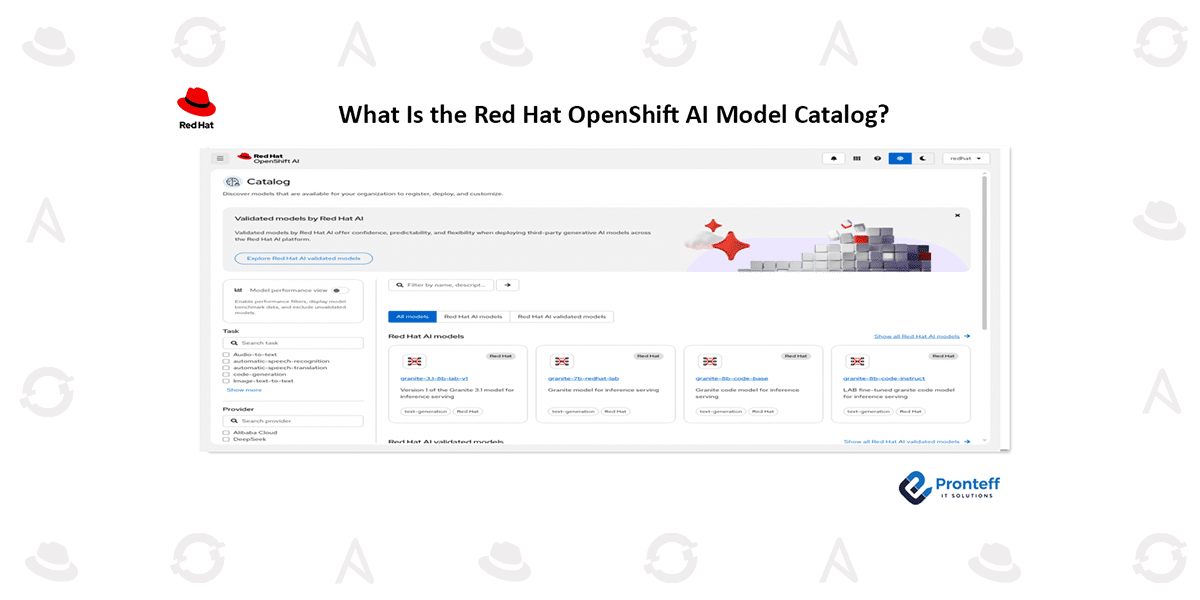
This is where the Red Hat OpenShift AI model catalog steps in. Instead of forcing teams to manually scout different repositories and untangle conflicting performance metrics, OpenShift AI consolidates the world’s leading open-source models into a single, organized library. It offers a unified platform to discover, compare, and deploy models with just a few clicks, backed by reliable, industry-standard benchmarks.
Effortless Model Discovery and Curation
The catalog’s main dashboard simplifies exploration by organizing models by name, version, parameter count, and quantization status. To help users find the perfect fit, the interface features a robust left-hand filtering panel to sort models by intended use case (such as code generation or speech recognition) and provider, alongside a global search bar.
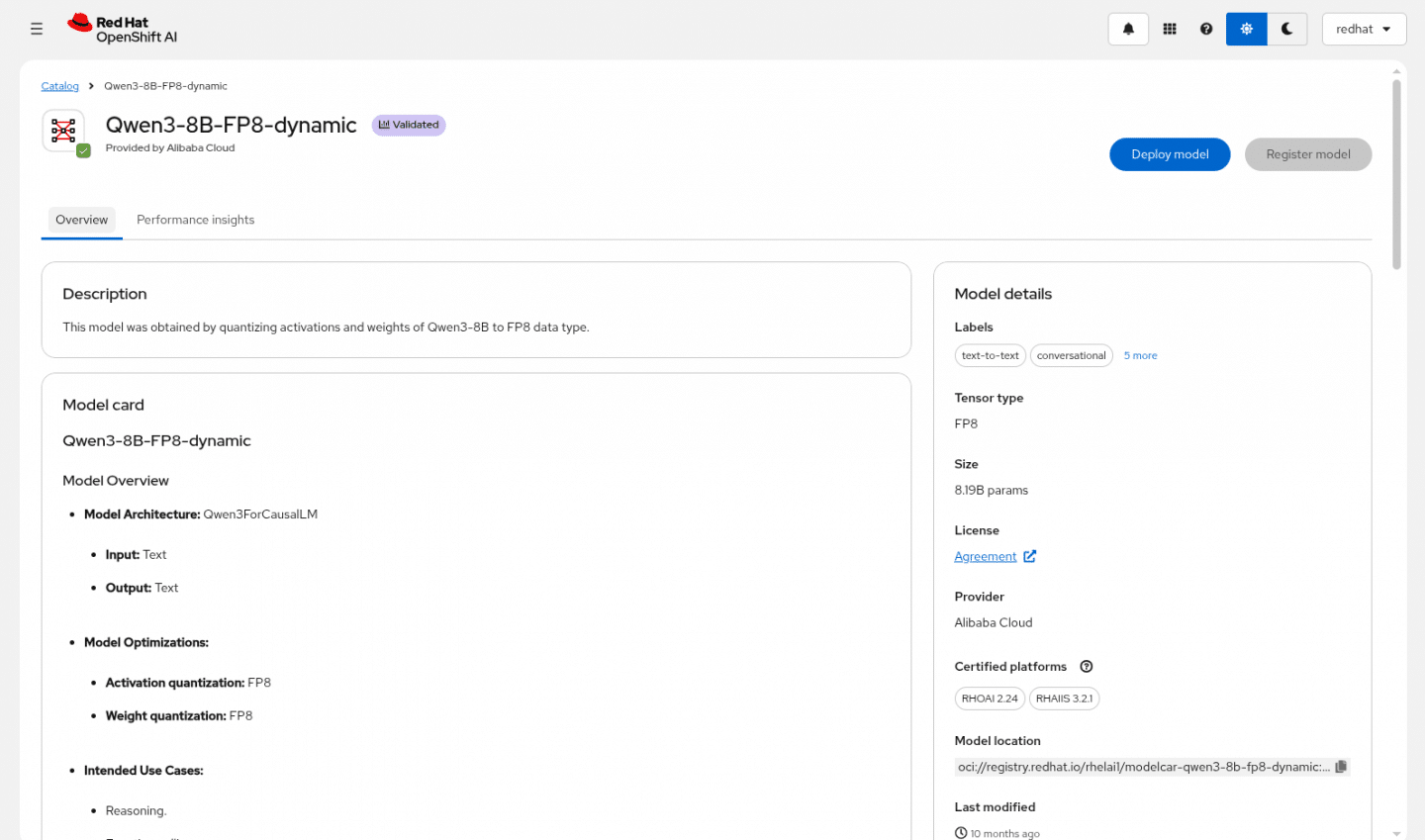
For teams looking to optimize speed and resource consumption, the catalog includes specialized, quantized versions of popular Large Language Models (LLMs). These have been streamlined using LLMCompressor, an open-source optimization tool.
To ensure seamless enterprise integration, these models are packaged as portable container images according to Open Container Initiative (OCI) standards and hosted securely in Red Hat’s registry. This approach allows organizations to manage, version, and govern AI models using the exact same DevOps and automation pipelines they use for traditional microservices.
Deep Technical Transparency and Insights
Selecting a model opens a comprehensive overview page detailing its architecture, licensing, and intended applications. For verified models, Red Hat explicitly lists the specific OpenShift AI versions certified for compatibility. Furthermore, users can inspect objective text-performance metrics evaluated via lm_evaluation_harness against HuggingFace OpenLLM V1 and V2 benchmarks.
The true standout feature of the catalog, however, is its Performance Insights. Red Hat’s validation teams rigorously test these models across practical, real-world scenarios—including interactive chatbots, Retrieval-Augmented Generation (RAG) pipelines, and coding assistants.
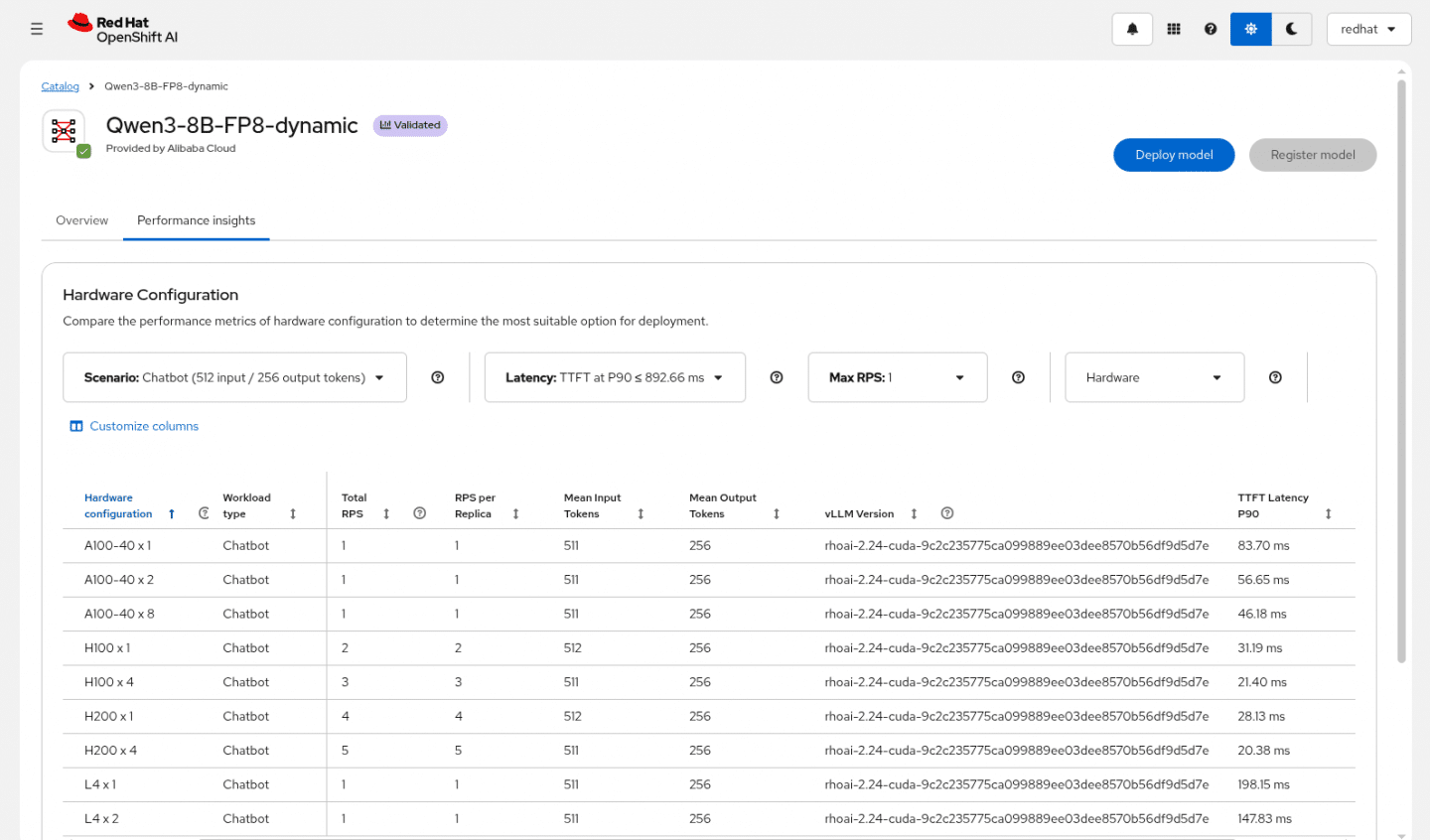
Tested on cutting-edge NVIDIA hardware (including A100, B200, H100, H200, and L4 GPUs) running the vLLM serving engine, the platform provides critical user-experience metrics:
-
Time-to-First-Token (TTFT): Measures how long a model takes to begin responding to a prompt.
-
Tokens-Per-Second (TPS): Measures the sustained generation speed of the response.
Users can easily filter these performance tables by hardware configuration, specific use case, or maximum requests per second (RPS) to see exactly how a model will behave in their environment.
Frictionless Deployment
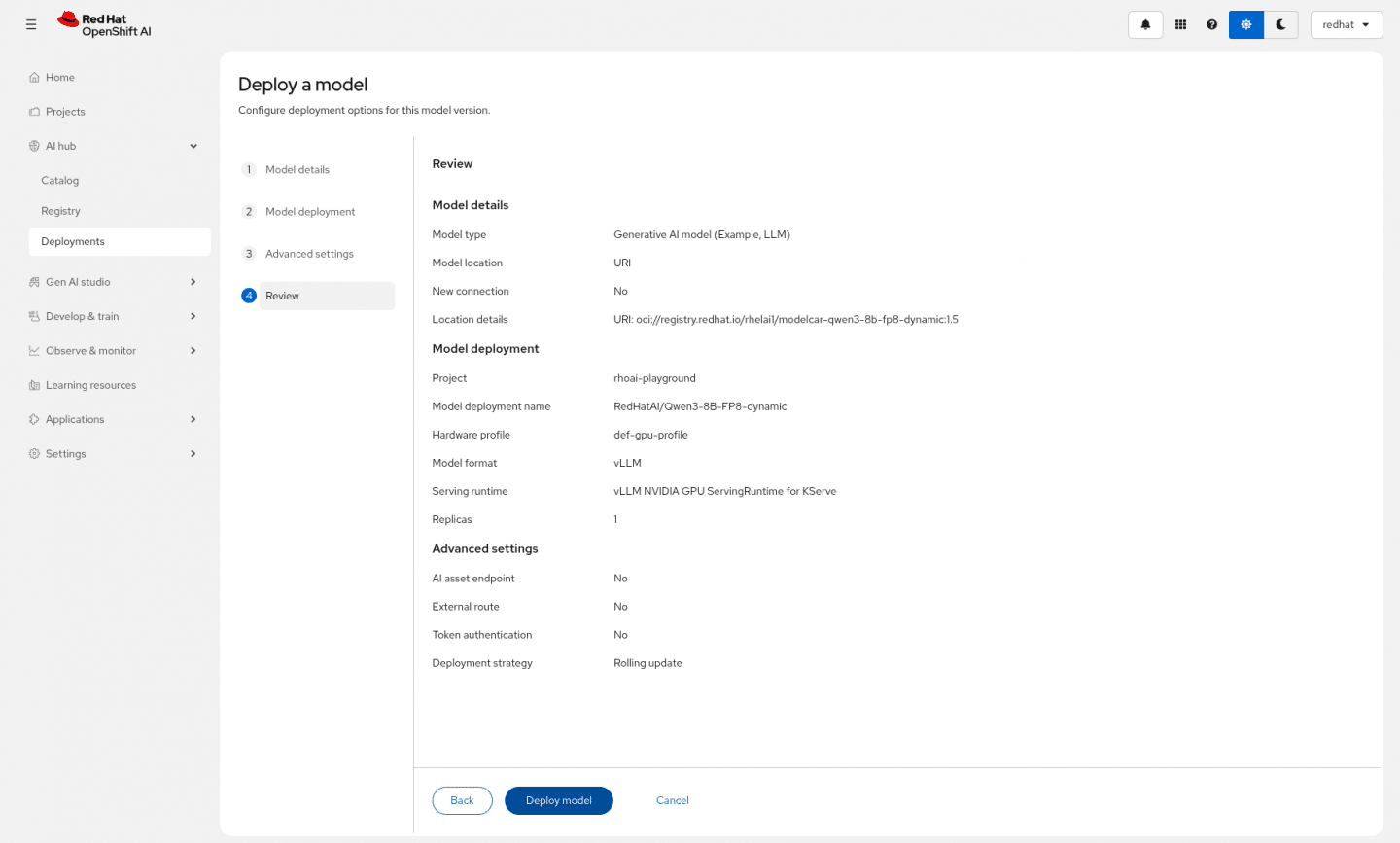
Once the ideal model is identified, moving to production takes moments. By filling out a brief configuration form—confirming details like the project environment, serving runtime, token authentication, and deployment strategy—teams can launch the model instantly with a single click.
By eliminating tedious manual environment setups, Red Hat OpenShift AI empowers teams to shift instantly from evaluation to application development, accelerating time-to-value for enterprise AI initiatives.