
Faster VM Migration with Storage Processing in MTV 2.12
In this blog, we will learn how to migrate VMs faster with storage processing in MTV 2.12.
Red Hat’s latest Migration Toolkit for Virtualization (MTV) 2.12 is aligned with Red Hat OpenShift 4.22 and introduces several enhancements aimed at making VM migrations faster, more flexible, and easier to manage. The release focuses on storage-based migration processing, expanded source-platform support, and AI-assisted migration capabilities.
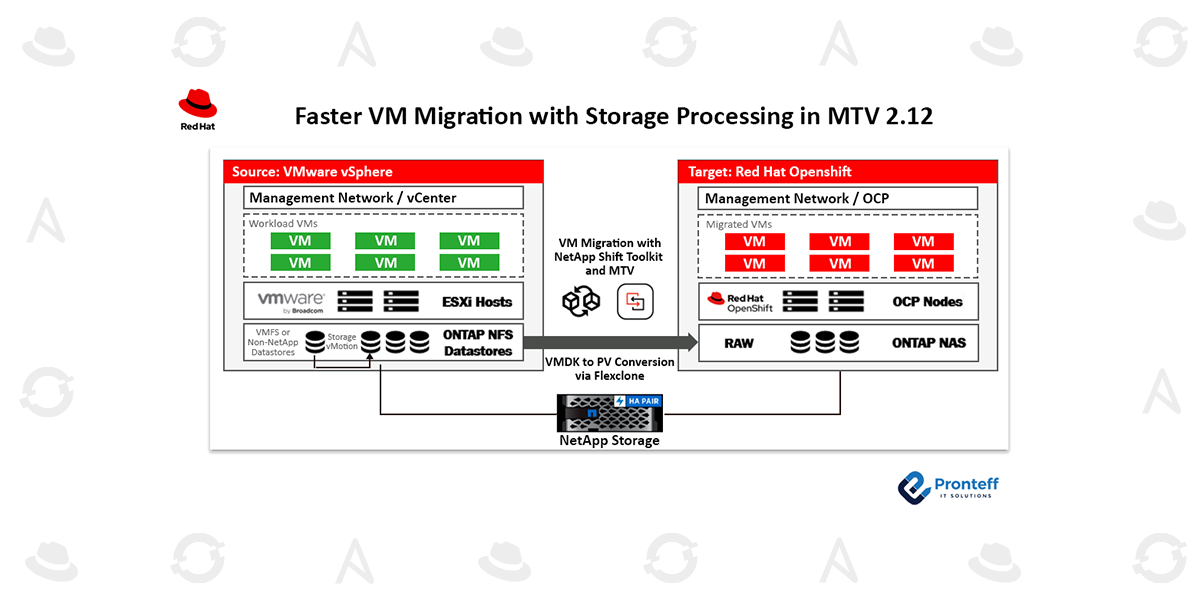
A key improvement is the ability to move away from traditional network-intensive migration methods by taking advantage of intelligent storage technologies. Integration with the NetApp Shift Toolkit provides organizations with a new approach to accelerating VM migrations.
Accelerate VM Migration with NetApp Shift Toolkit
Organizations running virtual machines on NetApp ONTAP storage can now take advantage of NetApp Shift Toolkit integration with MTV. Migration activities can be initiated through the familiar MTV user interface, while Shift Toolkit handles the underlying VM conversion and storage operations.
The integration moves much of the migration workload to the storage layer. Shift Toolkit uses storage-based cloning technology to create an instant copy of the VM filesystem within the same storage environment. This eliminates the need to transfer the complete VM data across the network.
The source VM can continue operating while changes are maintained separately on the cloned copy. This enables fast, zero-copy cold migration scenarios and can significantly reduce migration time and service disruption compared with conventional data-copy approaches.
Storage Offload for Warm Migrations
Storage offload for warm migrations is now generally available in MTV 2.12, providing another way to reduce downtime during VM transitions.
Warm migration allows most of a VM’s data to be transferred while the workload remains active. Only the changes made during the final stage need to be synchronized before the workload is moved to its new environment.
With storage offload, supported enterprise storage systems can handle snapshot-related processing directly. This reduces the processing burden on the hypervisor, helps maintain data consistency, and minimizes the duration of the final cutover.
Expanded Source Platform Support
MTV 2.12 also expands the range of environments from which organizations can begin their modernization journey. Two additional source platforms are introduced as Technology Preview capabilities:
- Microsoft Hyper-V: Provides organizations with an opportunity to test migration workflows from Hyper-V environments to OpenShift Virtualization.
- Amazon EC2: Enables teams to explore VM migration from AWS EC2 environments to OpenShift-based infrastructure, including OpenShift clusters running on AWS.
These additions give organizations more flexibility when planning their transition to OpenShift Virtualization.
Advancing Migration with AI
AI is becoming an increasingly important part of migration planning and operations. The MTV team is continuing to explore ways AI can simplify migration troubleshooting, planning, and execution.
Red Hat OpenShift Lightspeed Integration
Integration work between MTV and Red Hat OpenShift Lightspeed is underway. Migration documentation, troubleshooting guidance, and recommended practices are being incorporated into the AI-powered assistant.
The goal is to allow users to interact with migration resources using natural-language questions. In the future, users will be able to receive guidance and recommendations for resolving migration issues without having to manually search through extensive documentation.
AI-Assisted Migration with MCP
MTV 2.12 also introduces an MCP (Model Context Protocol) server as a Developer Preview. The server enables AI assistants to access relevant MTV documentation and resources when helping users plan and analyze VM migrations.
By connecting an AI assistant or large language model with MTV-specific resources, organizations can receive more contextual guidance throughout the migration process. This can help simplify complex migration tasks and support teams as they move traditional virtual machines to OpenShift Virtualization.