

Why AI Agents Need More Than an Agent Framework: Closing the Production Gap
In this blog, we will learn why AI Agents need more than an agent framework.
AI agents are rapidly moving from experimentation into enterprise production. Organizations are using them to manage support requests, automate workflows, process transactions, retrieve information, and interact with business applications.
But there is a major difference between an agent that works in development and one that can be trusted in production.
An agent may perform perfectly during testing and still create duplicate records, access unauthorized resources, execute an incorrect transaction, or provide inaccurate information once it starts interacting with real systems and customers.
The problem is not always the AI model or the agent framework.
The bigger challenge is the production infrastructure surrounding the agent.
Frameworks such as LangChain, LangGraph, CrewAI, and custom runtimes help developers build reasoning workflows, connect tools, and orchestrate multi-step tasks. However, organizations also need identity management, security, governance, observability, policy enforcement, and operational controls before autonomous agents can safely operate at scale.
When an AI Agent Meets Production
Consider an AI agent responsible for customer support, billing operations, and customer communications.
In a development environment, everything appears to work correctly. The prompts have been refined, tools are connected, and test cases produce expected results.
Production introduces a different set of conditions.
An API may successfully complete an operation but fail to return a response. A model may select the wrong resource. A generated response may contradict an organization’s actual policy.
These situations reveal a critical gap between the agent layer and the infrastructure layer.
Retries Can Create Duplicate Actions
Suppose an AI agent creates support tickets through a ticketing API.
The agent sends a request, and the API successfully creates the ticket. However, the response times out before reaching the agent.
The agent assumes the request failed and retries.
The second request creates another ticket.
Without proper controls, repeated retries can result in duplicate records, duplicate notifications, and unnecessary operational work.
The retry mechanism itself is not the problem. Retrying failed operations is a standard reliability practice.
The missing capability is idempotency—ensuring that repeating the same request does not unintentionally create multiple outcomes.
Production environments should therefore include mechanisms such as idempotency keys, request tracking, deduplication, transaction state management, and audit trails.
These controls protect the business when an agent encounters network failures, timeouts, or unexpected downstream behavior.
Broad Credentials Can Increase the Impact of AI Errors
Now consider an agent processing billing transactions.
During development, the agent may receive broad credentials because they make testing easier. But if those permissions remain unchanged in production, a relatively small model error can become a serious security incident.
Imagine the agent needs to process a transaction for Customer A but selects Customer B’s account identifier.
If the agent has permission to access multiple customer accounts, the downstream system may accept the request.
The problem goes beyond the AI model choosing the wrong account. The infrastructure allowed the agent to act on a resource it should never have been able to modify.
This is why identity and least-privilege access are critical for AI workloads.
Production environments should establish:
- Workload identity
- Scoped credentials
- API and resource-level authorization
- Secrets management
- Credential rotation
- Access auditing
- Clearly defined permissions
The model should never be the security boundary. An agent should not be trusted to decide what it is allowed to access.
Confident AI Responses Can Still Be Wrong
Not every AI failure involves an API or financial transaction.
Customer-facing responses can create another significant risk.
Imagine a customer asks about a product’s return policy. The organization’s actual policy allows returns within 30 days, but the AI agent responds that returns are accepted for 90 days.
The response may be clear, professional, and completely incorrect.
If that answer reaches the customer without validation, the organization may have to deal with refunds, customer disputes, compliance concerns, or reputational damage.
This is where AI guardrails and output validation become important.
The model’s response should not always move directly from inference to action.
A production workflow can introduce additional checks:
AI output → Policy validation → Business-rule validation → Approval or action → External system
This creates a control point where important responses and decisions can be evaluated against trusted information before reaching customers or critical systems.
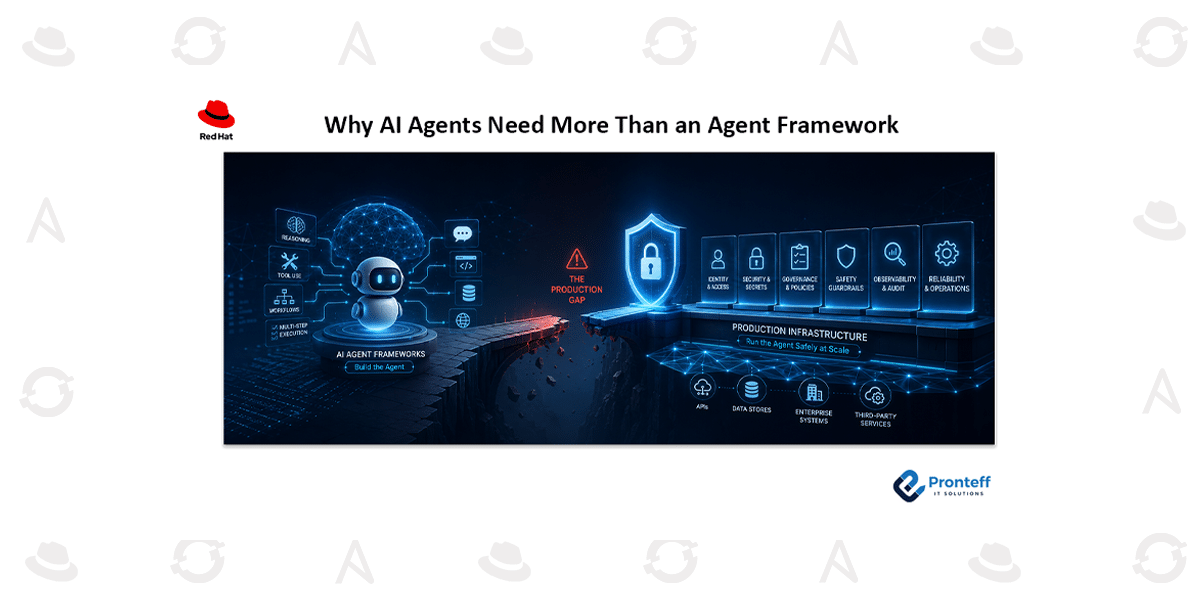
The Production Gap
These failures may appear unrelated, but they share a common root cause: the agent has capabilities without sufficient infrastructure-level controls.
| Challenge | Production Capability |
|---|---|
| Duplicate actions | Idempotency and deduplication |
| Excessive access | Identity and least-privilege controls |
| Incorrect transactions | Policy enforcement |
| Unsafe responses | Output validation and guardrails |
| Uncontrolled tool usage | Tool governance |
| Exposed credentials | Secrets management |
This highlights an important distinction between an agent framework and a production AI platform.
Agent frameworks help developers build the agent loop, connect models to tools, manage workflows, and execute tasks.
A production platform addresses the environment around that agent: identity, security, governance, observability, workload management, and operational reliability.
Both layers are important.
Bringing Existing Agents Into Production
Organizations do not necessarily need to rebuild their AI applications to introduce these controls.
A Bring Your Own Agent (BYOA) approach allows enterprises to continue using existing frameworks and agent architectures while adding the infrastructure required for production deployment.
Red Hat OpenShift AI provides a platform foundation for developing and operationalizing AI workloads in enterprise environments. This approach allows organizations to build on their existing AI investments while addressing the operational requirements associated with production AI.
The goal is not to replace the agent’s reasoning framework.
It is to provide a secure and governed foundation underneath it.
From “Works” to “Production-Ready”
The important question for organizations developing AI agents is not simply:
“Does the agent work?”
The more important question is:
“What happens when the agent is wrong?”
What happens when an API times out after completing a transaction?
What happens when an agent selects the wrong customer?
What happens when an AI-generated answer conflicts with company policy?
What happens when credentials are compromised?
And can your team determine exactly what happened afterward?
These questions reveal whether an AI agent is truly ready for production.
AI agents can deliver significant business value, but autonomy also introduces new operational and security requirements. Organizations need infrastructure that establishes clear boundaries around what agents can access, what they can do, and how their actions are monitored.
Agent frameworks provide the intelligence and orchestration layer. Production infrastructure provides the identity, security, governance, observability, and reliability foundation required to operate those agents safely.
The path from an AI agent that works in development to one that can be trusted in production requires more than better prompts and model selection.
It requires the right foundation.