
How Do EDB and Red Hat Enable Resilient Automation?
In this blog, we will learn how EDB & RedHat enable Resilient Automation.
In today’s fast-moving digital landscape, IT environments must consistently deliver high performance and reliability to keep business operations running without disruption. Centralized automation solutions like Red Hat Ansible Automation Platform play a vital role in managing complex infrastructure. By standardizing and scaling automation across teams and environments, organizations can convert repetitive, manual processes into structured, secure, and repeatable workflows aligned with enterprise governance requirements.
At the core of any mission-critical automation strategy is resilience. Reliability is not optional—it is foundational. High Availability (HA) at the database layer provides the protection that automation systems depend on, ensuring that critical processes continue even when infrastructure components encounter issues. True resilience extends beyond simple uptime, delivering continuous database availability that supports automation across the enterprise.
To strengthen this foundation, Red Hat and EDB have collaborated to offer a more robust enterprise automation solution. Organizations can now deploy production-ready EDB PostgreSQL clusters with enterprise-grade HA and automated failover capabilities to support the Ansible Automation Platform in demanding production environments.
Enabling Enterprise-Grade Resilience
This joint solution focuses on delivering continuous PostgreSQL availability to the automation platform by reinforcing the database layer.
By integrating EDB Postgres AI capabilities with Ansible Automation Platform, customers receive a fully validated and tested architecture designed to support mission-critical automation workloads. The result is a production-ready PostgreSQL backend engineered for continuous operations and long-term stability.
The solution is built on three tightly integrated capabilities:
1. Automated Deployment
Using familiar Ansible-based tooling, the entire HA cluster can be provisioned and configured automatically. This includes the operating system, PostgreSQL database, and failover management components. The deployment follows EDB’s established best practices and validated reference architectures, enabling organizations to scale automation with resilience embedded from the outset.
2. High Availability and Failover Management
This capability continuously monitors cluster health, manages the Virtual IP, and automates failure detection and switchover processes. If an issue occurs, the system promotes the standby node with minimal disruption. This active management ensures uninterrupted database availability and sustained access to the automation platform.
3. Disaster Recovery (DR)
Beyond high availability, built-in disaster recovery safeguards data integrity. The solution supports full and incremental backups, along with point-in-time recovery (PITR). These capabilities minimize data loss and accelerate recovery in the event of critical system failures.
How the Architecture Works
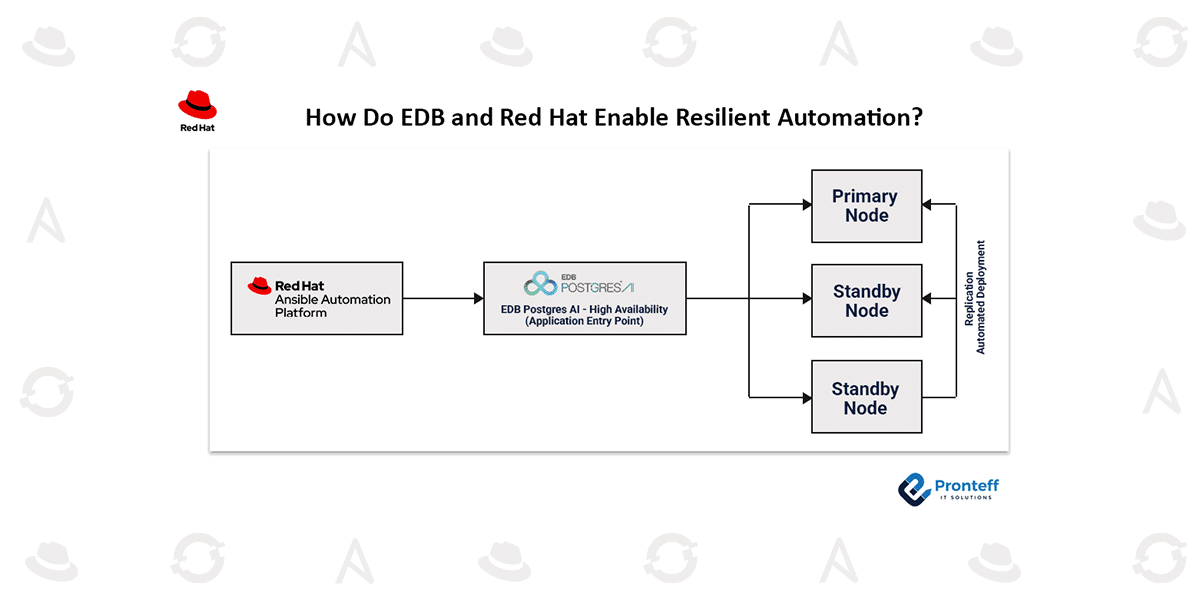
When Ansible Automation Platform is configured to use an external EDB Postgres AI database, enterprises gain advanced HA and DR functionality at the database layer—complementing the platform’s own resilience features.
This dedicated, clustered database setup supports continuous operations through:
- Infrastructure resilience: If a component of the automation platform becomes unavailable, data remains protected in the external database cluster.
- Active-passive replication: The architecture uses a Primary (active) node for read/write operations and a Standby (passive) node for real-time replication. If the Primary node fails, automated failover promotes the Standby to Primary, maintaining platform availability and business continuity.
Together, these capabilities create an integrated HA framework that combines automated failover, clustered database management, policy-driven automation triggers, and optional observability integrations.
Business Advantages
This validated configuration—developed jointly by EDB and Red Hat—helps organizations implement reliable HA replication, structured disaster recovery processes, and safeguards against common replication challenges. Automating the deployment process ensures the PostgreSQL backend remains production-ready and resilient.
Key benefits include:
- Automated high availability: Continuous monitoring, Virtual IP management, and automatic failover and failback maintain uninterrupted database operations.
- Streamlined deployment: Ansible-driven provisioning builds the full database cluster stack—from OS to PostgreSQL and failover management—using validated reference designs.
- Deployment flexibility: Organizations can choose between open source PostgreSQL and EDB Postgres AI database servers based on workload and operational preferences.
- Coordinated support model: EDB and Red Hat collaborate to support the full stack, simplifying issue resolution across both the automation platform and database infrastructure.
A Foundation for Future Innovation
The integration of EDB Postgres AI with Ansible Automation Platform represents a significant step toward more resilient enterprise automation. By delivering continuous PostgreSQL availability and simplifying the deployment of production-grade database backends, this solution reduces operational complexity while strengthening reliability.
Future enhancements will continue to build on EDB’s extensive PostgreSQL expertise and Red Hat’s leadership in enterprise automation architectures. Customer feedback will play a critical role in refining and expanding these capabilities, ensuring organizations have access to flexible, continuously available, and enterprise-ready automation solutions.