

Bridging AI Insights and Automated Operations
In this blog, we will learn how to turn AI Insights into Automated Operations.
Artificial intelligence is transforming every stage of IT operations. Modern AI systems can identify issues, analyze root causes, recommend solutions, and even execute corrective actions. However, as AI expands operational capabilities, it also introduces new challenges. Organizations now face an overwhelming volume of telemetry, alerts, tools, and interconnected systems that evolve at unprecedented speed.
As a result, the conversation has shifted. Enterprises are no longer asking whether AI can automate operational tasks—they are asking how to ensure AI-driven actions remain controlled, reliable, and compliant.
The Difference Between Intelligence and Execution
Knowing the correct action and executing that action safely are two distinct challenges.
AI excels at analyzing large amounts of operational data and generating recommendations. Yet production environments demand far more than recommendations. Every action must follow governance policies, respect role-based access controls, and maintain complete auditability.
For example, an AI assistant may determine that restarting a service will resolve a performance issue. However, executing that restart in a production environment requires validation, approvals, permissions, and safeguards. Red Hat Ansible Automation Platform provides these controls by ensuring actions occur only in approved environments, under authorized conditions, and with full traceability.
Organizations that already maintain tested automation workflows gain an additional advantage. Instead of generating new remediation logic for every event, AI can leverage existing automation assets. This approach reduces operational risk, lowers AI processing costs, and delivers more predictable outcomes as automation initiatives scale.
Why Many AI Initiatives Struggle to Deliver Results
Across industries, organizations continue to invest heavily in AI technologies. Yet many projects remain confined to proof-of-concept phases.
The challenge is rarely a lack of AI capabilities. More often, organizations encounter difficulties establishing the governance, oversight, and trust required before allowing AI-driven systems to influence production environments.
Research consistently shows that AI and agent-based initiatives frequently stall when they lack orchestration frameworks, approval mechanisms, and risk controls. Business leaders are understandably cautious about granting autonomous systems the ability to make infrastructure changes without visibility or accountability.
The challenge becomes even greater in hybrid and multivendor environments. Most enterprises rely on multiple monitoring, observability, and IT service management platforms. As a result, the execution layer must operate consistently across diverse technologies rather than being tied to a single vendor ecosystem.
Industry analysts increasingly emphasize that operational insights alone are insufficient. Real business value comes from combining AI-generated intelligence with trusted, governed automation capable of producing measurable outcomes.
Without a reliable mechanism that converts insights into action, AIOps investments often stop at recommendations rather than delivering operational improvements.
The Role of Red Hat Ansible Automation Platform in AIOps
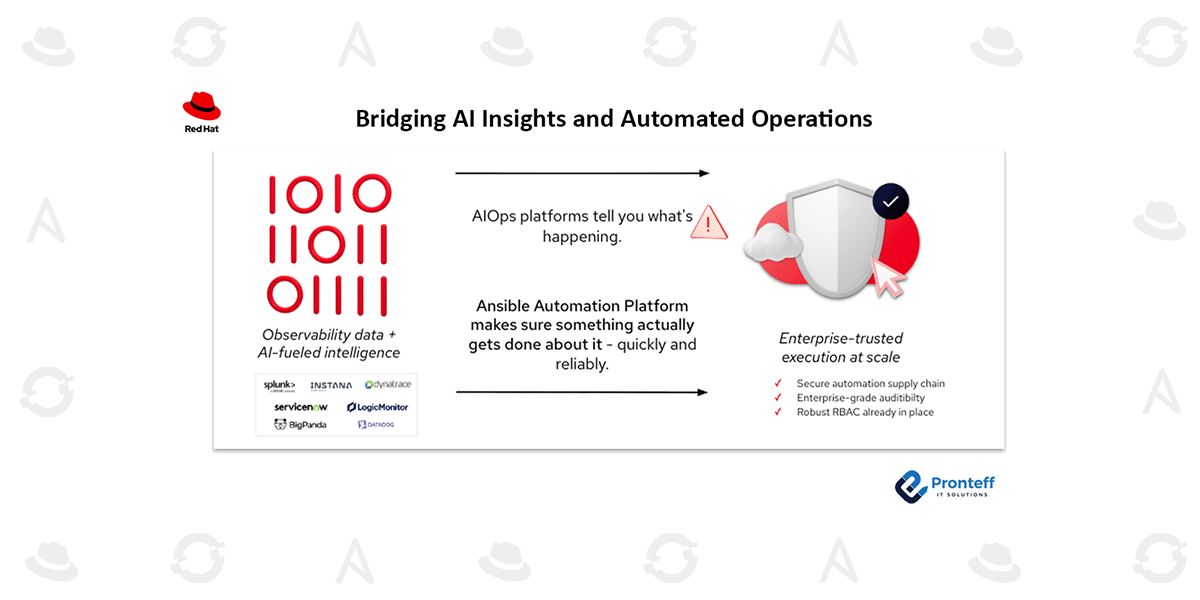
Observability and ITSM platforms play a critical role in detecting issues, correlating events, reducing alert noise, and identifying root causes. Solutions from vendors such as Splunk, IBM Instana, ServiceNow, Dynatrace, and LogicMonitor provide the intelligence necessary to understand operational conditions.
Red Hat Ansible Automation Platform complements these capabilities by serving as the execution and orchestration layer.
Rather than focusing on detection, Ansible Automation Platform specializes in turning intelligence into action across enterprise infrastructure, including:
- Network environments
- Public and private clouds
- Linux systems
- Windows platforms
- Containers and Kubernetes environments
- Storage infrastructure
- Security operations
Operational signals can enter the platform through event-driven integrations, APIs, or modern interfaces such as the Model Context Protocol (MCP). Regardless of the source, every action follows tested and reusable automation workflows that are auditable, governed, and aligned with organizational policies.
Built-in controls help prevent automation storms and conflicting remediation attempts. Approval workflows and human oversight mechanisms ensure organizations can adopt automation confidently without sacrificing governance.
In short, while detection and analysis may occur across multiple platforms, governed execution remains centralized and controlled.
Turning AIOps Strategy into Operational Success
Organizations that successfully move beyond AIOps pilot projects often begin with practical, low-risk use cases.
Initial efforts typically focus on activities such as:
- Enriching incident tickets with diagnostic information
- Automating certificate renewal and rotation processes
- Triggering approved remediation workflows for known conditions
- Collecting operational data for troubleshooting
Equally important is defining success criteria before implementation begins. Effective AIOps programs establish measurable objectives such as:
- Reduced mean time to resolution (MTTR)
- Improved automation success rates
- Lower false-positive alert volumes
- Increased operational efficiency
Clear metrics provide a foundation for evaluating progress and securing stakeholder confidence.
A Practical Approach to Scaling AIOps
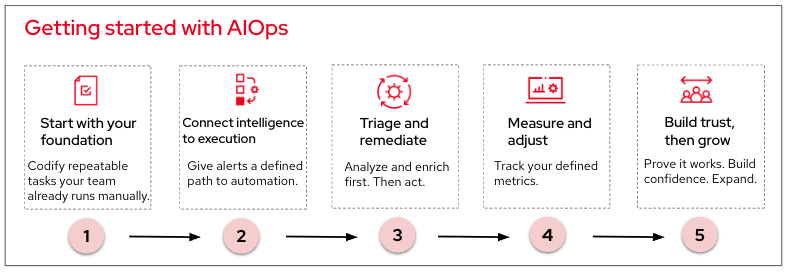
Organizations can accelerate adoption by following a structured progression:
Begin with Existing Processes
Identify operational tasks already performed manually or automated through established workflows. These processes provide a trusted foundation for future AI-driven automation.
Connect Intelligence to Automation
Integrate monitoring and observability systems with automation workflows. Start with predictable, low-risk scenarios that allow teams to validate outcomes and build confidence.
Prioritize Investigation Before Remediation
Focus initially on diagnostic and triage activities. Once teams establish trust in automated analysis, remediation workflows can be introduced gradually, particularly in regulated environments.
Measure Outcomes Continuously
Track agreed-upon performance indicators and use data-driven insights to refine processes and automation strategies.
Expand Through Proven Success
Consistent and auditable results create the trust necessary to extend automation into additional operational domains. Over time, organizations can introduce more advanced remediation workflows while maintaining governance controls.
Real-World Impact
Organizations across multiple industries are already realizing tangible benefits from combining AI insights with governed automation.
Financial services firms have implemented event-driven automation to process large volumes of infrastructure changes automatically while maintaining rollback capabilities and operational resilience.
Similarly, a major insurance provider operating across Spain and Latin America integrated Dynatrace with Event-Driven Ansible to automate incident response workflows, significantly reducing service ticket volumes and improving operational efficiency.
These examples demonstrate a broader trend: enterprises are increasingly moving from AI experimentation toward scalable operational transformation.
Looking Ahead
As AI becomes more capable, the focus of IT operations is shifting from simply generating insights to executing actions safely and reliably.
The organizations achieving the greatest value are those that combine AI intelligence with governance, automation, and operational accountability. By establishing a trusted execution layer, Red Hat Ansible Automation Platform enables enterprises to move beyond recommendations and deliver measurable outcomes across increasingly complex IT environments.
The future of AIOps is not just intelligent systems—it is intelligent systems paired with trusted, governed automation that can act with confidence at enterprise scale.