

Boost Automation with Ansible Content Collections
In this blog, we will learn how to boost automation with Ansible content collections.
Accelerating IT Automation with Enhanced Ansible Content Collections
One of the major advantages of Red Hat Ansible Automation Platform is its ability to support a broad range of IT automation scenarios with flexibility and scalability. To help organizations start automation initiatives more efficiently, the platform provides Ansible Content Collections. These collections offer access to more than 200 Red Hat-certified and validated automation assets developed by Red Hat and its technology partners, enabling teams to automate tasks faster and with greater consistency.
This article highlights newly introduced and enhanced content collections designed for several of the most widely adopted enterprise automation use cases.
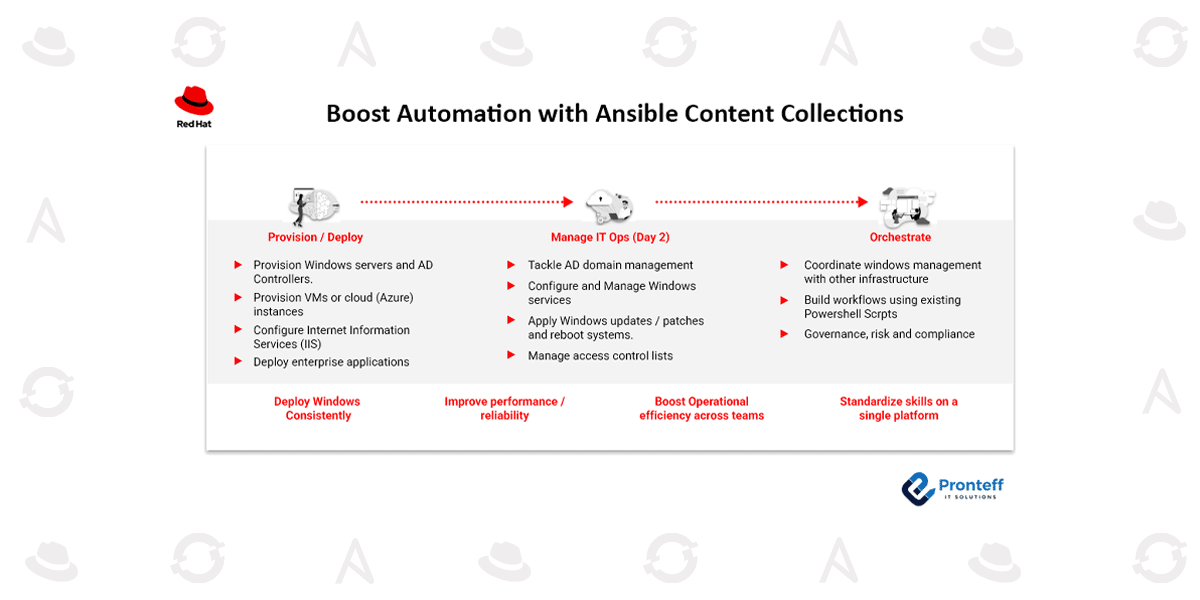
End-to-End Automation for Microsoft Windows Environments
Organizations managing Microsoft Windows infrastructures often require reliable automation for administration, compliance, monitoring, and patching. In addition to the existing Ansible Windows and Microsoft Active Directory collections, Red Hat now delivers an expanded portfolio of automation content for Windows ecosystems.
Microsoft MECM Collection
The Microsoft MECM collection delivers detailed patch orchestration and lifecycle management capabilities. It integrates directly with Microsoft Endpoint Configuration Manager (MECM), allowing organizations to use MECM as the authoritative compliance source while enabling controlled patching, orchestration, and reduced downtime for Windows systems.
MECM Operations Collection
The MECM Operations collection extends operational automation between MECM and the Ansible Automation Platform. It simplifies recurring Windows administrative activities such as monthly patch coordination, infrastructure validation, and operational health assessments.
Microsoft SCOM Collection
The Microsoft SCOM collection integrates System Center Operations Manager (SCOM) with Event-Driven Ansible capabilities available within Ansible Automation Platform. This integration enables real-time remediation processes, minimizes reliance on polling-based scripting methods, and supports automated ticket creation, self-recovering infrastructure management, and AI-powered IT operations.
Microsoft Compliance Collection
The Microsoft Compliance collection helps automate complex governance and compliance processes. It supports automated enforcement of baseline configurations, continuous compliance auditing, drift detection without service interruption, and generation of audit-ready documentation aligned with standards such as STIG and CIS.
Together, these new collections help organizations speed up automation adoption, improve operational efficiency, and strengthen compliance management throughout hybrid Microsoft environments.
AIOps Integration with Splunk and Ansible Automation Platform
Splunk, now part of Cisco, delivers widely adopted observability and security monitoring solutions for enterprise IT operations. Red Hat and Splunk continue collaborating on integrations and automation content that help organizations reduce Mean Time to Resolution (MTTR) and simplify operational management.
These collections enable seamless “Splunk insights to Ansible actions” workflows. Additional lifecycle automation collections also make it possible to manage Splunk environments using Infrastructure as Code methodologies.
Event-Driven Ansible Add-On for Splunk
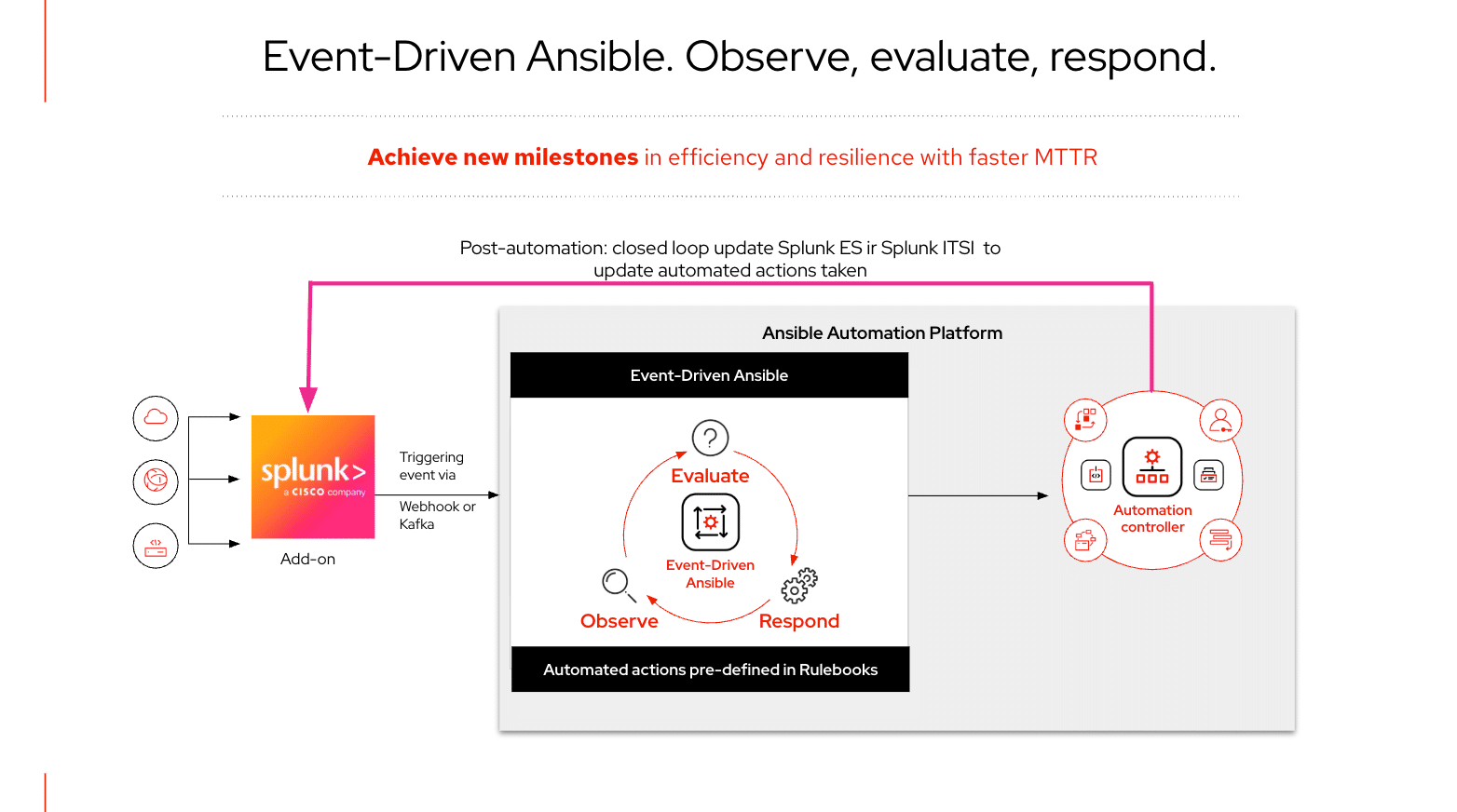
Available through Splunkbase, the Event-Driven Ansible add-on established the initial integration foundation between Splunk and the Ansible Automation Platform. It allows Splunk alerts to automatically trigger Event-Driven Ansible actions for automated remediation and response activities.
Splunk Enterprise Security Collection
The updated Splunk Enterprise Security (Splunk ES) collection improves management of Splunk ES configurations while supporting automated communications between Splunk and the Ansible Automation Platform. It also enables closed-loop workflows where remediation details can be attached directly to Splunk alerts.
Splunk IT Service Intelligence Collection
The newly introduced Splunk IT Service Intelligence (ITSI) collection automates configuration and operational management of ITSI environments. When integrated with Ansible Automation Platform, it supports event-driven workflows that automatically collect diagnostics, remediate incidents, or modify service configurations based on real-time observability data. Similar closed-loop communication features are also included.
Splunk Enterprise Lifecycle Collection
The Splunk Enterprise lifecycle collection now adds capabilities for managing Splunk Universal Forwarder agents across both Linux and Windows platforms. This helps automate deployment, maintenance, and lifecycle operations for monitoring agents throughout enterprise environments.
Cisco Splunk OpenTelemetry Collector Collection
This newly introduced collection automates the deployment and configuration of the Splunk distribution of the OpenTelemetry Collector. It simplifies rollout across Windows and Linux systems while ensuring consistent collection of logs, traces, and metrics for delivery to Splunk Enterprise or Splunk Observability Cloud.
Expanded AI-Centric Automation Content for Ansible Automation Platform
As organizations continue investing in artificial intelligence initiatives, Red Hat has introduced several automation collections focused on AI infrastructure and operations management.
Ansible Builder with MCP Support
Ansible Builder now supports embedding Model Context Protocol (MCP) servers directly into execution environments. Although currently available as a Technology Preview feature, this enhancement establishes a foundation for securely integrating AI assistants and models into automation workflows.
Ansible MCP Collection
The Ansible MCP collection works alongside Ansible Builder by serving as the interaction layer for MCP servers. It enables playbooks to discover available MCP servers dynamically, retrieve supported toolsets, and execute MCP-based tools directly within automated workflows.
Red Hat AI Collection
The Red Hat AI collection provides foundational automation for managing Red Hat AI environments. It supports efficient model deployment on Red Hat Enterprise Linux AI, streamlines advanced MLOps processes, and enables direct management of AI inferencing workflows through Ansible Automation Platform.
Cloud-Based AI Infrastructure and Operations Automation
To support enterprise AI deployments in public cloud environments, Red Hat provides updated automation collections for Amazon Web Services (AWS) and Google Cloud Platform.
Google Cloud Collection
The Google Cloud collection now includes native integration with Vertex AI. This allows operations and data science teams to automate the entire AI lifecycle. When paired with Event-Driven Ansible, organizations can move from reactive troubleshooting to proactive and self-healing MLOps and AIOps environments.
AWS Collection Updates
The AWS content collection has been enhanced to improve S3 reliability, standardize module functionality, remove outdated features, and align integrations with modern AWS SDKs. These updates help create more stable and maintainable automation workflows for cloud operations.
HashiCorp Terraform and Vault Collections
Updated HashiCorp Terraform and HashiCorp Vault collections now provide API-first integration capabilities for HCP Terraform and Terraform Enterprise. They also enhance automated secrets management through Vault Enterprise. These improvements strengthen Infrastructure as Code practices, simplify infrastructure lifecycle management, and provide enterprise-grade hybrid cloud automation support.
Virtual Infrastructure Automation
Many organizations are reassessing virtualization platforms to identify solutions that align with operational and financial objectives. Regardless of platform selection, businesses still require automation for compute, networking, storage, and application infrastructure.
Ansible Automation Platform offers flexible automation across multiple virtualization environments. One important integration in this space is Cisco Unified Computing System (UCS), managed through Cisco Intersight.
Cisco Intersight Collection
The Cisco Intersight content collection bridges software-defined automation with physical hardware lifecycle management. Now featuring more than 100 modules, the collection enables complete automation of server provisioning, configuration, and operational management entirely through code.
Key features include:
- Server Profile Templates as Code
- Policy-based compliance enforcement at scale
- Configuration drift management
- Automated firewall firmware updates
- Dynamic inventory integration with Cisco Intersight
- Full infrastructure lifecycle automation
Expanding Multivendor Network Automation Capabilities
As enterprise adoption of the Ansible Automation Platform continues to grow, Red Hat and its ecosystem partners are introducing additional enhancements to support multivendor networking environments.
ansible.netcommon Collection
The updated ansible.netcommon collection introduces new STIG-compliant Secure Shell (SSH) transport options for Netconf-based automation workflows, improving security and compliance readiness.
Cisco Meraki Collection
The Cisco Meraki collection now includes new capabilities designed to simplify Ansible Automation Platform license management.
Unified Juniper Device Collection
The unified Juniper Device collection consolidates features previously available through junipernetworks.junos into a single collection maintained with support from HPE Juniper Networking.
Cisco Catalyst Center Collection
This new collection automates several key networking operations, including device onboarding, software image lifecycle management, and policy enforcement across sites.
F5 Automation Collection
F5 has launched a new collection designed to support network modernization and streamline the migration of F5 application delivery solutions.
Palo Alto NGFW Policy Automation
This new automation content enables policy enforcement for Palo Alto Next Generation Firewalls (NGFWs), helping standardize security management.
Arista AVD Collection
The Arista AVD collection allows organizations to design, deploy, and validate Arista network fabrics automatically using Infrastructure as Code methodologies.
Recent Improvements to the Ansible Automation Platform Collection
Since late last year, multiple enhancements have been introduced to the Ansible Automation Platform collection to improve security, consistency, and overall operational simplicity. These updates strengthen platform reliability and provide a more streamlined user experience.
Mutual TLS (mTLS) Security Enhancements
New certificate management modules and routing attributes simplify native configuration of mutual TLS (mTLS). This enables organizations to implement zero trust security policies more effectively and satisfy strict compliance requirements across Ansible Automation Platform environments, including event-driven automation projects.
Improved API Integration Reliability
Enhancements to Gateway API lookup plugins improve URL generation accuracy, helping eliminate API communication errors and ensuring more dependable integrations.
Better Access Control Management
Updates related to custom role assignments ensure that granular access control policies behave consistently and accurately for team-based permission models.
Improved Playbook Idempotency
Enhancements to idempotency logic make automation execution more predictable while reducing the likelihood of unintended configuration drift.
Greater Platform Stability
Additional improvements to testing frameworks and timeout handling help maintain platform stability and reliability for business-critical automation workflows.
Building Complete Automation Workflows with Ansible Content Collections
Although individual collections provide immediate operational value, the true strength of Ansible Automation Platform comes from combining multiple automation components into unified end-to-end workflows.
By orchestrating automation across different platforms and management systems, organizations can streamline complex IT processes while improving consistency, speed, and operational efficiency.
For example, a single automated workflow could:
- Provision a new Microsoft Windows server
- Retrieve credentials securely from HashiCorp Vault
- Register the system within a ServiceNow CMDB
- Deploy Splunk monitoring agents
- Execute automated security hardening validations
As organizations gradually expand automation through playbooks and rulebooks, they naturally eliminate cross-functional bottlenecks and free technical teams to focus on strategic innovation initiatives.
Red Hat and its partner ecosystem continue delivering prebuilt and continuously updated automation content to help enterprises launch automation projects more rapidly and maximize the value of existing resources. This approach allows IT teams to dedicate more time to initiatives that directly support business growth and transformation.