

Building Red Hat AI That Works in the Real World
In this blog, we will learn how Red Hat AI works in the Real World.
Most leaders I speak with have already moved beyond the initial excitement surrounding AI. The discussion is no longer about whether AI is important, but rather how organizations can transition from experimentation to enterprise-scale adoption in a way that is secure, manageable, and repeatable across teams.
From my perspective—overseeing strategy and operations for AI Platform Core Components (AIPCC) within Red Hat’s AI Engineering division—this transition represents a major shift. AI is no longer simply a technology choice; it has become an operational strategy decision. A reliable AI platform enables organizations to deliver AI-driven capabilities faster, operate them consistently, and maintain alignment with governance policies, risk management, and long-term cost efficiency.
The introduction of Red Hat AI Enterprise further strengthens this foundation by combining model lifecycle management, inference capabilities, and operational oversight into a unified platform built for scaling AI across hybrid environments.
Four Key Reasons Organizations Choose Red Hat AI
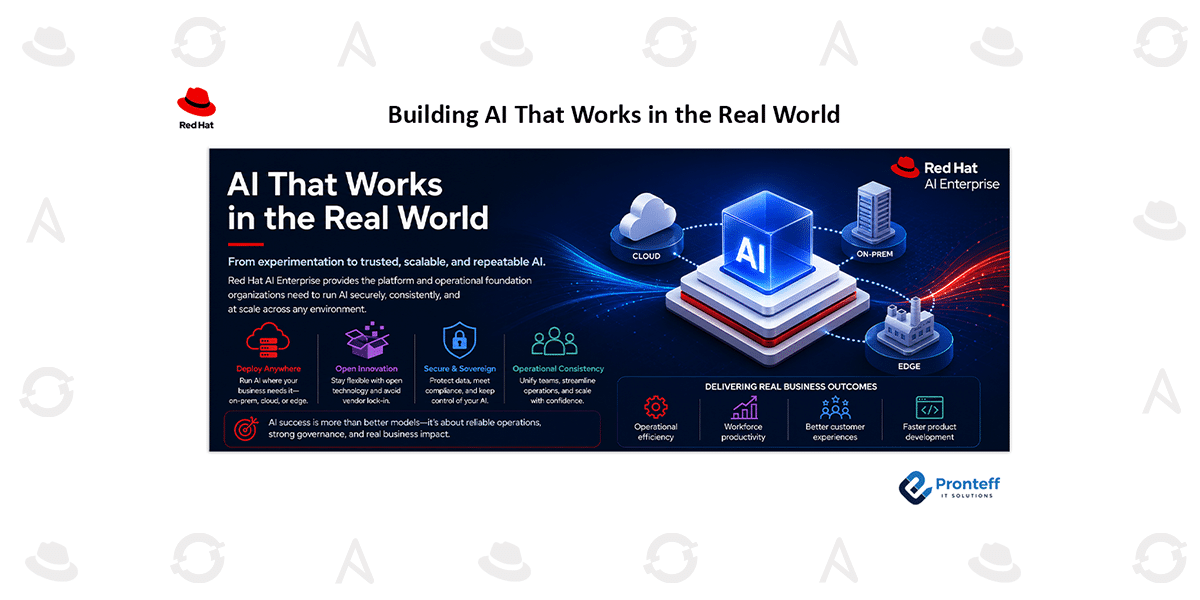
1. Flexibility to Deploy Across Any Environment
Modern enterprises rarely build AI solutions within a single infrastructure. Most organizations balance on-premises systems, public cloud scalability, and edge deployments while managing data residency, latency, and compliance requirements.
Red Hat OpenShift AI and the wider Red Hat AI portfolio are designed to support these diverse deployment models. This flexibility is critical because AI increasingly powers operational processes and customer-facing services that demand adaptable infrastructure choices.
2. Open Innovation Without Vendor Lock-In
A recurring priority among customers is maintaining the freedom to evolve as the AI ecosystem changes. Models, frameworks, and hardware accelerators continue to advance rapidly, and enterprises want to avoid rebuilding their AI stack every time the industry shifts.
For example, Turkish Airlines emphasized open-source compatibility and architectural flexibility as major reasons for adopting Red Hat technologies. In a fast-changing market, flexibility becomes an essential part of long-term risk reduction.
3. Security, Sovereignty, and Greater Operational Control
Security and governance are often decisive factors in enterprise AI adoption. AI introduces new concerns related to data access, inference management, and scaling sensitive workloads. Many organizations require AI environments that remain under their direct control to satisfy regulatory and sovereignty requirements.
A strong example is ARSAT, Argentina’s national telecommunications provider. The organization identified data sovereignty as a critical requirement and successfully moved from concept to live production within 45 days using OpenShift AI. Their rapid deployment was made possible through a combination of operational discipline and a platform aligned with governance needs.
4. Consistent Operations Across Teams
AI success is not determined solely by model performance. Sustainable adoption also depends on standardized workflows, stable environments, predictable deployment cycles, and scalable support processes.
Red Hat AI Enterprise helps establish this operational consistency by integrating lifecycle management, inference services, and operational tooling into a unified enterprise platform. This approach reduces friction between data scientists, platform engineers, and application teams while introducing shared governance and operational standards.
How AI Delivers Business Value
Industry research from organizations such as McKinsey & Company and Gartner consistently highlights several major drivers behind enterprise AI investments:
- Improving operational efficiency
- Increasing workforce productivity
- Enhancing customer experience and support
- Accelerating product and software development
In practice, organizations care less about the size of a model and more about whether the surrounding systems can reliably support production-scale AI operations. The real priority is building AI solutions that are governed, manageable, and integrated into everyday business workflows.
A Practical Framework for Evaluating AI Platforms
When discussing enterprise AI adoption with business leaders, several operational priorities consistently emerge:
Data Sovereignty and Compliance
Organizations often operate under strict privacy, regulatory, and data residency requirements. AI platforms must support deployment models that align with these constraints, whether on-premises, hybrid cloud, or multi-cloud.
Moving From Pilot Projects to Production
Demonstrations are relatively easy to build, but scaling AI into production environments is significantly more complex. Enterprises need platforms capable of supporting real-world operational workloads rather than isolated experimentation.
Adaptability in a Rapidly Evolving Ecosystem
The AI landscape continues to evolve quickly. Businesses need the ability to adopt emerging models, frameworks, and infrastructure technologies without repeatedly redesigning their environment.
Governance and Scalable Operations
As AI usage expands across departments, governance, lifecycle management, and enterprise-grade support become increasingly important. A strong platform should simplify risk management while still encouraging innovation.
Final Thoughts
Successful AI leadership today is less about chasing every new innovation and more about building the operational foundation required for sustainable AI adoption. Organizations making meaningful progress are investing in platforms that balance innovation with enterprise requirements such as security, flexibility, governance, and scalability.
Red Hat AI Enterprise is designed to support that balance by providing the infrastructure and operational capabilities organizations need to move confidently from experimentation to production. From an AI strategy and operations perspective, that balance is what transforms AI from a short-term initiative into a long-term business capability.