

How AI Agents are Redefining the Role of Developer Portals
In this blog, we will learn how AI agents are redefining the role of developer portals.
The rise of AI-powered coding assistants and autonomous agents has sparked an interesting debate within the platform engineering community. Some argue that Internal Developer Portals (IDPs) are becoming obsolete. With tools capable of generating code, answering questions, and automating workflows directly within development environments, many believe developers no longer need to rely on portals for information or guidance.
While this perspective highlights an important shift in developer experience, it overlooks the fundamental purpose of developer portals. The reality is that AI agents are increasing the value of developer portals—not diminishing it.
The Shift Away from Portal-Centric Workflows
There is some truth behind the argument. Developers prefer to remain focused within their IDEs rather than switching between multiple tools and browser tabs. Looking up service ownership, finding templates, or searching documentation through a portal can interrupt workflow and reduce productivity.
AI assistants have significantly improved this experience by bringing information closer to where developers work. However, reducing friction in how information is accessed is different from eliminating the need for that information altogether.
The challenge isn’t the existence of developer portals; it’s how their capabilities are delivered.
The Real Asset: Enterprise Context
The greatest value of an Internal Developer Portal has never been its user interface. Its true value lies in the organizational knowledge it centralizes.
A mature developer portal typically contains:
- Service and application catalogs
- API inventories
- Infrastructure standards
- Security and compliance requirements
- Golden path templates
- Team ownership information
- Deployment workflows
- Integration data from DevOps and monitoring tools
Collectively, this information forms a structured source of enterprise context. As organizations adopt AI-driven development practices, this context becomes increasingly important.
Why AI Agents Need Context
AI models are powerful, but they lack awareness of organization-specific rules, architectures, and processes unless that knowledge is provided to them.
Consider a scenario where an AI agent is asked to deploy an application into production. Without access to the enterprise context, it may:
- Deploy infrastructure that violates organizational standards
- Miss required security controls
- Use unapproved software versions
- Route workloads to incorrect environments
- Ignore compliance requirements
The result may be technically functional but operationally risky.
Now, imagine the same agent connected to an Internal Developer Portal. It can discover approved deployment templates, validate infrastructure configurations, verify compliance requirements, and follow predefined operational procedures.
The difference is not the intelligence of the AI—it is the quality of the context available to it.
The Evolution of Developer Portals
As AI adoption grows, developer portals are evolving into platforms that serve two distinct audiences.
- Human Developers
Developers will continue to use portals for onboarding, service discovery, documentation access, and project creation. Particularly in large enterprises with complex environments, a centralized interface remains highly valuable.
- AI Agents
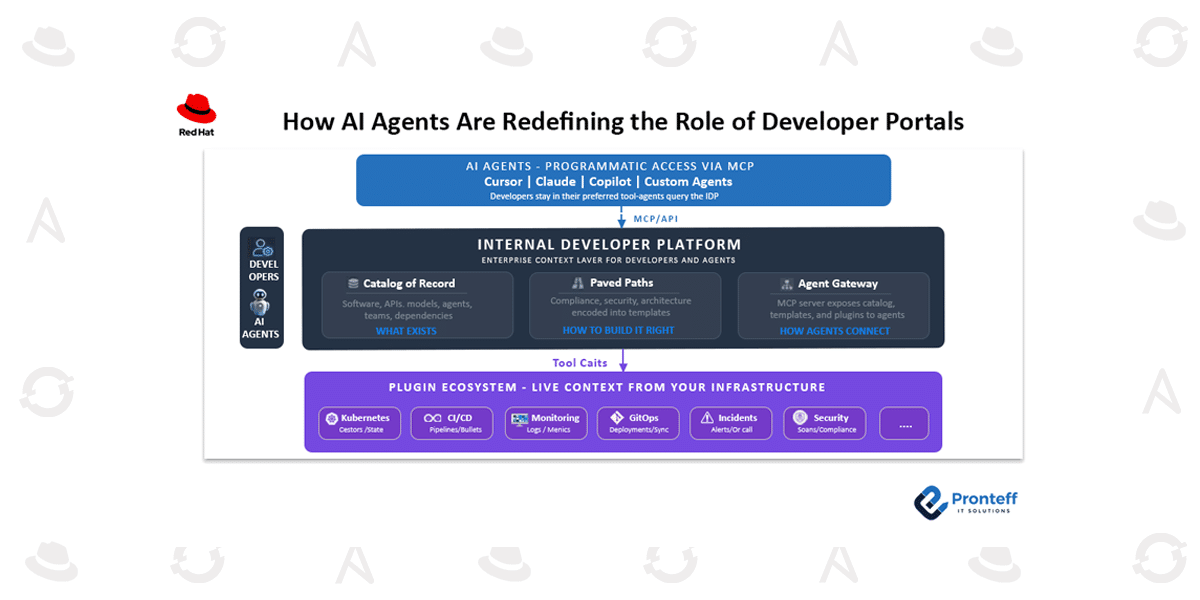
The second audience consists of AI-powered assistants and autonomous agents. Through emerging standards such as the Model Context Protocol (MCP), these systems can access catalogs, templates, documentation, and operational workflows programmatically. In this model, the portal becomes more than a website—it becomes an intelligence layer that agents can consume directly.Over time, AI agents may become one of the primary consumers of portal data, but both humans and agents will depend on the same trusted source of enterprise knowledge.
Enterprise Complexity Makes Portals More Important
The claim that developer portals are unnecessary often comes from organizations with relatively simple technology landscapes.
Smaller teams operating a single cloud platform with limited compliance requirements can often rely on tribal knowledge and lightweight documentation.
Large enterprises face a very different reality:
- Hundreds of engineering teams
- Multi-cloud environments
- Complex security controls
- Regulatory obligations
- Thousands of applications and services
- Diverse technology stacks
In these environments, expecting AI agents to infer organizational standards is unrealistic.
As complexity increases, the need for governed and curated context becomes even more critical. AI systems operating without that context can introduce significant operational, security, and compliance risks.
The Three Emerging Roles of Modern Developer Portals
As platform engineering evolves, Internal Developer Portals are taking on three increasingly important responsibilities.
- Source of Truth
The portal serves as a centralized inventory for applications, APIs, infrastructure resources, AI models, services, teams, and dependencies.By integrating with existing enterprise systems, it maintains an accurate and continuously updated view of the development ecosystem.
- Governance Through Golden Paths
Golden path templates encode best practices, security standards, architectural patterns, and compliance requirements.For AI agents, these templates become executable guidance that ensures automated actions remain aligned with organizational policies.
- Context Gateway for AI
Modern portals are increasingly exposing their knowledge through APIs and protocols designed for AI consumption.This allows coding assistants, AI agents, and automation platforms to access enterprise-approved information while operating within established governance frameworks.
Context Will Define Successful AI Adoption
Whether the consumer is a human developer or an AI agent, productivity depends on access to reliable context.
A modern developer portal understands:
- Where code repositories are located
- Which APIs are available
- Who owns each service
- Which deployment patterns are approved
- What compliance controls must be enforced
- How infrastructure and applications are interconnected
Combined with integrations across CI/CD pipelines, monitoring systems, observability platforms, and incident management tools, the portal provides the operational awareness required for intelligent decision-making.
Without this context, AI agents become unreliable. With it, they become highly effective collaborators.
What This Means for Platform Engineering Teams
Organizations investing in Internal Developer Portals are already building a critical foundation for AI-driven software delivery.
The service catalogs, templates, workflows, and governance models being established today will become the knowledge layer that tomorrow’s AI agents depend upon.
Rather than replacing developer portals, AI is expanding its purpose. The next evolution involves exposing portal capabilities through APIs and AI-friendly protocols so that both developers and agents can leverage the same trusted information.
Conclusion
The future of platform engineering is not about choosing between developer portals and AI agents. It is about combining them.
As AI agents become more capable and autonomous, the need for structured, governed, and enterprise-specific context becomes increasingly important. Developer portals provide that context.
The user experience may continue to evolve, and developers may spend less time directly interacting with portal interfaces. However, the underlying platform will become even more valuable as both humans and AI systems rely on it to make informed decisions.
Developer portals are not disappearing. They are transforming from destinations into essential infrastructure—powering the next generation of intelligent software development.