

Circuit Breaker Pattern in IBM API Connect: Design and Production Risks
Rate limiting can control traffic. A circuit breaker must do something more: recognise dependency failures, change state predictably, and allow recovery without sending full traffic back to an unhealthy service.
A backend service starts timing out during a busy period. Requests continue arriving through the API gateway, each call waits for the dependency, clients retry, and the failing service receives even more load.
This is where a circuit breaker can help. But there is an important distinction: adding a Rate Limit policy to an IBM API Connect assembly does not, by itself, create a circuit breaker.
The simplest mental model
A rate limiter asks, “How much traffic should pass?” A circuit breaker asks, “Given recent dependency failures, should this call be attempted at all ?”
What a circuit breaker is actually trying to do
A circuit breaker reduces repeated calls to a dependency that is likely to fail. Instead of allowing every request to wait for the same unhealthy backend, the system can fail fast for a period and then test recovery cautiously.
A conventional breaker uses three logical states:
- Closed: requests are allowed, and qualifying failures are observed.
- Open: calls to the affected dependency are stopped and handled through a defined error or fallback path.
- Half-open: a limited number of trial calls are allowed to determine whether the dependency has recovered.
The important part is not the state names. It is the transition logic: which failures count, how many failures are tolerated, how long the circuit stays open, and how much traffic is allowed during recovery.
Architecture and runtime flow
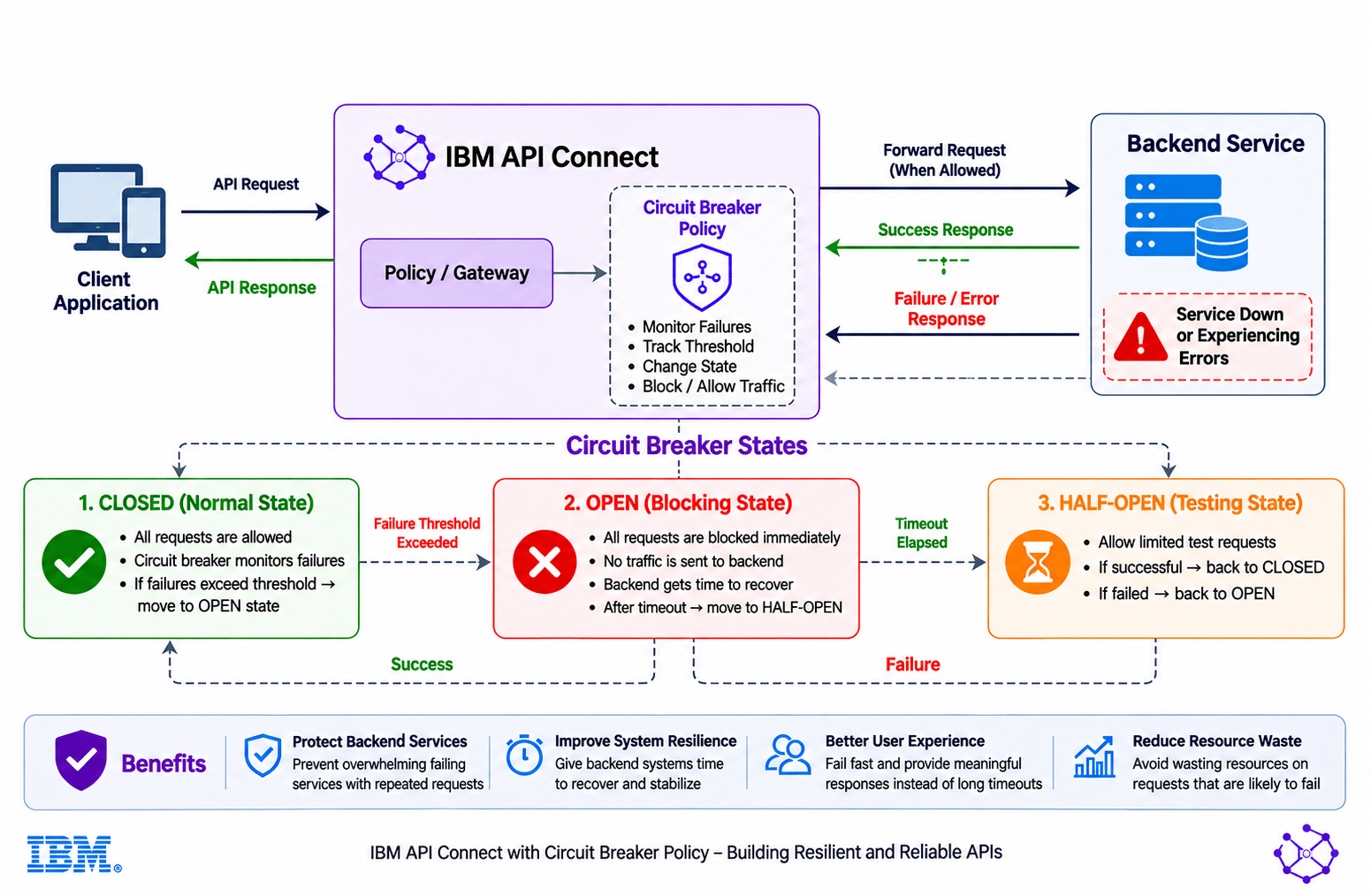
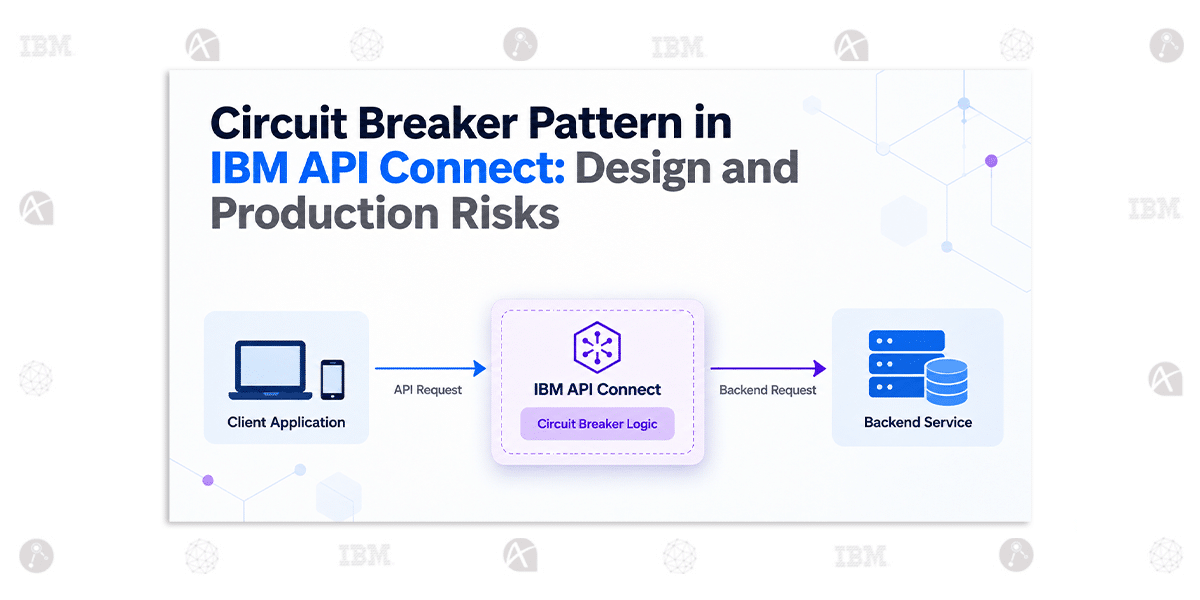
When a request arrives, the gateway first determines whether the protected dependency should be called. If the circuit is open, the dependency is not invoked. If it is closed—or the request is an approved half-open trial—the backend call proceeds within a bounded timeout.
The outcome is then classified. Timeouts, connection failures, and selected server-side errors may indicate dependency health problems. Business validation errors, authentication failures, or bad client requests usually should not be treated the same way.
The key implementation risk
A flow containing Rate Limit, Invoke, Catch, and GatewayScript may look like a circuit breaker, but the design still needs to prove correct failure tracking, state transitions, concurrency handling, and recovery behaviour.
Rate limiting, retries, and circuit breakers solve different problems
| Mechanism | Primary question | Best used for |
|---|---|---|
| Rate limiting | How much traffic is allowed? | Protecting capacity and enforcing usage limits |
| Timeout | How long should a call wait? | Bounding resource use when a dependency is slow |
| Retry with backoff | Is another attempt likely to succeed? | Short-lived transient failures where retrying is safe |
| Circuit breaker | Should this dependency be called now? | Fail-fast protection during repeated or sustained failures |
These controls are complementary. A timeout limits how long one call can wait. A retry gives a transient failure another chance. A circuit breaker stops repeated attempts when recent evidence suggests the dependency is unhealthy. Poorly combining them can create retry storms instead of resilience.
What matters in an IBM API Connect design
IBM API Connect provides assembly capabilities such as Invoke, Rate Limit, GatewayScript and error handling that can participate in a resilience design. The exact support and behaviour depend on the API Connect release, gateway type and policy version.
A production design should focus on a few questions:
- Failure classification: which outcomes actually indicate dependency failure?
- State scope: is the breaker protecting one operation, one backend, or several services?
- State consistency: what happens when traffic is distributed across multiple gateway nodes?
- Recovery: how long is the circuit open and how many trial requests are allowed?
- Timeouts: can a slow backend consume resources for too long before failure is observed?
- Observability: can operations distinguish an open circuit from an ordinary backend failure?
If reliable state management cannot be achieved in the gateway assembly, the breaker may belong in another resilience layer or application component rather than being forced into the API policy.
Production considerations
Circuit breakers are most useful when they prevent a dependency failure from spreading. But they do not repair the backend or guarantee end-to-end availability. They also do not remove the need for sensible timeouts, capacity controls and application-level recovery.
For operations that change business state—such as payments or order creation—retry and fallback behaviour require additional care. A timeout does not always mean the backend failed to process the request. Idempotency, transaction status checks, and reconciliation may therefore be part of the wider resilience design.
A good circuit breaker fails predictably.
Clients should receive a stable and safe response, while operations teams should have enough telemetry to understand why the circuit opened and when recovery was attempted.
Frequently asked questions
Does IBM API Connect have a native circuit-breaker policy?
The policy documentation reviewed for this design does not establish a single native policy that implements the complete closed, open, and half-open state machine described here. Confirm capabilities against the exact API Connect release and gateway type before describing a custom assembly as native circuit-breaker functionality.
Can Rate Limit policies be used to build one?
They can participate in a custom traffic-control design, but rate or count limits alone do not prove backend-failure tracking, recovery timing, state transitions, or controlled half-open traffic.
Should every HTTP error count as a circuit-breaker failure?
No. Client errors, authentication failures, and normal business responses may say nothing about backend health. Failure classification should reflect the dependency problem the breaker is intended to contain.
Does a circuit breaker replace timeouts and retries?
No. Timeouts bound individual calls, retries can help selected transient failures, and a circuit breaker suppresses calls when the dependency appears unhealthy. They need to work as one coherent resilience strategy.
The takeaway
A circuit breaker is not defined by the presence of familiar policy names in an API assembly. It is defined by behaviour: correct failure classification, predictable state transitions, controlled recovery traffic, safe error handling and clear operational visibility.
In IBM API Connect, start by validating what the deployed gateway and policies can reliably provide. If the required state behaviour cannot be implemented safely in the assembly, use a layer that can. A simpler and explicit resilience design is better than an unreliable counter arrangement labelled as a circuit breaker.