

Sovereign AI with Red Hat and Duality: Securing Sensitive Data for Enterprise AI
A bank wants to improve its fraud detection models using insights from multiple financial institutions. A healthcare organization wants to collaborate on AI-powered research using patient data. A government agency needs AI capabilities without exposing sensitive information.
The challenge is not simply accessing valuable data. It is enabling AI to process that data while maintaining privacy, security, regulatory compliance, and control over where information is stored and used.
Traditional security protects information while it is stored or transferred. However, when AI models actively process sensitive information, additional protection becomes necessary.
This is where Sovereign AI becomes important.
By combining Red Hat OpenShift with Duality Technologies’ privacy-enhancing technologies (PETs), organizations can establish secure AI environments that protect sensitive information while enabling collaborative AI development.
Why Sovereign AI Matters
AI workloads require access to data during training, inference, and analytics. Even when information is encrypted at rest and in transit, it may become exposed while being processed.
Sovereign AI helps organizations maintain control over:
- Sensitive datasets and customer information.
- AI models and intermediate model weights.
- Infrastructure and workload execution.
- Data access and processing environments.
- Regulatory and jurisdictional requirements.
The objective is to enable organizations to benefit from AI innovation without compromising data ownership, privacy, or control over sensitive information.
How Red Hat and Duality Enable Privacy-Preserving AI
The joint architecture combines Red Hat’s enterprise Kubernetes platform with Duality Technologies’ privacy-enhancing technologies to protect information throughout the AI lifecycle.
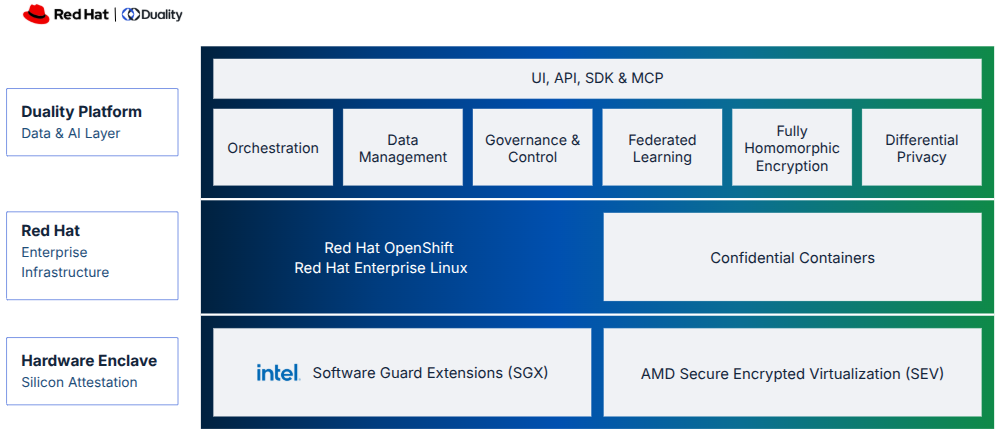
1. Confidential Computing
AI workloads often process sensitive information that must remain protected even while applications are running. Confidential computing addresses this challenge through hardware-based Trusted Execution Environments (TEEs).
Red Hat OpenShift supports confidential workloads using technologies such as:
- Intel Trust Domain Extensions (TDX)
- AMD Secure Encrypted Virtualization (SEV)
These technologies isolate workloads within protected memory environments, helping prevent unauthorized access from the underlying host operating system or hypervisor.
Hardware attestation also verifies the integrity of the execution environment before sensitive cryptographic keys or data are released.
This provides an additional layer of protection for confidential AI workloads running on enterprise infrastructure.
2. Federated Learning
Traditional machine learning often requires organizations to centralize datasets before training AI models. For regulated industries, moving sensitive information between organizations can introduce privacy and compliance challenges.
Federated learning takes a different approach by keeping sensitive data within its original environment.
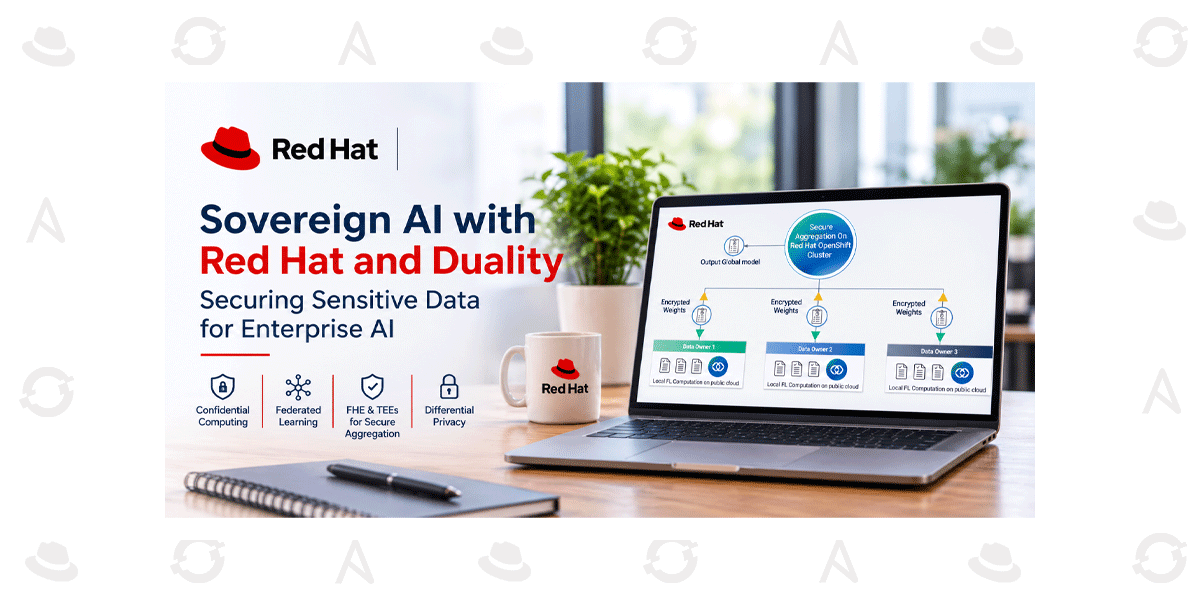
The process typically involves four steps:
- Local training: Participating organizations train AI models using their own datasets.
- Model updates: Each organization generates intermediate model updates.
- Secure transmission: The updates are encrypted and transmitted to a central server.
- Aggregation: The updates are aggregated to support collaborative model development.
This approach allows organizations to collaborate on AI training without directly sharing their raw datasets.
3. Secure Aggregation with FHE and TEEs
Although federated learning keeps raw datasets within their original environments, intermediate model updates can still introduce privacy risks.
Duality addresses this challenge through two important technologies:
Fully Homomorphic Encryption (FHE)
FHE enables computations and aggregation to take place directly on encrypted data without requiring the underlying information to be decrypted for processing.
Trusted Execution Environments (TEEs)
TEEs protect aggregation processes within hardware-isolated confidential environments, reducing exposure during sensitive operations.
Together, these approaches add protection to intermediate information and reduce privacy risks during collaborative AI operations.
4. Differential Privacy
Even when sensitive datasets are protected during training, AI outputs and model information may reveal details about the individuals whose data was used.
Differential Privacy (DP) addresses this risk by introducing controlled mathematical noise into model weights and analytical outputs.
This helps reduce the possibility of identifying whether a particular individual’s information was included in a training dataset.
Combined with confidential computing, federated learning, FHE, and TEEs, differential privacy provides another layer of protection across AI training, processing, and output generation.
Enterprise Use Cases for Sovereign AI
Privacy-preserving AI is particularly valuable for organizations that need to collaborate, analyze sensitive information, and maintain control over their datasets.
Financial Services
Banks and financial institutions can use federated learning to collaborate on anti-money laundering (AML) and financial crime detection. Each institution can contribute to model development while keeping customer information within its own environment.
Healthcare and Life Sciences
Hospitals and research institutions can collaborate on diagnostic model training and genomic research without centralizing sensitive patient datasets.
Retail
Retail organizations can use insights from distributed sales information to improve demand forecasting, inventory planning, and supply chain optimization while maintaining control over their respective datasets.
Government and Defense
Government agencies can support cross-agency intelligence sharing and protected AI inference while maintaining strict data access and security requirements.
Implementing Sovereign AI on Red Hat OpenShift
The joint architecture uses two important Red Hat components available through OpenShift OperatorHub to establish and manage confidential workloads.
OpenShift Sandboxed Containers Operator
Installed in the openshift-sandboxed-containers-operator namespace, this operator provisions the kata-cc runtime for hardware-isolated confidential workloads.
Red Hat Build of Trustee
Installed in the trustee-operator-system namespace, Red Hat Build of Trustee acts as the verifier and key broker.
It handles hardware attestation, trust policies, and secure cryptographic key release through components such as:
- KbsConfig
- TrusteeConfig
These components help establish the trust requirements needed before confidential workloads can access protected resources.
Understanding the Deployment Flow
Deploying confidential AI workloads on Red Hat OpenShift involves four main steps.
Step 1: Establish Trust
Trustee verifies the signed initdata.toml configuration containing trust endpoints and security policies.
Step 2: Configure Permissions
The workload uses the anyuid Security Context Constraint (SCC), allowing it to run with the required privileges inside its isolated environment.
Step 3: Launch the Workload
OpenShift schedules the pod using the kata-cc runtime, creating the confidential execution environment.
Step 4: Perform Attestation
Trustee verifies the hardware TDX quote against configured policies before securely releasing the required cryptographic keys.
This deployment process establishes a trusted execution environment for confidential AI workloads by combining hardware isolation, attestation, and controlled key release.
Production Considerations
Implementing Sovereign AI requires more than deploying the necessary operators and enabling confidential computing. Organizations must also evaluate infrastructure compatibility, access controls, key management, and governance requirements.
Important areas to consider include:
- Hardware compatibility: Verify support for technologies such as Intel TDX or AMD SEV in the target infrastructure.
- Key management: Configure appropriate attestation policies and secure key-release mechanisms.
- Access control: Carefully review elevated permissions, particularly the use of the
anyuidSecurity Context Constraint (SCC). - Data governance: Define policies for datasets, intermediate model updates, and AI outputs.
- Compliance: Validate the complete architecture against applicable regulatory and jurisdictional requirements.
Privacy-enhancing technologies strengthen data protection, but they do not automatically guarantee regulatory compliance. Organizations must evaluate the complete deployment architecture and its governance controls before production adoption.
The Takeaway: Enabling AI Innovation Without Compromising Data Privacy
Organizations should not have to choose between adopting AI and protecting sensitive information. Sovereign AI provides an approach to balancing both priorities through confidential computing, federated learning, encrypted aggregation, and differential privacy.
By combining Red Hat OpenShift with Duality Technologies’ privacy-enhancing technologies, enterprises can establish a foundation for collaborative AI development while maintaining greater control over sensitive information and execution environments.
For organizations in banking, healthcare, government, and other regulated industries, the next step is to evaluate infrastructure compatibility, security policies, attestation, and governance requirements before moving confidential AI workloads into production.
Protect sensitive data. Strengthen AI security. Enable enterprise innovation.