
Mastering the AI Era: Building a smarter technology model
In this blog, we will learn how to build a smarter technology model.
Organizations can no longer depend on static technology operating models. As AI capabilities evolve rapidly, the way people and machines work together is changing. To adopt these capabilities safely and efficiently, organizations need a new approach: frontier operations.
What Is Frontier Operations?
Frontier operations is the continuous process of aligning emerging AI capabilities with business objectives by adapting people, processes, and technology.
Rather than treating AI integration as a one-time project, it establishes an ongoing discipline that helps organizations reduce risk, optimize costs, and create new opportunities as AI evolves.
The Shift to Frontier Operations
Modern technology operating models must prioritize continuous learning and adaptation rather than fixed skill levels or static training programs.
Teams need to determine where humans should remain involved and where AI agents can operate independently. This requires clear visibility into agent limitations and an understanding of where human expertise delivers the greatest value.
Five Core Frontier Operations Skills
- Boundary Sensing – Continuously identify which responsibilities belong to humans and which can be reliably handled by AI agents.
- Seam Design – Create clear, verifiable, and auditable handoffs between people and AI systems.
- Failure Model Maintenance – Continuously identify and understand how AI agents fail as models, prompts, data, and use cases evolve.
- Capability Forecasting – Anticipate near-term AI developments and prepare workflows before new capabilities emerge.
- Leverage Calibration – Determine where human oversight delivers the greatest value through review thresholds, escalation paths, and approval controls.
From Prompt Engineering to Harness Engineering
Frontier operations move beyond traditional prompt engineering toward intention engineering—clearly defining desired outcomes, constraints, and verification criteria.
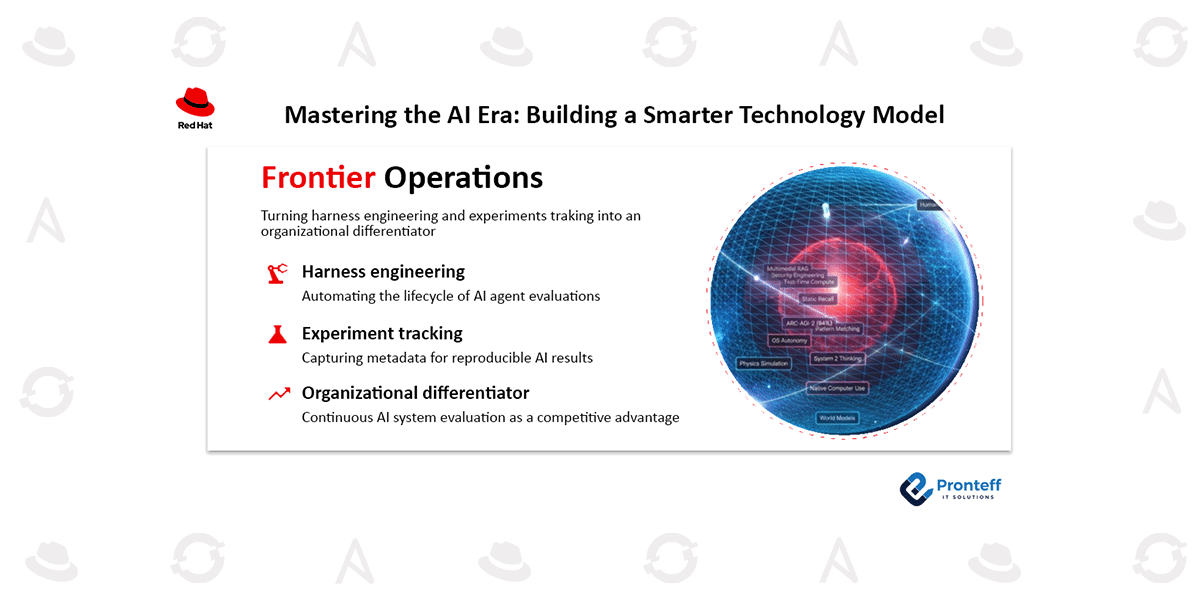
The next step is harness engineering, which manages the complete AI evaluation lifecycle.
- Experiment Tracking: Capture inputs, metadata, and context to make results reproducible and comparable.
- Continuous Evaluation: Make AI evaluation an ongoing process rather than a checkpoint before deployment.
Together, intention engineering and harness engineering transform AI adoption from trial-and-error experimentation into a structured and manageable capability.
Building an Antifragile Technology Model
Modern technology operating models should do more than withstand change—they should use change to accelerate innovation.
Frontier operations enables this by continuously helping organizations:
- Identify human-AI boundaries
- Redesign workflows and handoffs
- Update failure models
- Anticipate emerging AI capabilities
- Rebalance human oversight
This creates an operating model that becomes more adaptable as AI continues to evolve.
Red Hat AI: A Practical Foundation
Frontier operations require more than processes and strategies. It needs a platform that can support continuous AI change while maintaining governance, evaluation, observability, and hybrid-cloud consistency.
Red Hat AI provides this foundation by bringing inference, data-to-model workflows, and agent operations together on a hybrid-cloud platform built around Red Hat OpenShift, Red Hat Enterprise Linux (RHEL), and validated open source technologies such as vLLM, MLflow, and llm-d.
Mapping Frontier Operations to Red Hat AI
| Frontier Operations Skill | How Red Hat AI Supports It |
|---|---|
| Boundary Sensing | Model-as-a-Service (MaaS), MCP gateway and catalog, and SPIFFE/SPIRE-based identity help govern models, tools, and agent access. |
| Seam Design | Governed prompt management, versioning, and agent traceability create controlled and auditable human-AI handoffs. |
| Failure Model Maintenance | EvalHub, AI safety testing, and red teaming help identify vulnerabilities, failures, and risks before production. |
| Capability Forecasting | Model catalogs, flexible inference, llm-d, and hardware options enable teams to test emerging AI capabilities without rebuilding applications. |
| Leverage Calibration | Usage tracking, showback, autoscaling, metrics, and agent traces help optimize cost, automation, and human oversight. |
Harness Engineering Built-In
Red Hat AI provides capabilities for managing the continuous AI evaluation cycle:
- MLflow: Tracks experiments, parameters, metrics, artifacts, and agent activity for reproducible comparisons.
- EvalHub: Enables consistent AI benchmarking from development through production.
- AgentOps: Adds tracing, observability, and evaluation throughout the agent lifecycle.
These capabilities help organizations build and manage the evaluation infrastructure required for frontier operations.
Why Use Red Hat AI as a Foundation?
Three key capabilities support frontier operations:
- Operational Continuity – Extend existing hybrid-cloud operating practices to AI workloads without creating a separate operating environment.
- Open and Portable Architecture – Support different models, accelerators, agent frameworks, and deployment environments across on-premises, edge, and public cloud.
- AI Builder–IT Operator Collaboration – Give developers self-service tools while providing IT teams with governance, security, identity, safety, and observability capabilities.
A Practical 90-Day Approach
Organizations can begin building frontier operations incrementally rather than attempting a complete AI transformation immediately.
1. Establish Governed Inference
Deploy MaaS with approved models and policies. Define which models, teams, and environments can be used.
2. Instrument Before Scaling
Use MLflow experiment tracking and EvalHub for a high-value use case. Replace subjective assessments with measurable, repeatable results.
3. Launch a Traceable AI Agent
Start with one agentic workflow using AgentOps, prompt versioning, and MCP-governed tool access. Document failure patterns and human escalation requirements.
4. Measure Against Business Outcomes
Evaluate the implementation against clearly defined objectives and continuously refine the operating model.
Final Thoughts
Frontier operations provides organizations with a structured way to work with rapidly evolving AI capabilities. By combining continuous evaluation, adaptive workflows, and clear human-AI boundaries, organizations can adopt AI while maintaining control, accountability, security, and strategic alignment.
Red Hat AI turns these principles into an operational foundation through capabilities such as MaaS, EvalHub, AgentOps, governed prompts, and hybrid-cloud consistency—helping organizations make frontier operations a practical part of their technology operating model.