
Simplifying 5G Deployments with Red Hat OpenShift and Oracle
In this blog, we will learn how to simplify 5G Deployments with Red Hat OpenShift and Oracle.
Accelerating Cloud-Native 5G Networks for CSPs
As communications service providers (CSPs) move toward 5G adoption, they are transitioning beyond simply delivering faster connectivity. This shift represents the move to cloud-native architectures and microservices-based network functions. While 5G introduces significant innovation, it also brings new challenges, especially around interoperability and lifecycle management within the 5G control plane.
Challenges in Cloud-Native and Multivendor 5G Networks
Unlike traditional telecommunications infrastructures that relied on monolithic systems, modern 5G networks are built using cloud-native network functions (CNFs) designed as microservices. These CNFs must operate consistently across multiple vendors, orchestration systems, and cloud environments, which significantly increases the complexity of integration and testing.
Maintaining compliance with industry standards such as 3GPP, particularly for service-based interfaces (SBIs) in the control plane, adds another layer of difficulty. Differences in vendor implementations may also introduce hidden dependencies that complicate automated scaling, software upgrades, and fault management in multivendor deployments.
Furthermore, managing a distributed ecosystem requires robust observability, orchestration, and governance frameworks to ensure consistent security policies, performance monitoring, and operational visibility across the entire network. These capabilities are still evolving as the telecom industry continues to mature its cloud-native practices.
To support CSPs in navigating this transformation, Red Hat and Oracle combine their expertise and deployment experience to help accelerate the shift to cloud-native networks.
According to Honoré LaBourdette, Vice President of the Global Telco Ecosystem Success team at Red Hat, a unified cloud-native platform is essential for enabling agility and multivendor flexibility in 5G networks. Through their collaboration, Red Hat and Oracle provide a pre-integrated telco cloud platform designed to streamline deployments, reduce complexity, and improve operational efficiency for service providers.
The Importance of Platform Integration
Successful deployment of a cloud-native 5G platform requires careful configuration and optimization. This includes setting up a reliable cluster environment, integrating key add-ons, and applying performance tuning to ensure predictable operations. Worker nodes are also configured specifically to support high efficiency and consistent service quality.
Application packages are securely stored in private repositories to simplify management and maintain protection. Using automated deployment tools allows new applications to be onboarded quickly, reducing manual work and enabling CSPs to scale services more efficiently.
Networking architecture must also be optimized for control-plane operations, allowing traffic separation and secure data flows. Strong integration between the 5G core network functions and the underlying infrastructure, along with automation and observability capabilities, ensures the platform can scale dynamically as business demands grow.
A Joint Cloud-Native Solution from Red Hat and Oracle
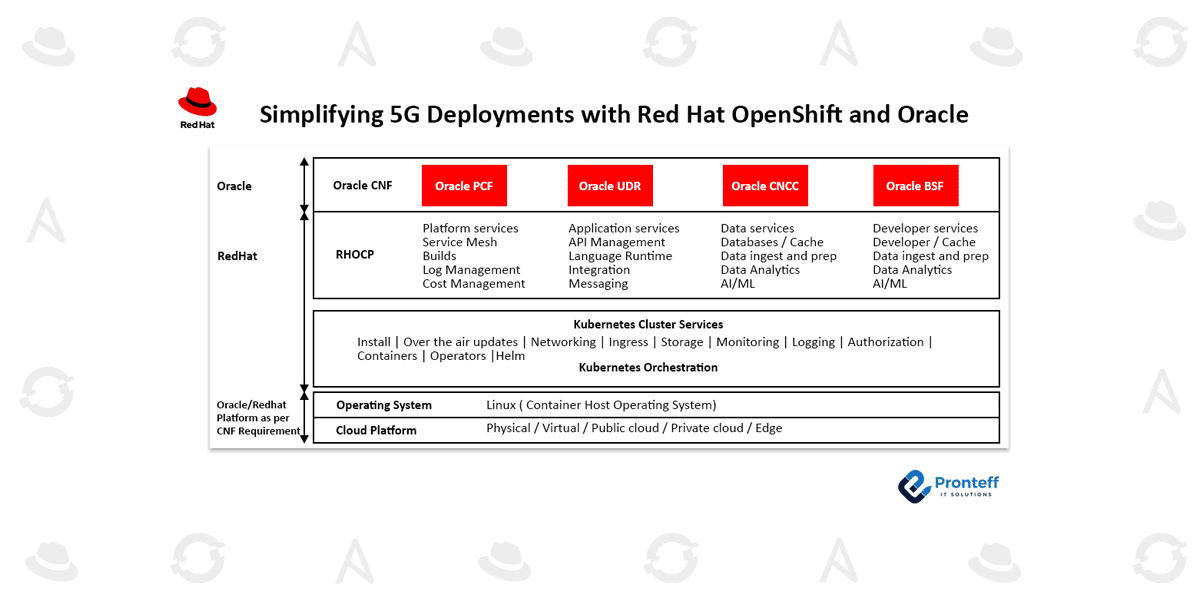
Red Hat and Oracle work together to provide a fully cloud-native solution that simplifies lifecycle management and deployment for CSPs. In this architecture, Red Hat OpenShift acts as the standardized telco cloud platform optimized to run Oracle 5G Core.
The platform enables automated onboarding, scaling, and upgrades through standardized CI/CD pipelines, helping organizations maintain consistent operations across complex multivendor environments. This integrated approach reduces deployment complexity and allows CSPs to bring services to market more quickly.
Benefits of Pre-Integration Expertise
Pre-integration experience plays a critical role in simplifying deployments. By leveraging tested configurations and best practices, CSPs can bridge operational gaps between application and platform teams.
Running Oracle’s 5G Control Plane CNF on Red Hat OpenShift provides multiple advantages, including improved automation, scalability, observability, performance, and cost efficiency. At the same time, it allows operators to maintain the flexibility required in multivendor ecosystems while preparing for future network evolution toward 5G and 6G technologies.
Sally Graves, Vice President of Product Development at Oracle Communications, highlights that Oracle’s solutions enable service providers to deploy secure and reliable 5G networks across various environments, including Oracle Cloud Infrastructure and on-premises deployments. Running Oracle 5G Core on Red Hat OpenShift also supports automated lifecycle management of network functions, improving operational efficiency and enabling new revenue opportunities driven by 5G services.
Unlocking the Full Potential of 5G
By combining Red Hat’s global deployment expertise with Oracle’s deep knowledge of 5G core technologies, CSPs can accelerate network deployments while reducing operational challenges. Leveraging pre-integration experience helps shorten implementation timelines and resolve potential integration issues in advance.
For service providers aiming to launch new services quickly and operate at scale, this collaboration provides a strong foundation for building efficient, flexible, and future-ready 5G networks.