
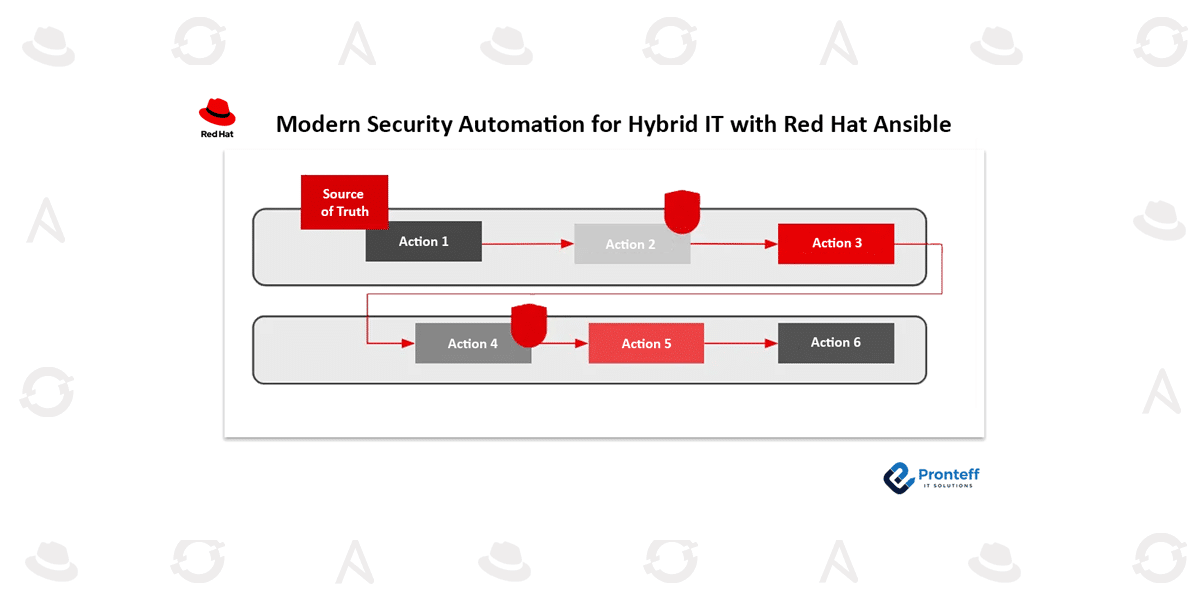
Modern Security Automation for Hybrid IT with Red Hat Ansible
In this blog, we will learn about modern security Automation for hybrid IT with Red Hat Ansible.
Modern IT environments demand speed, scalability, and resilience. At the same time, security teams must ensure compliance, reduce risk, respond to threats, and protect critical business assets. Balancing these priorities often creates operational challenges, especially when IT operations (ITOps) and security operations (SecOps) work independently.
Red Hat Ansible Automation Platform helps bridge this gap by enabling organizations to automate security and operational workflows through a unified platform. By embedding security into everyday IT processes, enterprises can improve efficiency, reduce manual effort, and maintain stronger governance across their infrastructure.
Why Security Automation Matters
Organizations today manage increasingly complex hybrid and multi-cloud environments. Manual security processes often lead to inconsistent configurations, slower incident response, and higher operational costs.
Security automation addresses these challenges by:
- Reducing repetitive manual tasks
- Enforcing consistent security policies
- Accelerating compliance activities
- Improving incident response times
- Minimizing configuration drift
- Supporting continuous governance
With Red Hat Ansible Automation Platform, security becomes an integrated part of infrastructure management instead of a separate operational process.
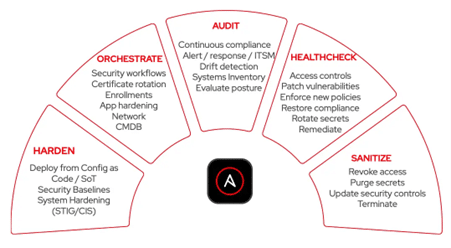
Automated Provisioning with Built-in Security
Infrastructure deployment is one of the best opportunities to implement security from the beginning. Ansible Automation Platform enables organizations to automate provisioning workflows while incorporating mandatory security controls.
For example, organizations can automatically:
- Deploy Red Hat Enterprise Linux servers
- Provision virtual machines
- Configure storage and networking
- Install security agents
- Apply baseline security configurations
- Configure access controls
Because every deployment follows the same automated workflow, infrastructure is built consistently while reducing the possibility of human error.
Standardized System Hardening
Maintaining secure system configurations across hundreds or thousands of servers is difficult when performed manually.
Ansible Automation Platform allows organizations to automate operating system hardening by validating systems against predefined security baselines.
Common hardening activities include:
- Enabling SELinux
- Applying STIG recommendations
- Running OpenSCAP compliance checks
- Configuring secrets management
- Deploying monitoring and observability agents
Organizations can schedule these checks regularly or automatically trigger them whenever new infrastructure is created, ensuring every system meets compliance standards from day one.
Simplifying Audit and Compliance Reporting
Generating compliance reports often consumes valuable administrative time, particularly during audits or after security incidents.
Automation simplifies this process by collecting infrastructure data, recording executed automation tasks, and generating detailed audit reports without manual intervention.
Organizations can automatically document:
- Configuration changes
- User activities
- Role-Based Access Control (RBAC) permissions
- Incident remediation actions
- Compliance status across environments
This creates a reliable audit trail while reducing the workload for both operations and compliance teams.
Continuous Health Checks and Policy Enforcement
Security is not limited to deployment. Infrastructure requires continuous monitoring to remain compliant throughout its lifecycle.
Using automated health checks, organizations can regularly:
- Detect configuration drift
- Verify policy compliance
- Deploy security patches
- Rotate credentials and secrets
- Validate system integrity
- Identify vulnerable assets
These recurring automation tasks help maintain secure environments while significantly reducing operational overhead.
Accelerating Incident Response with Event-Driven Automation
Rapid response is essential when security incidents occur. Delays can increase the impact of attacks and extend recovery times.
Event-Driven Ansible enables organizations to automatically respond when predefined security events are detected.
Automated response actions may include:
- Disabling compromised user accounts
- Blocking network ports
- Stopping vulnerable services
- Collecting forensic information
- Creating IT service tickets
- Sending alerts to security teams
Automating these initial response activities helps contain threats more quickly while allowing security teams to focus on investigation and remediation.
Secure Infrastructure Decommissioning
Removing obsolete infrastructure is just as important as deploying it securely. Simply deleting a virtual machine or server may leave behind active credentials, unused permissions, or exposed secrets.
Ansible Automation Platform supports automated decommissioning by:
- Identifying associated credentials
- Revoking privileged access
- Removing stored secrets
- Cleaning up dependent resources
- Generating audit documentation
This comprehensive approach helps eliminate potential security gaps that can remain after infrastructure retirement.
Key Business Benefits
Organizations adopting Red Hat Ansible Automation Platform can realize several operational and security advantages:
- Faster infrastructure deployment
- Consistent security policy enforcement
- Reduced manual errors
- Improved compliance readiness
- Quicker incident response
- Simplified audit reporting
- Lower operational costs
- Stronger collaboration between ITOps and SecOps
- Best Practices for Security Automation
Red Hat recommends adopting automation incrementally. Instead of attempting to automate every process immediately, organizations should begin with high-value, repetitive security tasks such as compliance validation, patch management, or system hardening.
As automation maturity grows, additional workflows—including provisioning, incident response, compliance reporting, and infrastructure lifecycle management—can be integrated into a broader enterprise automation strategy.
Measuring metrics such as time saved, reduction in manual effort, improved compliance, and faster response times helps demonstrate the long-term value of automation initiatives.
Conclusion
Security automation is no longer optional for enterprises managing complex hybrid IT environments. Red Hat Ansible Automation Platform enables organizations to integrate security into every stage of the infrastructure lifecycle—from provisioning and hardening to compliance, incident response, continuous monitoring, and secure decommissioning.
By automating routine security operations, businesses can improve operational efficiency, strengthen compliance, reduce risk, and empower both IT and security teams to focus on higher-value initiatives. The result is a more resilient, secure, and scalable IT environment that supports modern business demands.